Written by Andrés Gómez Emilsson on 1 October 2026.
This post is a contribution to the third Qualia Research Institute psychophysics retreat, which took place from May to June 2026 in Tepoztlán, Mexico.
Table of contents
As noted in the primary transcript of the conversation among the people who participated in the visual illusions test, two of the stimuli, the spiral arrangement of oscillators and the central channel, were among the strongest hits in the set. They had an outsized response to the state. We were not specifically anticipating these to interact so strongly. Some people did not spend much time looking at them, and some did not have that strong of a response, but a few people had very strong responses.
The stimulus
Both original animations.
The visual illusion itself is something you can play with. Oscillators are laid out in a two-dimensional space, and a coupling kernel modulates the coupling constant between each oscillator and the other oscillators at different Euclidean distances. In this case the coupling is symmetrical, since the kernel is the same in all directions.
Open the simulation on its own. Click to place oscillators.
The twist is that on top of the coupling kernel there is a vector field. The stimulus was created to develop an intuition for how, if the oscillators were electrical charges, oscillations in the charge might affect the magnetic field based on principles like the right-hand rule (as electric charge flows, it induces a magnetic field orthogonal to the movement of the charge). This simulation in particular is evocative rather than an accurate rendition of electromagnetic dynamics, but it does qualitatively point in the right direction.
For the 5-MeO-DMT psychophysics portion of the week we presented these two stimuli with the intention of seeing them while under the influence of low to medium doses. Both stimuli use the same coupling kernel and the same vector field. The only difference is the arrangement of the oscillators, which is a spiral in one and a vertical column in the other. Those who participated looked first at the spiral and then the central channel after it.
Dose and visual haptic coupling
The relevant dose range of 5-MeO-DMT while watching these stimuli was between 3 and 6 mg, self-administered over the course of 20 to 30 minutes.
Obviously, the effect was most pronounced at the peak, especially for people who stacked their doses and who thus got closer to the ceiling of what the session could achieve. In my case, I saw these animations around the peak after stacking the intakes. At this dose range there is very intense visual-haptic coupling. Meaning, the visual and tactile fields seem to unify (even more so than normal).
Normally there is a fairly clean distinction between the visual field and the haptic field (although, as participants from the HEART Canada 2023 retreat began to discuss, one is already somatically tracking the depth map of the visual field using somatic feelings). At this dose the two fields blend together. Almost as if they collapsed into a unified, fully synesthetic, field.
At somewhat higher doses you feel as if your somatic sensations are inhabiting the field around you in 3D. Sometimes they collapse into 2D, especially if you are looking at a wall or a screen, a two-dimensional surface without the cues that would generate a sense of depth.
What they look like on 5-MeO-DMT: the membrane
Open the simulation on its own. Click the field to place an oscillator; drag to poke the sheet.
When looked at on a low to medium dose of 5-MeO-DMT, the vector field of both stimuli seemed to drag the visual haptic field along with it.
The best way I can describe the feeling is that on 5-MeO-DMT the visual-haptic field overlays a kind of plastic, deformable membrane on top of the screen which starts out anchored to it. With the color changes of the oscillators and the changes in the vector field, this membrane gets pushed around. You feel embodied, somatic waves of pressure that track the changes in the vector field very closely, though they are not identical to it. There are places where the membrane gets squashed or compressed, positively pressurized, and regions where it gets stretched, as if there were negative pressure in it. Both motions feel like a certain kind of stress in the field. The type of stress is different in each case, but both feel recognizably like a kind of stress. Perhaps akin to how a spring is under stress both when you pull it and when you compress it.
The deformable plastic visual-haptic membrane, the vector field stretches and presses also showed physics-like properties. The first is that the membrane had a certain momentum. Once pushed in one direction, it wanted to continue moving in that direction, and the flow continued for a little bit even after the vector field switched directions. After reflecting on the experience, I realized that advection might be a good way to point at this effect. Namely, consider the ways heat can be transferred through the displacement of the material. In the state, the visual-haptic field is being deformed and pushed around almost like a fluid. I would not say an incompressible fluid, but certainly one that wants to homogenize its pressure, yet takes some time to relax and stop moving once it’s already moving in a certain direction.
Another property of this experience I can point to is both difficult to describe on its own, but easy to identify in the simulations I explored to replicate this effect (this is not uncommon in psychedelic replications, “I can’t describe it, but I know it when I see it” is typical of psychedelic phenomenology). This property is that in some places the membrane actually folds in on itself when the momentum is strong enough that it somehow overshoots in one direction. Think of a silk membrane on a nearly frictionless surface: if you push it far enough in one direction, it starts to fold over itself, and from your point of view you see the membrane overlapping with itself.
The feeling of this happening to your own visual-haptic field is not necessarily unpleasant, but it does demand a certain kind of resolution. Perhaps analogous to the call and response compositional technique in music.
When the visual-haptic field is deformed to such an extent it starts to overlap on itself, there is a sense of discomfort, as if you are entering a buggy regime of the field coupling. It is a distortion the perceptual system does not seem to want, because it distorts the content of what you are experiencing and causes the equivalent of double vision, but in the visual-haptic field as a whole. We don’t really have a word for this, so I was very pleased when I stumbled upon this effect by playing with the exposed parameters of the simulation.
Getting this particular effect required tuning quite a few parameters. These include how strongly the membrane is anchored to its starting position, how much it wants to snap back to it, its viscosity, and the degree of advection of the membrane. I don’t think this is close enough that I would feel comfortable saying the system lets us reverse engineer what is going on. But the qualitative pattern is very much there.
The spiral arrangement
With the oscillators arranged in a spiral the arrangement induces a spiral motion on the visual-haptic membrane that starts from the center and moves outward. The membrane experiences a general centrifugal movement outward, as if it was spreading out (well, saying “it is spreading out” doesn’t quite convey the feeling: it is your visual and embodied sense that is spreading out! You’re being centrifuged!). Perhaps think of spinning a bucket of water where a vortex at the center emerges and the water rises to its highest level at the edge of the bucket. But of course the pattern is a bit more irregular than that: it’s not a clean vortex, but a spiral motion, and the local perturbations and deformations also feel like something.
I was pleased to see in the replication that all three of these effects were very represented: the advection and momentum, the surface overlapping with itself, and the spiraling out. Qualitatively, I think the animation is fairly successful at replicating some of the key aspects of what it’s like to look at the animation on five.
The central channel
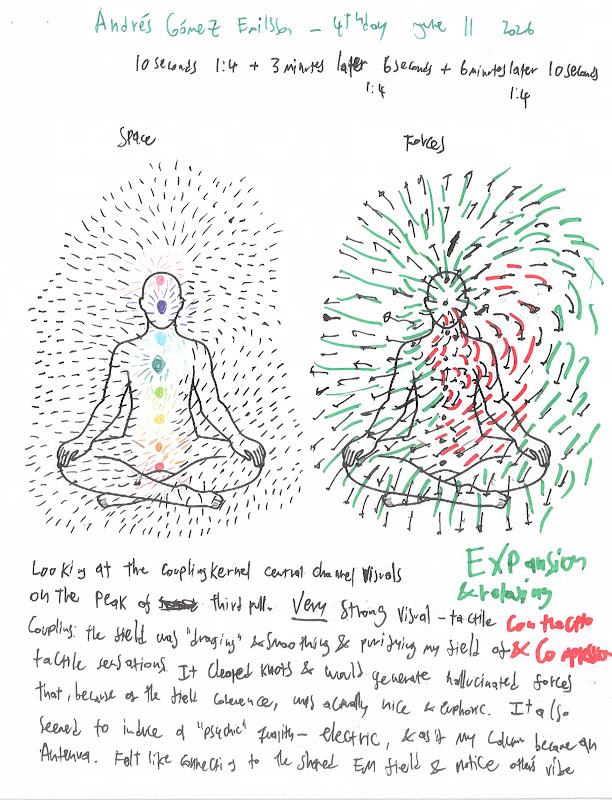
Drawing made right after the experience.
In the second stimulus the oscillators are arranged in a vertical column. The vector field responds to upward-moving waves of fairly low spatial frequency, such that the waves span the better part of the entire screen. As a consequence, in most frames you see one or two central topological bifurcations in the vector field, which travel upwards (in adjacent parameter regimes instead you get standing waves where the topological defect stays put, but the animation we looked at had traveling defects).
On 5-MeO I quickly noticed that the central column in the animation seemed to involuntarily map very strongly onto my “central channel”. By “central channel” I mean how energy courses from the (approximate location) of the base of the spine, through the entire spinal column, and upwards through the center of your head all the way into your crown chakra, almost as if hitting all of the chakras like notes in a musical instrument. The oscillators create an upward-moving rainbow flow that entrains a sense of energy coursing through this channel. The vertical movement of the colors was, in some sense, inducing this flow of energy in the central channel. On top of that, the vector field dragged the membrane sideways across it, with the same compression, stretching, momentum, and folding described above.
The Big Picture
Iterating over more experiences, more individuals, more oscillator arrangements and coupling kernels, and especially more parameterized dynamic phenomenology (PDP) for the membrane, will probably allow us to arrive at a promising set of very specific self-organizing principles underlying this phenomenality.
I want to emphasize that while this type of input has strong effects on 5-MeO-DMT, that doesn’t necessarily mean it is good to look at in the state. The large effect size is scientifically valuable, but that doesn’t translate automatically into beneficial therapeutic effects.
Looking at these animations on the state was somewhat uncomfortable at times, especially the spiral pattern: having centrifugal force on your haptic field under 5-MeO-DMT may not be a good idea per se. While this didn’t happen during our testing, we can expect that in the general case looking at an animation like that one could make you dizzy, or even make you purge with higher probability (note that purging on 5-MeO-DMT is not necessarily bad, and facilitators often beat drums if they see you stuck close to the point of no return, to help you get it over with, a practice that I believe is actually pretty sensible).
With that said, there is a potentially significant good side here as well. Especially with the “central channel” input, I got the sense that some tweaks to the animation may facilitate a kind of “purifying effect”.
As we have discussed in videos, conversations, and write-ups, one of the very big potential benefits of something like 5-MeO-DMT may be that it helps you unbraid your energy body. Meaning, bodymind knots (Cube Flipper, 2024) that store stress and start out interlocked may be present in your body and in your visual haptic coupling to begin with. This particular stimulus is ultimately just a random probe we tried. But I noted while looking at it on 5-MeO it seemed to simplify and “clean” the visual-haptic field. In fact, at times it seemed to align the flow of sensations, it even felt like my central channel would turn into an electrically charged antenna, and its global harmonics were slowly but surely simplified. Not unlike hitting a tuning fork with dry mud stuck to it, shaking it off. This exemplifies some of the principles proposed in Neural Annealing (Johnson, 2019), Healing Trauma with Neural Annealing (Gómez-Emilsson, 2021), in that energizing and purifying core resonant modes of the brain might be rejuvenating in some sense. But above all, the ideas explored in my PhilaDelic presentation Neural Field Annealing and Psychedelic Thermodynamics (2023) where I described how “when you treat your mind as a field, it starts to behave like a field”. Indeed, the smooth flow in the vector field driven by the oscillators would seem to override pinch points and patterns of coagulated solidity in the visual-haptic field. It seemed healing, if perhaps a bit too forceful.
I suspect that a carefully crafted animation patterned over this animation that mirrors your haptic field, together with a vector field that responds akin to a magnetic field relative to electric oscillators, could have enormous potential as a meditative and psychedelic healing tool. Such a practice might help purify pinwheels, pinch points, singularities, and topological defects in general in your visual-haptic field.
There is clearly more work to be done to replicate these accurately, but I am very happy with the tentative progress of these PDP simulations. If we conduct a similar study in the future, I would definitely emphasize investigating this phenomenon further. Potentially this would involve oscillators embedded in 3D that mirror your chakra system, with a three-dimensional vector field that responds to the movement of charge across these oscillators. It might be both grounding and unwinding. Perhaps a powerful method to unbraid patterns of solidity and irregularities in the body schema.
Appendix: technical details of PDP membrane simulation
The replication is a separate layer (the PDP layer) placed on top of the stimulus. It is an elastic sheet of oscillators that is advected by the base field, meaning the vector field of the stimulus.
Advection and momentum
Each point of the sheet is pushed by the vector field underneath it (Flow to Sheet). The push is not instantaneous. The sheet keeps a memory of the recent flow (Flow Memory), and its points have inertia that is slowed by friction (Damping). In the simulation this is how a push in one direction keeps going for a while after the vector field changes, as described in the report.
Tension and folding
Each point is pulled toward the average position of its neighbours (Stiffness). The pull keeps the sheet smooth and spreads a local push over the surrounding region, which produces the compressed and stretched areas. When the flow pushes harder than the tension can smooth out, neighbouring parts of the sheet are carried past one another and the sheet folds over itself.
Tether
Each point can also be pulled back toward its home position (Tether to Rest). This corresponds to the membrane being anchored to the screen and wanting to snap back to its starting configuration. In the tethered version the displacement of each point is also capped, so the sheet cannot tear away from rest. For the mathematically inclined, with the tether on the sheet follows a damped Klein–Gordon equation rather than the plain wave equation, which means there is a lowest frequency at which it can ring. In the animation presented above, the tether is off and the sheet wraps around the edges, so it has no frame and nothing it has to return to.
Color
Each point of the sheet carries an oscillator whose phase is shown as color. Each oscillator has its own natural frequency (Sheet Frequency, varied across the sheet by Frequency Spread). It is pulled toward the phase of its neighbours by a Kuramoto-style synchronization rule (Sheet Coupling). It is also nudged by the field at wherever the sheet has displaced it to (Field Drive on Phase), so the deformation of the sheet changes what each oscillator is driven by. The geometry and the colors are controlled separately. Advection moves the sheet, while frequency and spread change its colors. With the advection at zero the geometry stays perfectly still while the hue keeps cycling. It can look like churning despite nothing moving.
Feedback
The phase of the oscillators does not push the sheet, so the colors are a property of the sheet rather than part of the mechanism behind the behavior of the oscillators or the vector field. The causality in the animations presented flows strictly from oscillators to vector fields to deformable membranes. This need not be the case.
In fact, the original stimulus has a lever to close the loop between the oscillators and the vector field; for the animations presented during our experiences, this was set to zero, and thus the oscillators affect the vector field but not the other way around.
More so, the sheet can feed back into the base layer (Sheet to Base Layer), so that its deformation alters the field that is advecting it. A possible thread for future experiments would be to play with this feedback. Namely, to let the phase affect the physics as well, for example with synchronized regions becoming stiffer. The model would then be closer to the picture of a vector field responding to the oscillators the way a magnetic field responds to moving charges.
Citation
For attribution, please cite this work as:
APA
Gómez-Emilsson (2026, October 1). Coupling Kernels Embedded in a Vector Field on 5-MeO-DMT. https://heart.qri.org/retreats/2026-tepoz/andres-gomez-emilsson/coupling-kernels-vector-field-5meo.html
BibTeX
@misc{gomezemilsson2026coupling,
  author = {Gómez-Emilsson, Andrés},
  title = {Coupling Kernels Embedded in a Vector Field on 5-MeO-DMT},
  url = {https://heart.qri.org/retreats/2026-tepoz/andres-gomez-emilsson/coupling-kernels-vector-field-5meo.html},
  year = {2026}
}