Written by Andrés Gómez Emilsson on 11 September 2026.
This post is a contribution to the third Qualia Research Institute psychophysics retreat, which took place from May to June 2026 in Tepoztlán, Mexico.
Table of contents
- The winner’s podium (state by state)
- Did people experience the jhānas they reported?
- Who could rate what
- How do we know if we have a real signal?
- On computing the statistical significance
- What this study is and is not
- Others pointing in this direction
- What’s coming next
- Appendix A: Methods
- Appendix B: Why we do it this way
- References
When I announced this contest in a video in April, I predicted:
“If I show you eight visualizations and you just came out of a jhāna retreat exploring all eight jhānas, and I ask you to point at the one representing the fifth jhāna, then point at the one representing the third… even today, with very schematic depictions, I would expect there to be a high degree of agreement between participants.” (lightly edited for clarity)
Did this pan out? Actually, yes, to a significant extent. But the complete picture is more nuanced, and will be uncovered in layers, and with signs… ok, not to sound too schizotypical, but as you may know, frontier science is often indistinguishable from esotericism. Transcending the limitations of the prevailing epistemological paradigm often goes through an alchemical period where a lot of new experiments become conceivable and possible to perform, though the results remain often hard to interpret.
The winner’s podium (state by state)
A little context before the tables. The contest allowed up to three submissions per participant, and each submission could represent as many jhānas and transitions between jhānas as the participant wanted. Four of the strongest submissions are not single-state pieces: Symmetric Vision’s covers all eight jhānas, Wystan’s covers all eight, Eliade’s covers up to J5, and Anna’s covers the first four. The submission instructions asked people to tag which seconds depict which jhāna, and we use those tags to show you the relevant crop of each piece for visual clarity. The rating itself was of the whole submission against each state, not of the crop.
Right after the ten-day jhāna retreat ended, participants sat down and reported which jhānas they believed they had experienced. For each of those states they rated each animation from 1 to 5 with the prompt “How much does any aspect of this stimulus resemble any aspect of your jhāna experience?” (1 = “Not at all”, 5 = “Very closely”). We also included Access Concentration (AC), though we never announced an award for it and it is not part of the contest proper.
Two things about the numbers below. First, the centred column is the score after normalising each rater against everything else they scored, which matters because raters differ enormously in strictness (one gave a 1 to 89% of everything they saw, another to only 3%). Raw means are shown alongside since they are easier to interpret as ratings. Conviction is the share of qualified judges who gave the animation a 3 or above. Second, we exclude each judge’s ratings of their own contest entry, and we count a person’s ratings for a given state only if they reported reaching it and at least one of the two assessors agreed. Appendix A has the full rules.
Prize eligibility is noted but does not affect the ordering: these are the top entries out of the 104 animations rated, contest and non-contest alike. Only 5 submissions were eligible for prizes, and 13 in total were part of the contest once you include entries made by retreat participants before the meditation retreat started. Contest submissions were generally rated far above the other animations, which makes sense: the others were casting a wide net across oscillatory dynamics and physics-inspired simulations, probing for the possibility that some might be strong hits. Custom-made animations that specifically try to represent a given jhāna tend to score much better. That said, a few of the non-contest animations did reach the top three, and you can see them below.
Full rankings for all 104 animations are here. And if you want the whole dataset at a glance before reading any of this, the Stimulus Grid shows every animation we rated and where it falls across the jhānas and the 5-MeO-DMT dose levels.
Without further ado…
Access Concentration
| centred | raw | conviction | |||
|---|---|---|---|---|---|
| 1 | Eliade — From Disorientation to jhānas · HEART | +1.49 | 2.86 | 43% | n=7 |
| 2 | Enrique — access to J1 · HEART | +0.68 | 2.00 | 14% | n=7 |
| 3= | bilateral josephson array, body color · baseline | +0.51 | 1.86 | 29% | n=7 |
| 3= | Eliade — J2 tactile · HEART | +0.49 | 1.86 | 29% | n=7 |
| 3= | bilateral u1 superfluid, body color · baseline | +0.49 | 1.88 | 25% | n=8 |
| 3= | Anna · HEART | +0.48 | 1.86 | 29% | n=7 |
Access Concentration was the state with the lowest agreement between participants. Unlike the jhānas, which we discussed extensively before the retreat (both the techniques for developing them and their phenomenological characteristics), we did not talk at length about AC beyond defining it as a state where you can keep attention on the meditation object (breath, metta, energy body) without major distractions for a minute or longer. I don’t think there was enough agreement among participants about the nature of this state for the results to be particularly meaningful, but in the interest of completeness they are here.
Since Anna explicitly visualized J1 through J4 and no access concentration, we show the J1 section of her submission here; the features that resonated with AC could be found in another jhāna or throughout the animation.
First jhāna
| centred | raw | conviction | |||
|---|---|---|---|---|---|
| 1 | Anna · HEART | +2.30 | 4.00 | 100% | n=7 |
| 2 | Symmetric Vision · eligible | +1.73 | 3.50 | 88% | n=8 |
| 3= | Positive To Negative Coupling Cloud · baseline | +1.16 | 3.00 | 86% | n=7 |
| 3= | Double-Spondee to Spondee-Iamb · baseline | +1.16 | 3.00 | 71% | n=7 |
Second jhāna
| centred | raw | conviction | ||
|---|---|---|---|---|
| 1 | Anna · HEART | +1.51 | 3.00 | 67% |
| 2 | Symmetric Vision · eligible | +1.19 | 2.71 | 57% |
| 3 | Wystan · HEART | +0.93 | 2.50 | 50% |
Third jhāna
| centred | raw | conviction | ||
|---|---|---|---|---|
| 1 | Anna · HEART | +2.00 | 3.40 | 100% |
| 2 | Symmetric Vision · eligible | +1.61 | 3.00 | 67% |
| 3 | bilateral josephson array, body color · baseline | +1.53 | 3.00 | 50% |
Fourth jhāna
| centred | raw | conviction | |||
|---|---|---|---|---|---|
| 1 | Wystan · HEART | +2.55 | 4.00 | 100% | n=3 |
| 2 | Anna · HEART | +2.30 | 3.67 | 100% | n=3 |
| 3 | Symmetric Vision · eligible | +2.11 | 3.50 | 100% | n=4 |
Fifth jhāna
| centred | raw | conviction | |||
|---|---|---|---|---|---|
| 1 | Symmetric Vision · eligible | +2.31 | 3.75 | 75% | n=4 |
| 2 | Wystan · HEART | +1.81 | 3.33 | 67% | n=3 |
| 3 | Eliade — From Disorientation to jhānas · HEART | +1.56 | 3.00 | 50% | n=4 |
Sixth jhāna
| centred | raw | conviction | |||
|---|---|---|---|---|---|
| 1 | Symmetric Vision · eligible | +2.17 | 3.33 | 67% | n=3 |
| 2 | Wystan · HEART | +1.77 | 3.00 | 50% | n=2 |
| 3 | Sasha · HEART | +1.17 | 2.33 | 33% | n=3 |
Seventh jhāna
| centred | raw | conviction | |||
|---|---|---|---|---|---|
| 1 | Symmetric Vision · eligible | +2.79 | 4.00 | 100% | n=3 |
| 2 | Sasha · HEART | +2.12 | 3.33 | 100% | n=3 |
| 3 | Wystan · HEART | +1.71 | 3.00 | 50% | n=2 |
Eighth jhāna
| centred | raw | conviction | |||
|---|---|---|---|---|---|
| 1 | Symmetric Vision · eligible | +1.96 | 3.00 | 100% | n=1 |
| 2 | Eliade — From Disorientation to jhānas · HEART | +0.96 | 2.00 | 0% | n=1 |
Overall
The announcement set out nine cash prizes: one for each of the eight jhānas at around $500, and Best Overall Contribution at around $1,000. Symmetric Vision is first among eligible entries at every jhāna from J1 to J8, so all nine go to him.
It is his third top prize across QRI contests, after the replication contest and the psychedelic cryptography contest of 2023.
We also announced two honorable mentions carrying no prize money. Anna’s submission showed really compelling transitions between jhānas, so we are awarding her Best Transition Sequence. None of the submissions seemed particularly useful for inducing jhānas, alas, so we are withholding Best Jhāna Induction Aid. Hopefully that is motivating for the next iteration of the contest. We will have to see.
Did people experience the jhānas they reported?
At the end of the ten-day retreat, participants declared which states they believed they had reached. They had also been filling out daily surveys tracking their practice and any jhānic absorption, were interviewed with microphenomenology methods about their single deepest experience, and were asked to draw it with an emphasis on the apparent dynamic generators.
Separately, two advanced meditators interviewed each participant about their deepest absorptions and were asked to guess both the peak level of absorption and the level of marination for each jhāna they believed the participant had experienced.
I was very curious about this part of the study. I have always wondered how often an advanced meditator would agree about the states another meditator is experiencing. It is not unusual to see people claim things like “guys, I finally experienced the first jhāna, I now have access to bliss whenever I want”, where an advanced meditator interviewing that person might conclude instead “they experienced an intense wave of pīti, but their level of concentration is likely below Access Concentration”. It is easy to confuse interesting states along the way with the jhānas themselves. Participants here were all aware of various models of jhāna phenomenology before the retreat, and had on-site practice interviews with one of the assessors, though he was instructed not to tell participants where they likely were on the map and to offer only pragmatic suggestions.
So what did people report, and what did the assessors make of it?
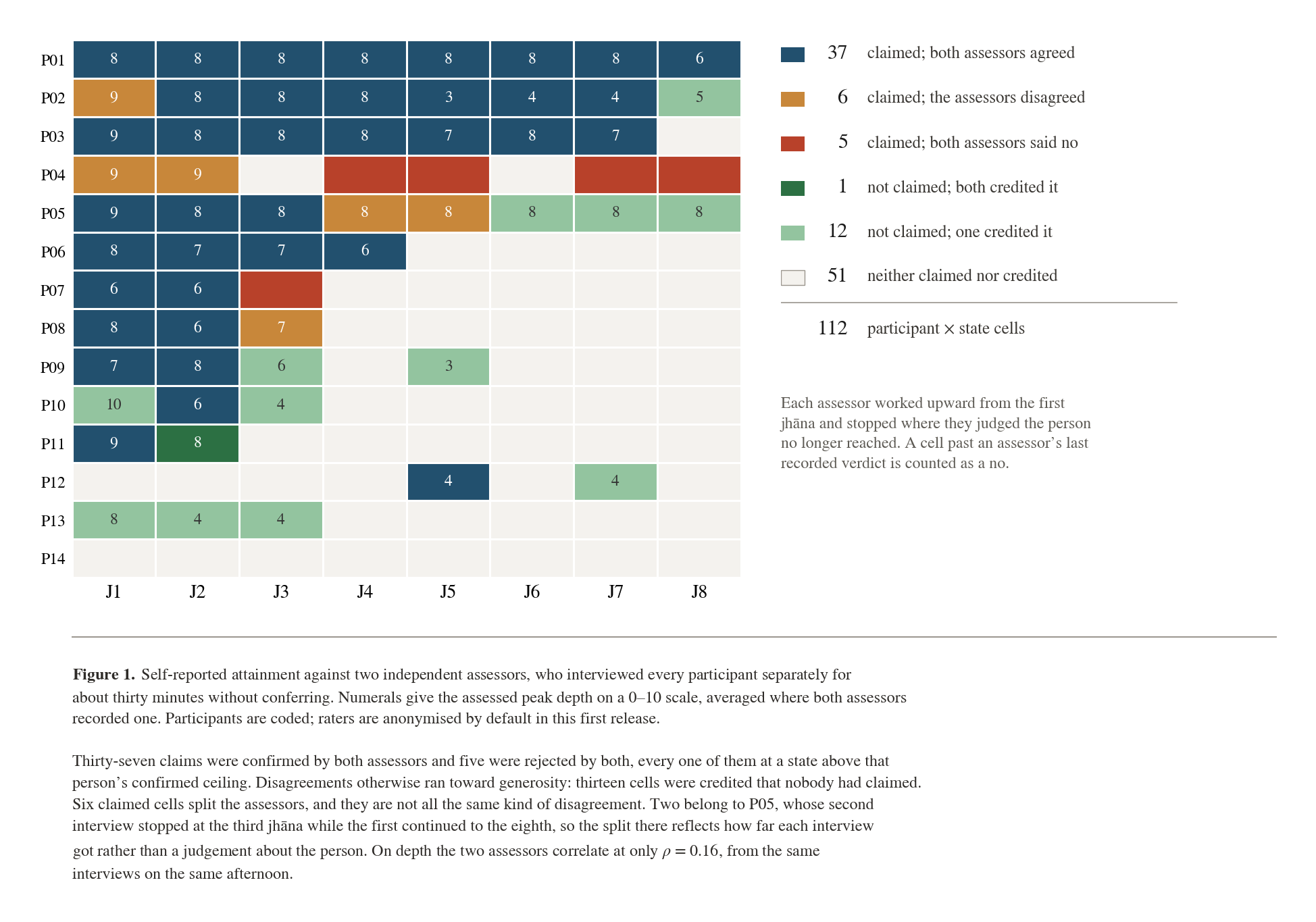
Of the 112 person-by-state cells (14 times 8), 37 were claimed by the participant and confirmed by both interviewers, and 51 were neither claimed nor credited by anybody. Only five were claimed and rejected by both. Six were claimed with one assessor saying yes and the other no. Thirteen were credited by an assessor without the participant having claimed them at all, twelve of those by one assessor and one by both.
Self-report and assessor judgement therefore agree on 83.9% of cells, though that figure flatters us somewhat, since it counts the 51 cells where neither party thought anything happened and nobody was ever going to disagree about whether P14 reached the eighth jhāna. Correcting for chance, the two agree at a Cohen’s kappa of 0.68 (95% CI 0.48 to 0.84, bootstrapping over participants rather than over cells, since each person contributes eight rows that are anything but independent), conventionally described as substantial agreement, and a permutation test that shuffles each person’s assessor verdicts within their own row puts it well beyond chance (p < 0.0001). Fuller statistics in the technical tranche.
The assessors also agreed with each other 93.3% of the time on the binary question, across the 45 cells that both of them explicitly judged. Two very experienced practitioners in separate interviews generated very similar verdicts about who had been where, and given how much disagreement exists in the literature about what even counts as a jhāna, I would not have been surprised if this had come out considerably worse.
My expectation going in was that people would over-claim relative to the assessors, and that is not what happened. Thirteen cells were credited that participants had not claimed, against five claims that both assessors rejected, so if anything the assessors were the generous party: one participant declared no jhānas at all and was credited with three, and another declared five and was credited considerably higher by one of the two interviewers. That said, the asymmetry does not clear significance on its own, so I would put it as a direction that surprised me and not as an established effect.
I am P07 in the figure. I generally did not get to experience states of absorption substantially stronger or more varied than in previous retreats. A big factor is that I was the person on the ground responsible for the logistics of the whole retreat. Each house had one participant assigned as the logistics point-person, responsible for checking messages and solving problems, and I was the main point-person for the retreat as a whole. In the future I will distribute this role during the planning process, and potentially hire a full-time on-site logistics person so I can really focus on developing access to the formless states. My intention was to hit ten hours of meditation a day, but in practice I was often hitting between six and nine, and the logistics I worked on during the afternoon seemed to counter some of the concentration I had developed during the day.
I originally hoped to experience formless jhānas, but halfway through the retreat I settled for the more realistic goal of being a datapoint for the research, and that still produced useful data. I did believe at the time that I could reach and marinate in J1 and J2 to some extent, and I was not entirely sure about J3, but if asked to decide my guess was “yes, at least touched it briefly on the last few days”. The independent assessment of both interviewers was that I experienced J1 and J2 but not J3. What I thought was a J3 experience is, in their view, a particularly peaceful subvariant of J2. Go figure. We kept my judgements of J1 and J2 and dropped my ratings for J3.
The five rejected claims are the only cases where somebody said they had reached a state and both assessors disagreed. Four of them belong to a single participant, at the fourth, fifth, seventh and eighth jhānas, and the fifth is mine. In terms of the analysis, then, my J3 is the entire effect of the qualification filter, since the other over-claimer never went on to rate the states in question. Rerun the contest scoring using only cells that both assessors confirmed and the top scoring entries do not change, and the same holds further downstream: the reliability contrast, the state correlations and the rankings are all essentially unchanged whether you gate on self-report or on assessor confirmation.
Of the six cells with one yes and one no, two belong to the same person, at the fourth and fifth jhānas, where one interview continued all the way up to the eighth while the other stopped at the third. That one was our mistake rather than a difference of opinion about the participant, a matter of how far each conversation got, and it is easy enough to fix by agreeing a stopping rule between assessors in advance. The other four are ordinary disagreements, and we should expect roughly that many even if the assessors are picking up a real signal.
The estimates of depth were not consistent between assessors. They agree 93.3% of the time on whether a state happened and at a Spearman correlation of 0.16 on how deep it went. So whether somebody reached a jhāna looks measurable with this method, and how deep they went does not. The anchored scales we used for the 5-MeO week, where we gave reference experiences for what a 5 or a 7 means, reached 0.90 agreement between self-assessment and my own assessment, so I suspect proper anchoring next time will fix this rather than it being something deeper about the unmeasurability of depth.
Who could rate what
Not everyone can rate everything. You cannot ask somebody whether an animation resembles the seventh jhāna if they have never been there. Teachers define the jhānas differently, there are levels and depths within each of them, people routinely mistake access concentration for jhāna, and so on. So for the final analysis we gate the responses twice over: a participant’s ratings for a given state count only if they reported reaching it and at least one of the two interviewers agreed. As it happens the two gates almost entirely coincide, and the assessment gate removes exactly one person’s worth of data, namely my 104 ratings at the third jhāna. The self-report gate is thus the critical filter.
| AC | J1 | J2 | J3 | J4 | J5 | J6 | J7 | J8 | |
|---|---|---|---|---|---|---|---|---|---|
| judges | 11 | 10 | 9 | 7 | 5 | 5 | 3 | 3 | 1 |
| ratings | 989 | 914 | 839 | 647 | 440 | 442 | 219 | 219 | 103 |
Selecting people with the rare combination of having a chance of touching the formless jhānas and of being able to talk about it afterwards with computational frameworks barely got anyone to the highest levels in a ten-day retreat. Only one participant had access to the eighth by our criteria, and we knew in advance they likely would, since they already have access to these states off-retreat. This is arguably the largest limitation of the study and it affects everything else: scores for the seventh jhāna rest on three opinions, and those for the eighth on one. Statistical care does not fix this. It is one key thing I want to fix for the next iteration, since recruiting for depth at the formless end would help the analysis much more than doubling the number of animations would. The main challenge will be finding participants with stable formless access who can also engage with and contribute to QRI-like content.
Raters differ, and they differ consistently
The variability in strictness mentioned above is likely a reasonably stable property of the rater, which psychometricians call severity and which in signal detection terms is the criterion. Each person’s severity is measured quite precisely here, since it pools several hundred ratings: split somebody’s ratings in half at random and the two halves agree on how strict they are at about 0.94.
The harder question is whether severity travels between tasks. Among the eight people who rated the same 91 animations twice, once against the jhānas and a week later against 5-MeO-DMT dose levels, the correlation between their mean ratings in the two arms is +0.73. With only eight people that estimate is fragile (bootstrapping over participants gives a 95% interval from −0.26 to +0.98, and a permutation test gives p = 0.04), so I would put it as a suggestive pattern rather than an established one. What is well justified is the within-condition fact that motivates the normalization in the first place, which is that in any given rating session participants differ enormously in their tendency to give ratings across the board.
The optical phenomena questionnaire does not show the same pattern at all (r = −0.18 across the two weeks), and it cannot be rescued by normalizing, since subtracting a week mean or a stimulus mean changes everybody by the same constant and leaves the correlation untouched. The likely reason is that twenty of the twenty-two optical stimuli were rated higher under 5-MeO-DMT, and by very different amounts per person, so the rater parameter is getting washed away by how different the two states actually were.
Judges who made animations
Six of the thirteen contest submissions came from people who were also raters, and all of the non-contest animation sets were built by participants too. We exclude each judge’s ratings of their own contest entry while keeping their ratings of the non-contest animations, for two reasons.
The first is memory of intent. A contest entry was built to depict a particular state and its maker knows which one, so their rating partly reports what they meant on top of what they see in the moment. The non-contest animations are different in kind, having been generated as probes across all the states without any particular target, so there is no intention available to leak into the rating. When one of the people who helped develop the probes rates one of them, they are judging a stimulus that starts out unlabeled, and the results bear this out: Taru gave her own bilateral Josephson array a 1 at the third jhāna, where four other judges gave it a 3. Not the behavior of somebody flattering their own work.
The second reason is a residual conflict of interest. Not prize money, since meditation retreat participants were never eligible for it, but the reputational value of appearing at the top of the table. I think this is a weak consideration, and removing it costs 36 ratings out of 4,848. It always hurts to throw out otherwise high-quality data, but such is life.
We checked whether any of this matters, and it doesn’t matter much. Comparing the two policies across the whole correlation matrix, the median change in correlation is 0.015 and the largest is 0.087. There is a pair that crosses the significance threshold in one direction and none in the other. The data does not support the idea that artists were systematically kind to themselves: relative to their own ratings of everything else, matched by state, Andrés ran +0.17, Eliade −0.00, and Taru −0.15. These are not meaningful biases, if even real.
Importantly, the two HEART entries that top a podium are therefore scored entirely by other people. Anna’s first jhāna is the judgement of seven judges, none of whom made it.
How do we know if we have a real signal?
Take care of all the above and you still cannot say what a 4 means. Did the meditator recognise their jhāna, or is it a pretty animation and they are being agreeable? Averages alone will not tell you.
Fortunately the 104 animations were not all made with the same intent. Thirteen were built to depict particular jhānas, so those are where independent meditators should converge if anything real is being tracked.
The other 91 were general probes, and all of them were made with what we call Parametrized Dynamic Phenomenology (PDP): simulations of dynamic systems with adjustable parameters, rather than hand-made videos. Appendix B compares that with other research designs. Roughly half came from an earlier coupling kernel study, as educated guesses about what distinguishes N,N-DMT from 5-MeO-DMT. The rest were made during the retreat, where the instruction was to throw everything at the wall and see what sticks: generate animations from a wide range of physics-inspired self-organizing principles, and keep whatever produced striking dynamics, with a nudge toward topologically interesting transitions like the simplification or cancellation of pinwheels. We also made bilaterally symmetric versions of many of them, and that one came from outside. Leigh Brasington, who wrote Right Concentration and runs a lot of jhāna retreats, did a two-hour Q&A with the team before the retreat, and mentioned that in his experience very clean jhānas feel bilaterally symmetrical. So we included both a symmetric and an asymmetric version of many animations, to see whether the symmetric ones would score higher. They mostly don’t, as discussed below, though his claim was specifically about very clean jhānas, which is close to the condition this cohort is least able to test. So these are not sterile controls in the sense of random noise, but informed attempts spanning a wide state-space and made without a specific state in mind.
All 104 were rated in one sitting by the same people on the same 1 to 5 scale. That lets us split the panel into two random halves and check whether both halves put the animations in the same order. For the thirteen contest entries the halves agree at 0.81 to 0.96. For the 91 probes, the same statistic runs from −0.07 to 0.74, clustered well below 0.5.
I find that contrast validating. When an animation really was built to depict a jhāna by somebody who had been there, meditators converge on recognising it, and when it was built as a general probe their answers diverge. So we read the agreement between raters rather than the average of their scores.
This is also why there is no leaderboard of 91 animations in this post. Past the top few the ordering is mostly noise, and we can demonstrate that it is.
And it does answer the prediction I opened with, with an important qualification. The high degree of agreement I guessed at is real, but only for stimuli that were built to depict a state. It is not a general property of meditators looking at pretty patterns, which is worth knowing, because the failure mode I was most worried about going in was that people would simply be agreeable about anything sufficiently trippy.
Anna’s submission: what high specificity looks like
Anna’s ratings across the full range of states:
| AC | J1 | J2 | J3 | J4 | J5 | J6 | J7 | J8 | |
|---|---|---|---|---|---|---|---|---|---|
| raw | 1.9 | 4.0 | 3.0 | 3.5 | 3.7 | 1.00 | 1.00 | 1.00 | 1.00 |
Her submission is titled for the first four jhānas and tops three of them. At the fifth it drops to exactly 1.00, with zero variance, and stays there, meaning that not one judge at any formless state moved off the floor.
This is discriminant validity, and I think it is the strongest evidence we produced that the instrument is measuring something rather than registering enthusiasm. An animation that scores high everywhere might just be evocative. An animation that scores high on precisely its four target states, and unanimously at the floor on the other four, is being recognised specifically.
By the count of how many judges named it their single favourite, Anna’s finished first, five votes to three. It loses the overall ranking only because it declines to compete in the formless states at all. Total-score ranking rewards the generalist while the science favours the specialist, so we should probably score specificity directly next time.
Notes on a few of the other submissions
Sasha’s entry is the most under-recognised piece here. It ranks 38th of 104 overall and is near the bottom on total score, but comes second at the seventh jhāna with 100% conviction. A poor general animation and an excellent depiction of nothingness.
A hierarchical model that separates “depicts this state” from “is evocative in general” actually puts Sasha ahead of Symmetric Vision at the sixth and seventh. We are choosing not to use a sophisticated model like this for the final scoring because there is always the risk of doing the equivalent of p-hacking for finding “an analysis that makes a certain entry win”. In the future, I would consider pre-registering the range of statistical techniques we intend to apply so we can recover more signals without causing suspicion of playing favorites.
On computing the statistical significance
Each animation gets one average per state, and it is tempting to treat those averages as inputs for other statistical methods. But they come from a very variable number of participants: access concentration gets eleven judges, the seventh jhāna average comes from three, and the eighth is one person’s score. Standard methods will assign the same confidence to all of them and then carry those numbers forward.
So we bootstrap over participants instead of over average scores. When we resample over both raters and animations, the number of statistically supportable relationships (the correlations between jhānas, or between a given jhāna and a 5-MeO-DMT dose level) drops from 32 to 12. This is good, even if it lowers the number of “findings”, because we should not spend resources on relationships that are likely noise. That said, many of the twenty that fell away could still be real and merely underpowered, and our philosophy is to fish for large effect sizes first and come back for the subtle ones once the instruments are better.
Our first pass through this data produced a considerably richer set of findings than what you have just read, and most of them evaporated for this reason. There will be more on this in the tranches to come, and I intend to report the discards alongside the findings throughout.
What this study is and is not
The n is small by participant count: 14 people in the jhāna retreat and 15 in the 5-MeO-DMT sessions. What compensates is the volume and type of data, the fact that the animations were educated guesses by knowledgeable participants rather than random samples, the amount of longitudinal data per person, and the think-tank format itself. Still, I consider this a pilot study and a proof of concept for a novel research paradigm rather than any kind of definitive take on the jhānas or 5-MeO-DMT. Our goal was to identify large effect sizes that would show up even with few participants, while acknowledging that the study is underpowered for real but subtler patterns, and to produce insights that can be translated into formal mathematical models compatible with neuroscience.
The emphasis on dynamics and on large effect sizes does raise the chances that what we found generalizes. When a mathematician, a visual artist and a meditator all agree that of the dozens of waves they have been shown, this one is the most similar to what the wall looked like on 5-MeO-DMT, chances are you are finding something general about how the human nervous system works rather than something specific to the cohort. For the time being I remain cautious and do not overstate our results.
We will be releasing comprehensive results over the next couple of months in three tranches: not only the animation ratings, but the psychophysics tests, the microphenomenology interviews, novel Oscilleditor-like architectures, and as much raw data as we can share without compromising anonymity for those who request it. This post is the first of those, and is focused on the contest submissions, with the non-contest animations that reached a top three included partly as a teaser and partly because they are genuinely evocative in interesting ways.
Others pointing in this direction
We are not the only people who have thought that you could study exotic phenomenality by building stimuli and checking them against those who have been there. We are the first to do this with explicit dynamic systems, participant contributions, a think-tank model, and on jhānas, 5-MeO-DMT, and their overlap.
The closest published relative comes out of Anil Seth’s group at Sussex. In 2017, Keisuke Suzuki, Warrick Roseboom, David Schwartzman and Seth built the Hallucination Machine, a deep-dream VR setup shown to participants and then scored with the same altered-states questionnaires used in psilocybin studies, and the response profile that came back resembled psilocybin on several dimensions and not on others. Suzuki has since pushed this much further. His C × G × D framework, published this year from Hokkaido University’s CHAIN, treats a classifier, a generator and a discriminator as three tunable components and asks which settings produce which family of hallucination, with first-person reports constraining the model rather than correlating with it. That is parametric in the sense we mean, and the nearest thing in the literature to PDP, though it is presented as a theoretical framework rather than as an instrument you can open in a browser and turn knobs on. There is related work applying the same machinery to hallucinations of different aetiology, which is also of interest to us, though we haven’t yet actively pursued the thread.
The deeper difference is in where the generator comes from. A PDP generator is built from first principles, so what its parameters mean is known. In contrast, a trained classifier or generator is opaque, and getting from a good match to a claim about mechanism is tricky. It requires doing interpretability work on the model first, and then on the empirical matches specifically. That asymmetry holds even if a C × G × D pipeline ends up scoring better than we do on the participant-given ratings. My guess is that we are also currently closer on the phenomenology itself, at least for these states, since so much of what people report is rhythmic, feedback-laden and tracer-like, which is what the Oscilleditor is natively made of, whereas deep-dream output is natively focused on apophenia-like phenomenality (which is a real part of the psychedelic experience, just not its main feature, and which I believe is emergent from more basic dynamic changes rather than a primitive).
Also at Sussex, Trevor Hewitt has built the Six-Dimensional Visual Hallucination Questionnaire, which scores the contents of a hallucination on geometric content, semantic content, vividness, complexity, focality and detail, rather than recording that one happened and how intense it was. His first two dimensions are similar to the contest rubric, as we asked people for phenomenal character rather than semantic content. He has also mapped the geometry of stroboscopically induced hallucinations at scale with computer vision. Strobe has the considerable advantage of being legal and generally safe, which is why a large sample size is available there, and more so, the conscientiousness of the researchers is commendable!
On the meditation side the parallel is Matthew Sacchet’s Meditation Research Program at Harvard and MGH, which has been running intensively sampled 7T fMRI studies of jhāna. Their 2024 NeuroImage case study and their 2025 Cerebral Cortex paper on how absorption reorganizes functional connectivity gradients are, as far as I know, the most careful neural characterization of these states anybody has produced. They treat phenomenology as something to be modeled rather than as a nuisance variable, which is deeply aligned with our approach.
The theoretical ancestor of the coupling kernel work is older than either. Bressloff, Cowan, Golubitsky, Thomas and Wiener (2001) derived Klüver’s form constants from the symmetry group of striate cortex, and that paper is a large part of why we look at coupled oscillators at all.
The earliest version of our own argument I can point to is from April 2015, in Psychophysics for Psychedelic Research: Textures. The method there is not mine; it is Benjamin Balas’s odd-one-out paradigm, which uses Portilla and Simoncelli’s parametric texture model (2000) to synthesize textures from a set of image statistics, and then selectively removes individual statistics from the generator to see which ones the visual system is actually using. You get three textures for 250 milliseconds at a few degrees of eccentricity, two the same and one not, and the experimenter learns which statistic mattered from which lesion you can detect. What I proposed was pointing this at psychedelics, on the reasoning that if a statistic that is normally invisible becomes discriminable under LSD, you have learned something quite specific about what the visual system is doing that it does not ordinarily report on. A similar basic move as the present study, eleven years earlier.
The 2015 design is also cleaner than the one we ended up running, at least in some ways. Odd-one-out with a lesioned generator is a real psychophysical task, with a forced choice and a correct answer, so there is no scale for a rater to be strict or lenient on and the severity corrections above would not be needed at all. The floor effects would not disappear so much as change character, since instead of everybody giving a 1 you would get performance at chance, which is a floor with a known value and a known standard error. And the fact that an average is partly a measure of who happened to be qualified to rate it is a sampling problem rather than a scale problem, so forced choice would do nothing about that one. We used ratings because we wanted 104 stimuli against nine states from people with a finite number of hours, and forced choice does not scale that way. Participants were feeling stretched by the number of surveys and tasks already, so adding a long psychophysics task would not have worked. Getting a discrimination battery into the next retreat is on the list, though it will probably have to run alongside the ratings on a much smaller stimulus set already filtered to maximize the probability of large effect sizes, hence the complementarity of these approaches.
Psychedelic Turk proposed a platform for running that sort of thing at scale in 2018, and the tooling began development soon after. QRI’s Tracer Replication Tool went up in October 2020, where you adjust tracer length, decay, frequency and opacity until the simulation matches what you remember seeing, and what comes out is a set of precise parameters for a signal-processing transformation. Collecting Qualia Souvenirs followed in 2021 and articulated the value-add that such a tool produces: a digital recreation of the quality of an experience you can share with your friends! The term is useful here, since every contest submission is already a kind of qualia souvenir. Somebody brings something back from the first jhāna, and the question is whether other people who have been there recognise it, which for purpose-built souvenirs comes out at 0.81 to 0.96 and for general probes at roughly zero. Visualizing Tactile Sensations (Volpato, Gómez-Emilsson, Kuntz and Martinez Quintero, 2023) did the equivalent for the tactile field, and is the direct ancestor of QRI’s still unreleased Tactile Visualizer, which produced a good fraction of the animations rated here. The coupling kernel paradigm followed at the end of 2024, and the Oscilleditor in late 2025.
The judging format has a similar history. At our 2023 Brazil retreat the replication contest was judged by people who had taken the compound in question a few days earlier, and the psychedelic cryptography contest went further: submissions claimed to hide information that could only be decoded while on a classical psychedelic, and the judges sat there on mushrooms and ayahuasca trying to decode them. I like to mention the negative results: for the large majority of submissions there was no detectable difference between looking at them sober and looking at them high. But the submissions by Symmetric Vision and Bear From Void did work as psychedelic cryptography, and showed the proof of concept is workable in practice.
One thing did change along the way. Psychedelic Turk was a crowdsourcing proposal, which is close to the opposite of what we ended up doing. The 5-MeO week did run psychophysics and visual illusions on people while they were in the state, but the cohort was fourteen hand-picked people who dosed as carefully and precisely as possible in a supporting environment, rather than a sample from an open platform.
The generative systems here are systems of coupled oscillators rather than deep networks, and coupling strength, kernel shape, topological charge and the dimensionality of the interacting lattices are all quantities you could then go looking for in a brain. What we are after with PDP is not a good picture of a jhāna, which is all a replication contest asks for, but the simplest dynamic system that produces the state, whose parameters we can then treat as a hypothesis about what nervous systems (and the field they are embedded in) are doing. If one fairly simple system turns out to reproduce many of the states at different settings, that is much better evidence of a real mechanistic correspondence than a complicated system that reproduces one.
A tunable model is also not restricted to the states somebody has already reported. You can follow the parameter path from the first jhāna to the third and ask a practitioner whether anything along the way is familiar, or take the settings that best match the fifth and keep pushing in the same direction. The factorial here is a small version of that: six physical systems, with bilateral symmetry and embodiment varied on each of them, which is two knobs and a question about which states respond to them. The answers were mostly negative (Brasington’s bilateral symmetry does very little, embodiment matters at the third jhāna and not much elsewhere), but we got them by running the comparison instead of arguing about it, and that only works because the knobs are there in the first place.
The raters had just spent ten days in the states in question, and their claims about which states those were got independently adjudicated by two advanced practitioners. Most work in this area shows the stimulus to people who were in the state years ago, or who may never have been in it at all, and takes their word for it.
The stimuli were made by the participants themselves. A lot of those two months went into group vibe-coding, which is mostly how people levelled up and which produced useful things in its own right (Vase Breathing among them), but the material that went into the contest and the ratings was made separately and kept out of circulation until after the jhāna retreat, so nobody was scoring something they had already workshopped with the group.
None of this is a criticism of the work above. Sussex and Harvard are doing careful science under constraints we do not have, starting with institutional review and the expectation that a reviewer be able to evaluate your stimulus generator. Ours are different: QRI does not administer anything to anybody, so the work depends on settings that handle their own screening and on participants who were going to be in these states regardless of us. Being small and self-funded is what lets us build an instrument in an afternoon and discard it the same evening. Eleven years into thinking about this and six into building the instruments, what we have is a set of tools and observations that I think other people will find worth picking up.
What’s coming next
Alongside the jhāna retreat we had an overlapping cohort doing a 5-MeO-DMT retreat, running the same instruments and the same animations against a very different family of states. You can see the overall picture in the Stimulus Grid, but there is a lot to unpack, and a 5-MeO-DMT-specific writeup will be posted in the next tranche.
Infinite bliss!
Appendix A: Methods
The retreat
In May and June of this year we spent two months in Tepoztlán, México. The stated aim was to uncover the similarities and differences between the phenomenality of 5-MeO-DMT-induced states and jhāna meditation, approached from as many angles as we could manage. Fourteen people took part in the ten-day jhāna retreat and fifteen in the 5-MeO-DMT sessions, with substantial overlap.
Three weeks of preparation preceded the retreat, with two hours of daily meditation suggested by the meditation coach in order to build momentum: an 8:15 to 9:00 block, a guided 12:30 to 1:00 block, and a 6:15 to 7:00 block.
What we ran over those two months:
- Developed and tested three new questionnaires designed to distinguish between jhānas and between levels of 5-MeO-DMT.
- Conducted microphenomenology interviews, with qualified interviewers, of the deepest experiences.
- Ran psychophysics and cognitive performance tests before and after the jhāna retreat.
- Made countless drawings of experiences right after having them, for both jhāna and 5-MeO-DMT.
- Recorded transcripts of technical discussions about the possible dynamic systems underlying these state shifts.
- Learned to vibe-code replications of exotic states of consciousness, individually and as a group, and contributed dozens of simulations capturing qualitative and quantitative aspects of these experiences.
- Wrote hundreds of pages of free-form phenomenology reports (cf. Guide to Writing Rigorous Reports of Exotic States of Consciousness).
- Looked at visual illusions and performed psychophysics tasks at various doses of 5-MeO-DMT.
- Recorded dozens of long video interviews about the nature of these experiences.
- Evaluated each other’s experiences: two very advanced jhāna practitioners independently interviewed every jhāna retreat participant for 30 minutes to determine which jhānas they actually experienced as against what they claimed, and I did a 40 to 60 minute interview with every 5-MeO-DMT participant to estimate, based on my own experience with the substance, how far they went at their deepest.
- Recorded commentary and meta-commentary by advanced meditation practitioners on the trip reports of the 5-MeO-DMT week, to evaluate whether jhānic phenomenality was present in them.
- Recorded biometric data (heart rate, breathing, EEG) during jhāna meditation and 5-MeO-DMT experiences.
- Worked individually and as a group to brainstorm, code and test novel dynamic systems to compare against our experiences, with an emphasis on precisely characterizing the wave dynamics of 5-MeO-DMT visual and tactile sensations, and their coupling and interference.
- And, most relevant for this post, had participants rate over a hundred animations by how similar they are to the phenomenality of their experiences.
The rating task
Thirteen of the fourteen retreat participants completed the rating session. For each state a participant reported reaching, they scored every animation from 1 to 5 on the prompt “How much does any aspect of this stimulus resemble any aspect of your jhāna experience?”, with 1 = “Not at all” and 5 = “Very closely”. So if you believed you had experienced J1 and J3, you would go through the animations twice, once scoring how J1-like each one is and once how J3-like.
Two properties of the resulting distribution are worth having in mind when reading any of the numbers above.
Almost everything is a 1. Seventy percent of all ratings were “not at all”. This is not a defect in the data, since most animations genuinely don’t look like a jhāna and meditators fresh off a ten-day retreat are not in a generous mood about it. But it does distort the statistics in a way that is easy to miss: when nearly everything scores at the minimum, an animation with a tiny error bar is usually one that everybody rated 1, not one we measured precisely. The practical upshot is to read the error bars at the top of the field and ignore the ones at the bottom.
Raters don’t share a scale. Individual mean ratings ran from 1.13 to 2.96, and the proportion of “1” responses from 3% to 89%. One judge said no to almost everything and another said yes to most things, looking at the same animations in the same room. A raw average is therefore partly a measure of who happened to be qualified to rate that particular animation, which is why everything above is ranked on centred scores.
Where the animations came from
The 104 rated animations came from five sources:
- Jhāna contest submissions by external participants.
- Submissions by retreat participants, who did not qualify for the prize but contribute to the science.
- Animations created with QRI tools, including the Tracer Tool and the Oscilleditor.
- Custom-made animations built from physics-inspired dynamic systems.
- Visuals capturing specific non-linear optics phenomena (cf. BaaNLOC).
For the third and fourth categories I started from the best animations in a previous pilot study, where online participants rated animations by their similarity to psychoactives (LSD, psilocybin, 2C-B, ketamine, DMT, 5-MeO-DMT, MDMA) and to meditation (jhāna and fire kasina). I focused on the animations that best differentiated 5-MeO-DMT from jhāna in that dataset, with the caveat that the study did not ask about specific jhānas or specific doses of 5-MeO-DMT, which muddies the waters quite a bit.
We then had Eliade and Taru create further animations exploring (1) topological defects, (2) color versus black and white, (3) bilateral symmetry versus asymmetry, and (4) physics-inspired dynamic systems and differential equations. Many were made with QRI’s Tactile Visualizer, especially settings with rich turbulent dynamics and topological defects, and a few with the Oscilleditor.
The bilateral symmetry contrast was added because of Leigh Brasington (personal communication, 2026), who did a two-hour Q&A with the team before the jhāna retreat and reported that very clean jhānas feel bilaterally symmetrical to him. Several other people gave the team time in the run-up, including Justin von Bujdoss on darkness retreat phenomenology specifically, who motivated us to add some images to the Optics set. Brasington’s is the one that had a material the stimulus set here analyzed.
Blinding and eligibility
We ruled that participants would not look at each other’s submissions, or works in progress, until the surveys were filled out. The concern was biasing people’s retreats or subtly steering them toward inducing states that resemble the submissions. Aside from their own entries, every contest submission was new to participants when they first saw it in the survey.
Symmetric Vision worked on his submissions independently while at the Tepoztlán retreat, received no feedback from any participant, and left before the meditation retreat started. He did not discuss his submissions with others or participate in the rating. He is the only prize-qualifying entrant who attended any part of the QRI retreat.
Gating and exclusion rules
- State gate. A participant’s ratings for a given state count only if they reported reaching it and at least one of the two assessors agreed. This removes my 104 ratings at J3 and nothing else.
- Self-rating exclusion. Each judge’s ratings of their own contest entry are dropped (36 ratings out of 4,848). Their ratings of non-contest animations are kept, since those were generated as probes across all states with no particular target.
- Rater centring. Each rater’s scores are normalised against everything else they rated, within rater and state, to correct for severity.
- Resampling. All confidence intervals bootstrap over participants rather than over cells or averages, since each person contributes many non-independent rows.
Appendix B: Why we do it this way
Why look for similarities and differences between 5-MeO-DMT and jhāna?
Over the years I have heard many experienced meditators describe their 5-MeO-DMT experiences as having jhānic elements, from a certain kind of qualitative resemblance all the way to claiming that high-dose 5-MeO-DMT took them through a sequence of jhānas they could not distinguish from the meditative versions.
Both states are often described in terms of simplicity and low information content, which makes them a good target for understanding fundamental principles of qualia computing. When the experience is maximally simple, the role of conscious content in computation is partialled out from non-conscious neural computation and from the less computationally heavy roles for experience in the functioning of the organism.
Both families also load highly on the valence axis. Jhānas are reliably high valence, whereas 5-MeO-DMT samples have a broader scope, ranging from the very positive to the very negative, the very mixed and the very neutral. The relationship between information-content extremes and valence extremes is itself a potentially huge hint for reverse-engineering the phenomenological and computational signatures of valence.
Understanding the overlap also creates opportunities. If 5-MeO-DMT effects can be coached into becoming clean jhānas, they could in principle accelerate meditative progress; and jhāna practice could increase the chances of a positive and beneficial 5-MeO-DMT experience.
From the point of view of QRI’s mission (mapping the state-space of consciousness, understanding the computational properties of consciousness, and better understanding valence in order to develop technologies that reduce suffering at scale), modelling the similarities and differences between jhāna and 5-MeO-DMT is a slam dunk. There is no solid research, peer reviewed or otherwise, that cleanly connects these two families of experiences, and there is bound to be a lot of low-hanging fruit. There is also a visible gap between the number of meditation replications and the number of psychedelic replications (see r/replications), and this study is an attempt to remedy it. Rarely are depictions of a state tested against people who have just been marinating in them, and rarer still to have them blindly coded by participants who can compare two phenomenality landscapes against each other right after experiencing both.
Recipes and reviews
But Andrés, isn’t it the case that there are countless artifacts around the world replete with religious iconography depicting various states of meditation?
Here I want to make a conceptual clarification that should disabuse you of the idea that we have plentiful high-quality visualizations of meditative phenomenality. The distinction is between a recipe of a state and a review of a state.
My favourite example is cooking a chocolate cake. Reading the recipe you might encounter sentences like “make sure to thoroughly dissolve the flour into the water before proceeding” and “insert a wooden toothpick into the center: if it comes out clean or with a few moist crumbs clinging to it, the cake is ready, but if it has wet batter on it, bake the cake longer”. No matter how much you squint, those are not descriptions of what the cake will taste like. They are instructions. If you want to know what the cake tastes like you read the review section, not the recipe.
Likewise, the majority of religious iconography related to meditation states is participating in the recipe of the state, along with chants, rituals and coaching sessions, rather than carefully trying to depict it with technical precision. Much less where the animations are created with transparent methods like computer simulations of specific dynamic systems interacting with an image.
A ladder of epistemic approaches
Ranking research designs by how quickly they hone in on the phenomenon and how well they let you test predictions, we get something like a ladder of evidentiary power.
Rung 1: first-person report. Someone writing about their experience: “third jhāna feels light.” The participant does not know what to say in particular, and will generally talk about a mixture of what they think the researcher is interested in and what they personally found salient and can remember. If the insight depends on noticing aspects of the experience that are usually not salient, the right information will not make it through this filter. That said, it is a useful discovery tool, especially when the participant has unusual expertise or a lot of sensory clarity. If you structure the responses too much in advance, you leave on the table useful observations participants would otherwise have recovered.
Rung 2: structured report. Scales anchored on relatable experiences (defining points in the scale by reference to things like “natural orgasm, meaning no crazy kundalini or drugs, is a 5 out of 10 valence” or “panic attack reaches a 7/10 on the logarithmic arousal scale”, and making sure the participant knows the difference between an anxiety attack and a panic attack), questionnaires, or microphenomenology interviews. With a standardized structure, two people’s answers can be compared. Microphenomenology in particular also works as a powerful discovery tool, and focuses on a level of analysis that suppresses high-level conceptual appraisal of the state.
Rung 3: finding similarities in a stimulus. You show a custom-made replication to participants and ask whether it is evocative, suggestive, or similar in some way to the state in question. This overcomes vocabulary problems (“I don’t know how to describe it, but I know when I see it”), the filter of saliency, and attention gating on phenomena one was merely aware of but did not attend to. It is also a holistic assessment: there may be no single defining feature that evokes the state, but a gestalt of the elements does. If you make a video reproducing significant aspects of what it is like to look at a wall on psilocybin and it makes the top 50 best-of-all-time r/replications submissions, you have good reason to think you are pointing in the right direction. That said, there are many ways an animation might resemble an experience, and work is needed to separate the essential from the incidental. “This reminds me of my LSD trip because I was at the beach and the replication is a psychedelicized wavy beach picture” is not helpful at all. Culture also maintains remarkably resilient cartoon depictions of exotic states, such as tie-dye patterns being associated with psychedelic states despite the texture being very different.
Rung 4: parametric replication. Rather than showing a custom-made video, you create a simulation with tunable parameters and show participants what it looks like at different settings, or let them tune the parameters themselves until the simulation faithfully evokes the state. This is what we call Parametrized Dynamic Phenomenology (PDP). If you succeed at creating evocative stimuli for multiple states with the same underlying dynamic system, you have not only the stimuli but a mechanistic account of what differs between those states. In PDP one aims to replicate as many states as possible with the simplest possible underlying architecture: a system that is easy to specify but accurately replicates a wide range of phenomenalities gives you good reason to think there is a mechanistic correspondence between what the brain is doing and the structure of the system. This rung opens up the possibility of using psychophysics to reverse engineer the brain and the role of consciousness within it. QRI’s Tracer Replication Tool is the first example of this ever made, to our knowledge, and more recently the Oscilleditor for wavy visual phenomenality via coupling-kernel-layered Kuramoto grids.
Rung 5: parametric replication anchored to objective measurables. The parameters of the dynamic system that best matches a particular phenomenology can be analyzed in tandem with physiological measurements, which in principle helps identify the implementation details of the system used for modelling.
The Jhāna Visualization Contest on its own is at rung 3. Taking the other animations into account, the study moves to rung 4, since the 91 non-contest animations were parametrically generated by transparent dynamic systems with user-facing adjustable parameters (the Oscilleditor, the Tracer Tool, the unreleased Tactile Visualizer, and iterations we developed during the first part of the retreat), selected for their theoretical relevance to both jhāna and 5-MeO-DMT. Some were educated guesses informed by previous pilot studies, notably about the role of topological defects in systems of coupled oscillators and about the interaction between systems of different dimensionalities as a principle of canonical computation we have been exploring for a few years. Adding the psychophysics and biometrics reaches the fifth rung, though the utility of this depends on the quality of measurements and whether they were accurately tagged.
Why these fourteen people?
The endgame here is something we might call a Super-Shulgin Academy. From the Hyperbolic Geometry of DMT Experiences lecture I gave at Harvard in 2019 (transcript lightly edited for clarity):
Shulgin, one of the most advanced psychonauts out there, himself synthesized 200 different psychedelic substances. In PiHKAL and TiHKAL, he would take them, have his friends take them, and write reports about them. He would figure out the toxicity and the different dose thresholds. He was not actually interested in phenomenology; he considered himself more of a toolmaker. He was just like: okay, we discovered this psychoactive. Let’s go on to the next substance.
One way you can think about the Super-Shulgin Academy is as an integrated approach that brings together phenomenologists, philosophers, and people from highly technical fields. It creates high-quality consciousness researchers and psychonauts, charts different states of consciousness, and investigates how different trajectories have different advantages and disadvantages. It might find useful applications for exotic states of consciousness, like “we discovered that this 5-MeO-DMT mixture is really good for trauma”, and then everybody uses it. It practices the art and craft of creating ultra-beautiful experiences, and develops a philosophy or memeplex that gives us the big-picture view of what it all means.
We currently cannot paint that picture because we don’t know what’s out there. We don’t know what is in the state-space of consciousness. We are still at the moment in history where we are like people in the Old World: we have no idea. There is still no systematic map of it.
[…]
I’m angling this as potentially the seed of a future Super-Shulgin Academy. We are very interested in people from STEM fields and philosophy signing up to openly discuss their experiences and conduct controlled experiments.
This means stepping away from the paradigm where these substances are simply given to the general population while scientists stand there in lab coats, with a pretense of objectivity, saying “oh, I can explain this in terms of EEG patterns”. We move into a paradigm where the scientists are also taking the substances and talking with each other.
When I give presentations about QRI’s “think tank” paradigm for consciousness research I show this slide and ask the audience “what is this?”
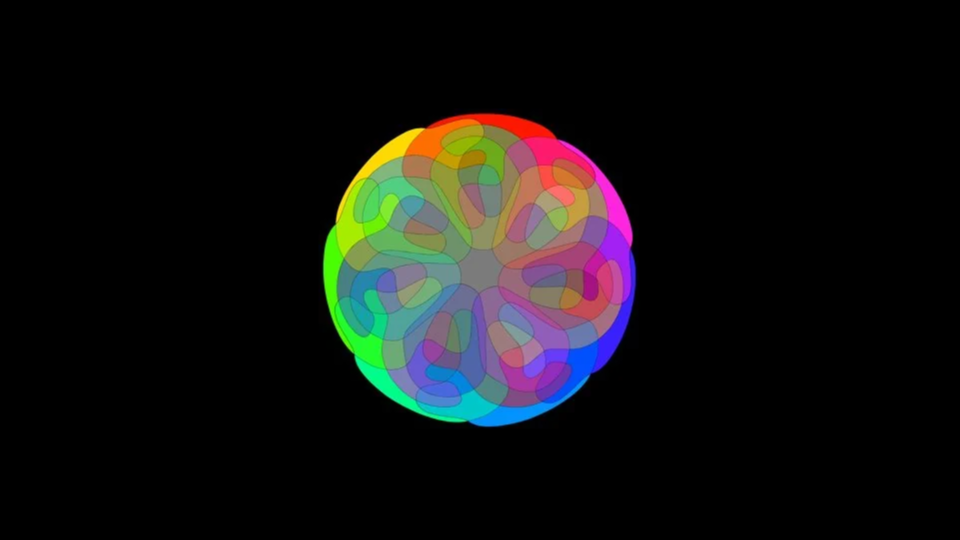
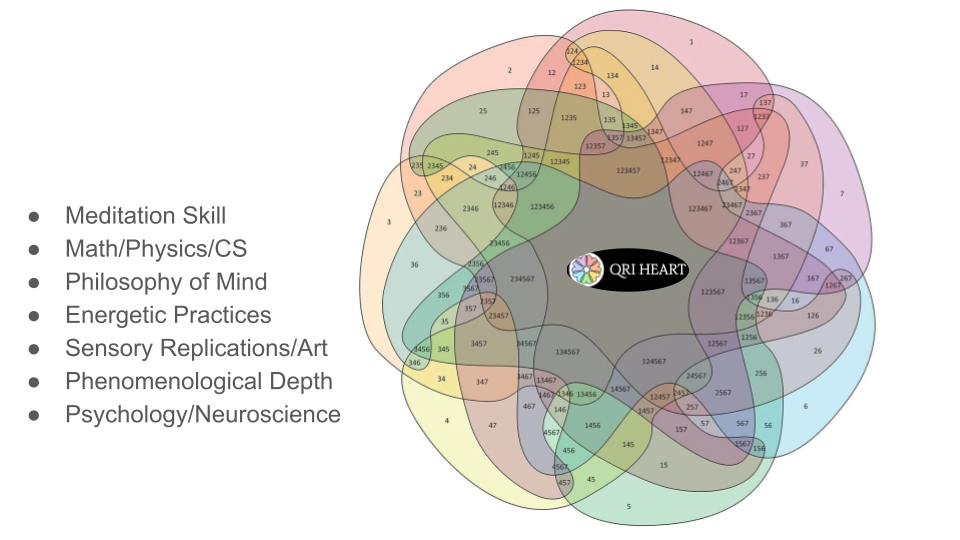
Is this just a pretty picture? I, myself, find it quite aesthetic! But the reason I put it up is that it is an elegant way of drawing a Venn diagram for seven different sets, drawn in such a way that every possible intersection of those sets is present on the screen (a fun aside: for any number of sets, it’s always possible to draw a Venn diagram where each combination of sets has a region to their own, can you come up with the proof?). Aesthetically I love the seven-fold symmetry of this particular rendition, and I originally found it surprising that a single shape rotated seven times could account for all of the subsets. But I digress. The reason I show it in these talks is because it schematically evokes what I think an interdisciplinary team might look like at its best.
In my (admittedly limited!) experience, whenever I have been part of an interdisciplinary team, or watched one from nearby, what usually happens is that people spend most of their time teaching each other the basics. You bring in a physicist, an anthropologist, maybe an expert in art, and they end up covering the basics of calculus or the basics of history, because there is not much meaningful overlap between them to begin with. You can still put on the stamp of “an interdisciplinary team looked at it” and produce a report, but the synergy isn’t always there.
The juicy part of interdisciplinary research is the synergy of advanced ideas from each field, combined in a non-trivial way and intelligible to enough of the team that they can simmer and provide the foundation for further development. For this to happen there has to be substantial overlap in the knowledge of the participants; the more people who have significant knowledge of at least two fields, the better. You need connective tissue. Psychedelic and meditation research often suffers from non-overlapping expertise. There are anthropologists looking at psychedelics, mathematicians who have looked at the network topology of the visual cortex, neuroscientists inspired by models from physics, cognitive scientists interested in art, and artists who are really good at depicting these states. But the density is not sufficient, and just as in contagion networks, network density brings a phase transition. In this case, the ignition of genuine synergy.
Ever since I started blogging about psychedelics in 2014 I have been gathering interesting people. Not your random Terence McKenna loving, Timothy Leary quoting type of psychonaut who considers Alan Watts and Ram Dass the pinnacle of psychedelic philosophy. Ok, this came out mean, not my intention. But you get the idea! The community I have helped co-create includes somebody with a PhD in math from MIT, somebody who studies material science and has explored ketamine and LSD together many times, very advanced meditators who recognize that the attentional dynamics during cycles of insight clearly have mathematical properties even if they cannot yet name them precisely, and a programmer who took a lot of physics courses in college and has spent dozens of careful hours analyzing psilocybin wave dynamics. And so on.
As I said in the quote above, in 2019 we raised a flag (activated the Batsignal?): hey, hold on a second, I am really interested in the mathematics of these states of consciousness and in formalizing them with a technical team of like-minded individuals. Since then I have gathered contacts and cultivated relationships with a collective of people who are both very technical and very curious about the phenomenon. In assembling QRI’s HEART retreats I have been careful about which points of synergy to look for, and tried to make sure there would be genuine surface area for interaction and useful co-working.
The disciplines I emphasise:
- Meditation skills. Advanced meditators train a lot on describing their phenomenology carefully, so they are a category I am always on the lookout for.
- Math, physics, computer science.
- Philosophy of mind, ideally epistemologically optimistic. I actually think we can make progress in philosophy of mind, and we are doing philosophy with a deadline, because we now have a lot more data and can actually build the arguments.
- Energetic practices. People who do a lot of yoga, breath work and tantric practice systematically and achieve remarkable results, that is, people who play with the energy parameter of experience using powerful techniques.
- Artists who specialize in phenomenological replications, especially psychedelic replications.
- Demonstrated phenomenological depth. People who have collected a very wide range of experiences, including extreme pain and extreme pleasure, insight cycles, and many cultures inhabited.
- Psychology and neuroscience, especially computational neuroscience.
Symmetric Vision, who won this contest, is the prototypical participant on the art side, with credentials you need to see for yourself: sort r/replications by best of all time. Of the top 25 replications of all time, 7 come from Symmetric Vision (who also goes by the artist name StingrayZ), such as I Can See Through That Coffee and Embedded Geometry Experienced On Psychedelics. The comment sections are worth reading on their own: “this is the most accurate yet keep up the good work”, “Holy shit, this is it”, “Bruh you have something special”, “you’re unmatched”, “Literally coming down from this and can confirm, super super good rep”.
These replications are done manually, and if you ask him how, he will say “I just play with the tools until it looks right”, which is of course a bit too modest; he has tutorials available online (e.g. this one from 9 years ago). I have seen him work and he is a wizard at this: a typical replication has around 70 layers of effects, many interacting with and tuning one another, which is how he achieves the subtle multimodal correlations that make his psilocybin-induced audio-visual synesthesia replication convincing. At HEART we are privileged to be able to recruit from this exact population; other great examples are Bear From Void and Scry. Interestingly, I always end up meeting people in this category either at some festival or in my inbox.
The same “I know it when I see it” effect applies to text as well as images. Some people write trip reports that many psychonauts read and think “yes, that’s right”, or “I could never have put it that way”. Independent inter-rater agreement applies to advanced meditators too, where you can see it in the fact that someone is sought out as a teacher by communities that have every incentive to be discerning about who they learn from. It helps when someone holds formal recognition from monastic institutions to teach, and above all if they can talk the language of modern science and engage with QRI’s ideas and arguments.
If you want novel insights that truly hit at the phenomenon you are studying, you have much better chances if you get the conditions just right. In the same way that making a particular mineral requires the pressure and the temperature and the materials to be just right for that special emergent effect, interdisciplinary teams also benefit from ideal conditions. It is not a matter of staying in touch by email, talking over coffee and writing a paper together. If you are studying exotic phenomena for which current instruments fail, what you need is to develop new instruments grounded in fresh and careful observation. This is why spending weeks together in an experientially and technologically enriched think tank, with access to the phenomena and with the motivation to figure out how they work at a computational, algorithmic and implementation level rather than staying at the narrative level, will beat the slow and methodically misinformed route.
The people we want involved are already investing a lot of their mental energy in making sense of consciousness, which is something you cannot pay anyone unmotivated to do. You can’t pay somebody to figure out consciousness; it is too large and unusual a problem. It has to come from within. People in this category think about the binding problem in the shower, or about the mathematics of pleasure and pain, or try to depict their latest sleep paralysis using software. They are independently curious, which means something like ninety percent of their brain is put to the task. They are not motivated by social reward. They want to get it right.
Field lines before equations
What is the scientific, epistemic or philosophical benefit of this study? The simple answer is that the hypothesis space is very large, and that gathering structural clues about the nature of the phenomenality we are studying is both very valuable and largely undone.
I like a metaphor to explain the epistemological situation of modern psychedelic research. Imagine trying to discover electromagnetism using exclusively brief experimental sessions and questionnaires. You take people from the general population who are typically not experienced with electricity or magnets, you put them in a room with strange objects they have never seen (an electromagnet, a Faraday cage, a capacitor), you give them half an hour to play with these exotic instruments, and then you ask them to fill out a questionnaire while doing biometrics on them. Ok, the biometrics are overextending the analogy, but you see what I mean.
You are probably not going to get Maxwell’s equations out of this. You would get publications with titles like “Use of a capacitor associated with a sense of latent energy”, “Faraday-cage exposure reduces perceived connectedness with the surrounding environment”, and “Factor analysis identifies three dimensions of magnet experience: attraction, repulsion, and mysterious agency”.
A more promising approach is to gather a powerful bunch of curious physicists, mathematicians, visual artists and engineers, let them play with the raw materials as much as they want, and give them whiteboards and software and AI so they can draw diagrams, propose and test models, and develop theories about what is going on. It is possible in principle to arrive at equations without first drawing the field lines, but it sure helps to know which patterns your equations need to explain. Demanding the detailed equations governing visual waves on 5-MeO-DMT before supporting exploratory work is like asking Faraday to supply Maxwell’s equations before he has gathered enough hints to even point at them. Careful documentation and checks on repeatability still matter, of course. But detailed equations usually come downstream of learning what the phenomena look like when you have investigated them long enough to build a body of experiments, observations and drawings.
Possible unusual participant correlations
Selecting participants who are outliers along several dimensions at once distorts correlation statistics inside the selected group. Think about how Stanford selects for academic achievement and for athletic achievement: within Stanford, learning that somebody is a serious athlete should lower your estimate of their academic ability, even though the two likely correlate positively in the general population. We are likely to encounter Berkson’s paradox in our sample. With selection on attainment, on technical ability, and on descriptive skill all at once, personal attributes that seem negatively correlated within the group may just be an artifact of the selection process.
This is likely to affect some of our results. Zooming out, though, it affects correlations much more than it affects centred score averages, so rankings and ratings are comparatively safe. The much bigger problem remains the size of the jhāna arm: 14 people in a ten-day retreat cannot generalize much, especially given the variable range of jhānas they accessed. But we work with what we have, and as far as the contest submissions go I feel good about it: people had no conflict of interest rating their entries, the scores use only ratings from participants who reported the state and were credited with it by at least one assessor, and most importantly, people were very recently acquainted with their experience.
References
Balas, B. J. (2006). Texture synthesis and perception: Using computational models to study texture representations in the human visual system. Vision Research, 46(3), 299–309. https://www.sciencedirect.com/science/article/pii/S0042698905002336
Brasington, L. (2015). Right concentration: A practical guide to the jhānas. Shambhala.
Bressloff, P. C., Cowan, J. D., Golubitsky, M., Thomas, P. J., & Wiener, M. C. (2001). Geometric visual hallucinations, Euclidean symmetry and the functional architecture of striate cortex. Philosophical Transactions of the Royal Society B, 356(1407), 299–330. https://royalsocietypublishing.org/doi/10.1098/rstb.2000.0769
Gómez-Emilsson, A. (2015, April 20). Psychophysics for psychedelic research: Textures. Qualia Computing. https://qualiacomputing.com/2015/04/20/psychophysics-for-psychedelic-research-textures/
Gómez-Emilsson, A. (2018, October 28). Psychedelic Turk: A platform for people on altered states of consciousness. Qualia Computing. https://qualiacomputing.com/2018/10/28/psychedelic-turk-a-platform-for-people-on-altered-states-of-consciousness/
Gómez-Emilsson, A. (2020, October 9). Modeling psychedelic tracers with QRI’s psychophysics toolkit: The Tracer Replication Tool. Qualia Computing. https://qualiacomputing.com/2020/10/09/modeling-psychedelic-tracers-with-qris-psychophysics-toolkit-the-tracer-replication-tool/
Gómez-Emilsson, A. (2021, March 6). Collecting qualia souvenirs. Qualia Computing. https://qualiacomputing.com/2021/03/06/collecting-qualia-souvenirs/
Gómez-Emilsson, A. (2025, September 13). Indra’s net via nonlinear optics: DMT phenomenology as evidence for beamsplitter holography and recursive harmonic compression. Qualia Research Institute. https://qri.org/blog/indras-net-nonlinear-optics
Hewitt, T., et al. (2026). Measuring the contents of hallucinations from psychedelics and stroboscopic light: The Six-Dimensional Visual Hallucination Questionnaire. Royal Society Open Science, 13(9). https://royalsocietypublishing.org/rsos/article/13/9/rsos260647/483177/Measuring-the-contents-of-hallucinations-from
Hewitt, T., et al. (2026). Mapping the geometry of stroboscopically induced hallucinations at scale [Preprint]. bioRxiv. https://www.biorxiv.org/content/10.64898/2026.02.18.705710v1
Meditation Research Program, Massachusetts General Hospital and Harvard Medical School. https://meditation.mgh.harvard.edu
Portilla, J., & Simoncelli, E. P. (2000). A parametric texture model based on joint statistics of complex wavelet coefficients. International Journal of Computer Vision, 40(1), 49–70.
Qualia Research Institute. (2023). Replication contest. https://qri.org/blog/replication-contest
Qualia Research Institute. (2023). Psychedelic cryptography contest. https://qri.org/blog/psycrypto-contest
Qualia Research Institute. (2024). From neural activity to field topology: How coupling kernels shape consciousness. https://qri.org/blog/coupling-kernels-consciousness
Qualia Research Institute. (2025). The Oscilleditor. https://qri.org/oscilleditor/
Qualia Research Institute. Guide to writing rigorous reports of exotic states of consciousness. https://qri.org/blog/rigorous-reports
Qualia Research Institute. Psychophysics toolkit: Tracer Replication Tool. https://psychophysics.qri.org
Qualia Research Institute. (2026). The 2026 QRI Jhāna Visualization Contest. https://qri.org/blog/jhana-contest
Sacchet, M. D., et al. (2024). Intensive whole-brain 7T MRI case study of volitional control of brain activity in deep absorptive meditation states. NeuroImage. https://pubmed.ncbi.nlm.nih.gov/39681243/
Sacchet, M. D., et al. (2025). Advanced meditative absorption reorganizes functional connectivity gradients. Cerebral Cortex. https://pubmed.ncbi.nlm.nih.gov/40215476/
Suzuki, K. (2026). A classifier × generator × discriminator framework for hallucinatory phenomenology. Frontiers in Psychology. https://www.frontiersin.org/journals/psychology/articles/10.3389/fpsyg.2026.1819038/full
Suzuki, K., Roseboom, W., Schwartzman, D. J., & Seth, A. K. (2017). A deep-dream virtual reality platform for studying altered perceptual phenomenology. Scientific Reports, 7, 15982. https://www.nature.com/articles/s41598-017-16316-2
Visual hallucinations of different aetiology: A computational perspective. (2023). Frontiers in Human Neuroscience. https://www.frontiersin.org/journals/human-neuroscience/articles/10.3389/fnhum.2023.1159821/full
Volpato, M., Gómez-Emilsson, A., Kuntz, E., & Martinez Quintero, D. (2023). Visualizing tactile sensations. Qualia Research Institute. https://qri.org/blog/visualizing-tactile-sensations
Citation
For attribution, please cite this work as:
APA
Gómez-Emilsson (2026, September 11). Can you draw a jhāna? Results of the 2026 QRI Jhāna Visualization Contest. https://heart.qri.org/retreats/2026-tepoz/andres-gomez-emilsson/jhana-visualization-contest.html
BibTeX
@misc{gomezemilsson2026contest,
  author = {Gómez-Emilsson, Andrés},
  title = {Can you draw a jhāna? Results of the 2026 QRI Jhāna Visualization Contest},
  url = {https://heart.qri.org/retreats/2026-tepoz/andres-gomez-emilsson/jhana-visualization-contest.html},
  year = {2026}
}