Written by Andrés Gómez Emilsson on 1 October 2026.
This post is a contribution to the third Qualia Research Institute psychophysics retreat, which took place from May to June 2026 in Tepoztlán, Mexico.
Table of contents
- Three retreats
- Why jhanas and 5-MeO-DMT
- Why this matters for reducing suffering
- Set and setting
- The chronology
- An AI-native Study
- Research instruments
- The 5-MeO-DMT week
- Psychophysics and visual illusions on 5-MeO
- Contributions from the participants to this first tranche of artifacts
- Attention moves as probes
- Organizational lessons
- Huge Thanks
- Avataṃsaka and Buddhapop
An informal overview of eight weeks of jhana and 5-MeO-DMT research, for public consumption.
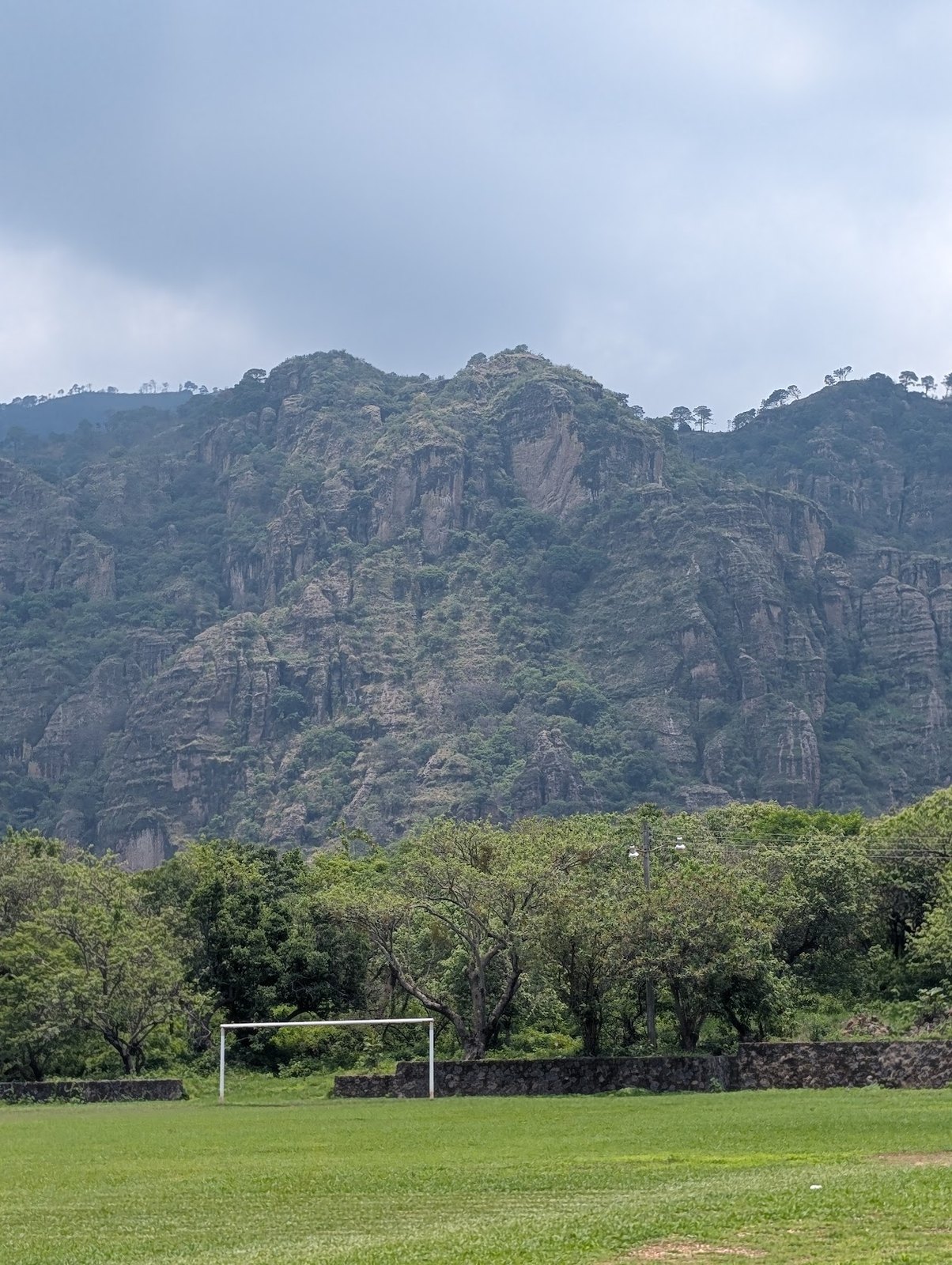
This is the third research retreat where QRI organizes a group of people to stay together for an extended period of time in order to investigate specific states of consciousness with a variety of techniques.
Three retreats
In the first retreat, in Brazil, we studied psilocybin mushrooms and ayahuasca. The most fascinating technique there was what I would call the museum of consciousness approach. We created hundreds of experiments and visuals in advance, partly intuition guided and partly experientially guided (as in, “these look amazing at a festival”, or “people say you should look at this on mushrooms”). A lot of it was theoretically motivated, and a great deal of it was really about exploring state-spaces.
Thanks to Andrés Silva and others we had a bunch of tools that could sample things such as different spatial frequency bands in the visual field, or temporal flickers, or quasi-crystals. So we could fine tune the parameters in huge state spaces. The guide we gave people for what to report when looking at an image was “anything unusual, anything that looks particularly different than normal”, and when somebody did not quite get the idea, the pointer that worked was “how is the image fucky?” We focused on finding what is weird and unusual and worth reporting.
The philosophy was that casting a wide net will result in better results than going with one specific hypothesis and testing it with three well-controlled experiments. We wanted to find the needles in the haystack, and we found a lot of them. Among them: the structure of the composition of different gestalts at different dosages, and images that you can perceive better on psilocybin than sober (for example, very subtle fractal movement). That narrowed down to some extent where to look next, and we came out with high quality replications of these inputs as well as a lot of theoretical development.
Relatively soon after, in 2023, we did the Canada retreat. Also three weeks long, now with twelve researchers as opposed to eight (people would come and go, though there was usually a group that stayed the entire time). Here we studied 5-MeO-DMT. We had a facilitator, but also a lot of flexibility, and we started with extremely low dosages. You can see my presentation or read about it in the previous posts.
A lot of theoretical ideas emerged from that retreat. The coupling kernel as a principle of canonical computation, for instance, and the interaction between the dimensionalities of different systems, like a fractal vascular system and a two-dimensional skin system with different oscillators and volumetric 3D oscillators all interacting with each other came out of digesting the observations made in this retreat. Same for the way vector fields are relevant to model haptic sensations, and the way the visual and tactile fields couple to each other. From there we started to develop a body of evidence by showing stimuli generated with specific dynamic systems we associated to different states to psychonauts and asking them “what does this remind you of?” and “from zero to ten, how DMT-like is this?” So by the time the Tepoztlán 2026 retreat came about, we had a body of interesting hypotheses and stimuli that had worked really well in the past, while continuing to develop core theoretical QRI goals. Namely, identifying hints for the substrate of consciousness (nonlinear optics), and identifying 5-MeO-DMT as something whose effect is partly to induce a global coherence that entrains the entire field.
The latest retreat was much more ambitious. It was eight weeks scheduled, and the schedule was produced in collaboration with Wystan, our main meditation coach, who spent the entire time with us. The goal here was again to throw everything at the wall and see what sticks, this time focused on 5-MeO-DMT and the jhanas. The aim was to experience the formless jhanas, and more so to marinate in jhanas and get as acquainted with them as possible.
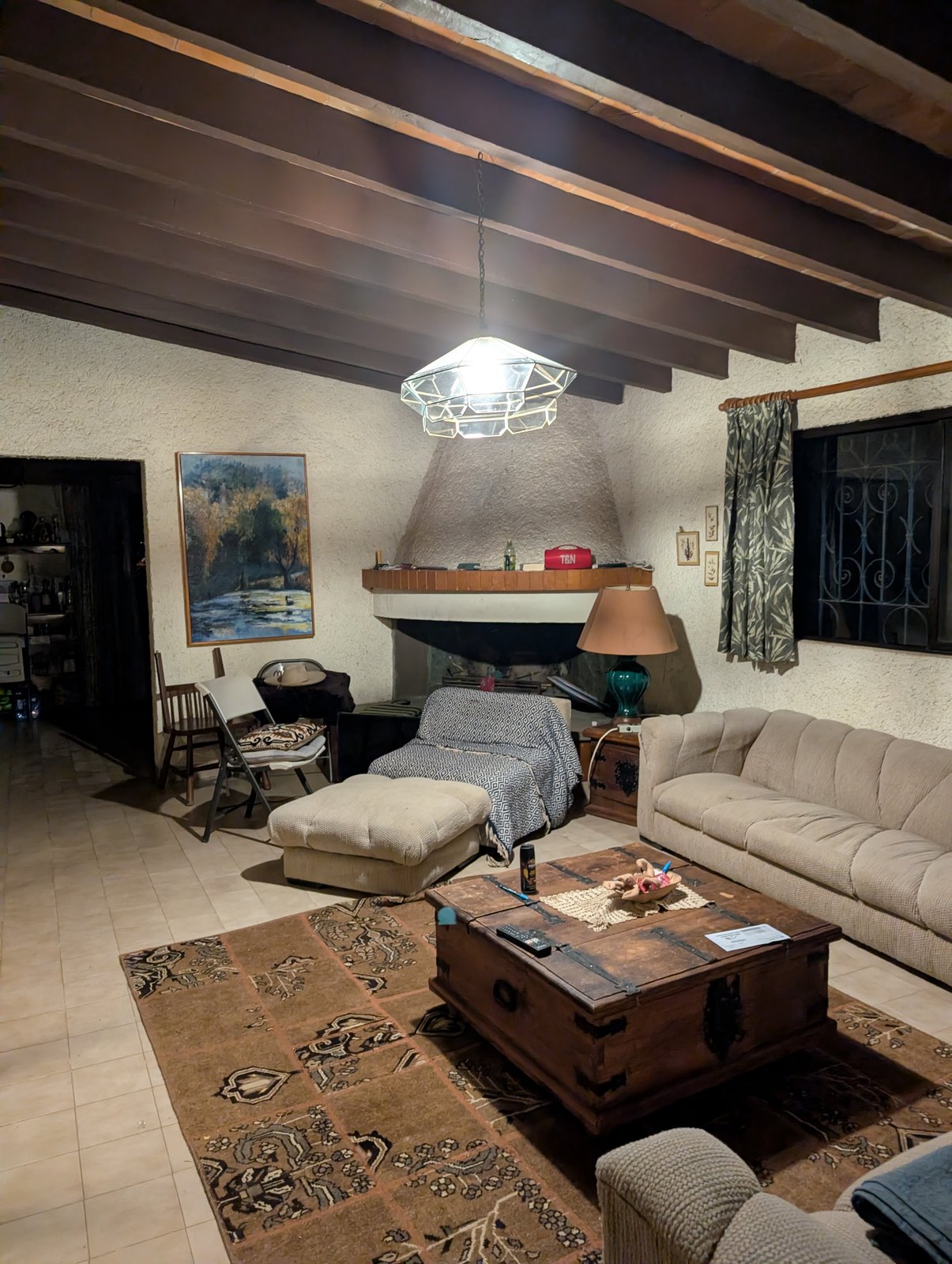
Living room of the central house we stayed at in Tepoztlán (picture taken after everyone had left).
Why jhanas and 5-MeO-DMT
There exist surveys, and there are neuroimaging datasets, that characterize jhanas and to some extent 5-MeO-DMT, and there is fascinating research there. But the phenomenality of these states has not yet been fully characterized.
The choice of these two states was very carefully made. For a long time at QRI (2018 and probably earlier) I have identified 5-MeO-DMT and the jhanas as extremely promising research avenues for consciousness research: they’re relevant to probe phenomenal binding, valence, and for gathering hints about the physical properties of the substrate of consciousness. As in physics, you often gain a lot of information from looking at pure materials, and the relationship between valence and information content is one we’ve been observing since the beginning of QRI (Michael Johnson’s Symmetry Theory of Valence being a key generator of hypothesis spaces we explore). Both Jhanas and 5-MeO-DMT are often described as very pure, with rather homogeneous content, and likewise, surprisingly to those who think pleasure is inherently related to complexity, also load high in the valence dimension.
The relationship between these two state-spaces has also come up again and again in various contexts, with practitioners and psychonauts bringing it up spontaneously in conversation. Advanced meditators I’ve talked to who happen to have tried 5-MeO-DMT often describe what they experienced in jhanic terms. For example, they might say, “in my first high dose 5-MeO-DMT experience I climbed up through the jhanas, and then I got to the sixth, then the fifth, then the sixth, and then climbed down the ladder and stayed in the second jhana.” But there hasn’t been a specific study looking at this relationship, nor do I think contemporary mainstream science really has a way to do so in a satisfying way.
So we thought this was probably the best bet we had to make a substantial research contribution in a short amount of time. Namely, we wanted to create research tools that would measure what is interesting about these state-spaces and then compare them meaningfully in a multifaceted way: what is unique, what is similar, and what is different? What is the Venn diagram of effects? Can we come up with any quantitative assessment, or with scales that help us make sense of the relationship between these types of experiences?
Among the selection of people, we had academic researchers who have worked on psychometric questionnaire development, visual artists, advanced meditators, very experienced psychonauts, people who have organized other retreats, and long time collaborators at QRI. We also had people who are perhaps more into logic and mathematics, but who are very conversant with all the topics we talk about. Above all, people who have really digested and considered QRI frameworks, so that there could be a legibility to each other’s work and approaches. We were interested in creating, forgive the corporate speak, synergy.
Overall I was extremely satisfied with how the retreat went, and I think that it made me grow both as a researcher, an organizer, and as a participant.
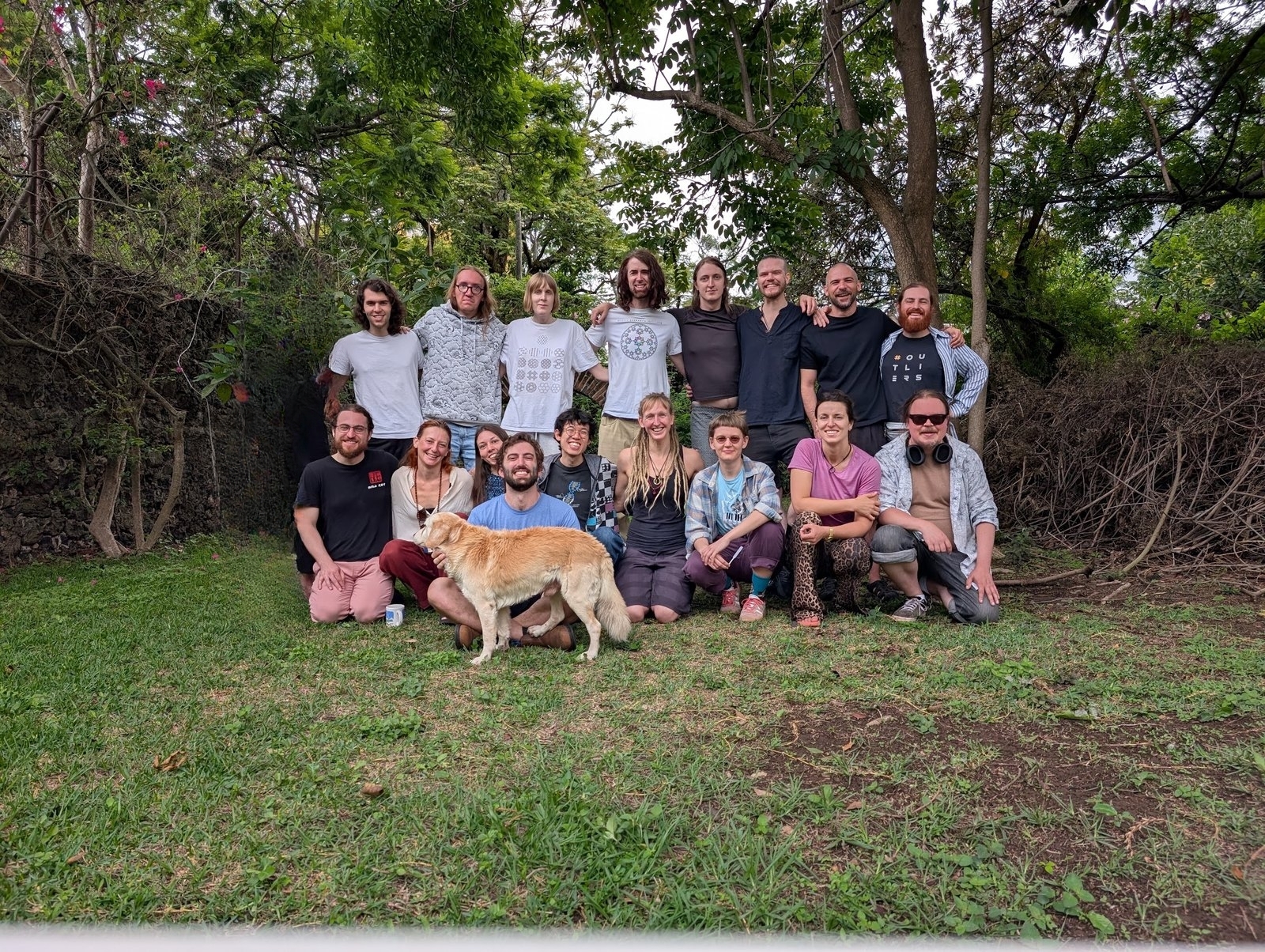
Picture of participants taken between the jhana retreat and the 5-MeO-DMT week. (Napoleón, the dog, didn’t partake in the 5-MeO-DMT week, but did partake as an erratic and self-directed participant in the Jhana meditation sessions during the retreat. Gracias Napo!)
Why this matters for reducing suffering
The most direct way this research connects to reducing suffering is through valence. Jhanas and 5-MeO-DMT include some of the highest-valence states a human being can reach, and much of the retreat design went into making those states as pure as we could, so that their structure would be easy to see. Cube Flipper’s write-ups on the form and formless jhanas document that structure from the inside, including its symmetries. If the Symmetry Theory of Valence points in the right direction, then understanding these states should also tell us something about their opposites: which kinds of symmetry breaking show up as discomfort, tension and pain.
I wrote about why ethics has to engage with the actual phenomenology of value in Just Look At The Thing! How The Science of Consciousness Informs Ethics. The argument there is that our theories of value carry assumptions about consciousness that we can check by looking, and this retreat was an attempt to do some of that looking with better instruments. For why the best and worst experiences may differ by orders of magnitude, and why that should change our priorities, see Logarithmic Scales of Pleasure and Pain.
The application I care most about is medical. When you go to the doctor with chronic pain, you describe it with words like “crushing”, “stabbing” or “burning”. People use those words consistently over time, but nobody knows whether your “burning” is the same as someone else’s, and the doctor cannot see it. We want to supplement that step with a world-simulation tool: animations that couple visual and tactile fields, and eventually other modalities, built from the paradigms that worked best at the retreat, such as Kuramoto oscillators, sinusoidal gratings and Hilbert-curve layouts. A patient would tune the simulation until it matches what they feel, and the resulting parameters would be their description. Our earlier work on visualizing tactile sensations and coupling kernels is the starting point for this.
For this to be practical, the tool has to find a match quickly. We have developed methods for searching the parameter space of these models efficiently, so that a person arrives at a replication of their experience in as few steps as possible. These will be described in the second tranche of write-ups.
If this works, several things follow. We could look for subtypes within conditions such as migraine and fibromyalgia by treating them as oscillatory disorders, each with its own signature in the simulation. That could shorten diagnosis, which matters: in a survey of 800 fibromyalgia patients in eight countries, it took an average of 2.3 years and visits to 3.7 different physicians to get a diagnosis, after people had already waited almost a year before seeing a doctor at all (Choy et al., 2010). We could also track valence over time at a much finer grain than a 0 to 10 scale, and in medicine, once you can track something, you can start to change it. And because these descriptions could be shared and compared, we could crowdsource which interventions help with which kinds of pain, including pains that are currently considered intractable.
Set and setting
The setting was Tepoztlán, in Mexico, about 90 minutes from Mexico City. For the most part we arranged cars or taxis for people from the airport.
I made it a point to take care of people’s safety. For example, I was very diligent about making sure that people would not get stung by scorpions (see writeup on the topic). We realized that even though the probability that someone would die if they got stung by a scorpion was extremely small, it would still make sense to make sure it didn’t happen. A sting of the scorpions present in that location can be very painful, and it can cause something like a panic reaction. I thought it was very important that we had the tools to avoid being stung, especially during the jhana retreat and the 5-MeO-DMT section. Clearly you do not want to disturb those states, since you want to get a clean measure. And you want participants to remember the retreat as something they enjoyed. Not merely remembering it as “I contributed to research”, but “this was personally meaningful.”
I also emphasized many times that participation was completely voluntary, and that at any point anybody could quit any of the activities, whether that meant not meditating on a given day or not taking 5-MeO-DMT at all.
We rented a number of Airbnbs, and some of us stayed at a house that used to belong to my grandparents. I am pretty familiar with that place, which really helped when it came to orienting people about the details of the environment. The setting was sometimes raw, but in a cool way: very intense thunderstorms and lightning, and the electricity going out every now and then. We moved between locations by walking, by car, by taxi or by bicycle (some people fixed up bicycles we had there and used them to get around).
The locations themselves were pretty great for the most part, though each room came with trade-offs, so we made a gigantic list of the pros and cons of every one of them. Some rooms were more noisy at night, or a little bit hotter, or had different grades of privacy, or access to a private bathroom versus a shared one. Putting all of that on the table meant that people could make their own trade-offs. If you are very sensitive to noise but you do not care about scorpions, you can take more scorpions in exchange for a more peaceful soundscape. People would also switch rooms if they did not like their room, and we got extra housing at some point too.
The COVID and flu protocol
I especially did not want people to get COVID or the flu during the jhana retreat or the 5-MeO week. So for about a month we had what you could call strict, and what I would call conscientious and diligent and probably fairly reasonable, filters against COVID.
I requested that everybody wear masks when they went to the store. When somebody new would arrive there would be a quarantine period, where they would wear a mask and test 24 hours apart (sometimes more like 16 hours) with rapid tests. It is all probabilistic, and my calculations were heuristic, but the point is to reduce probability without being excessively burdensome. So the protocol ended up being that people would come in with a mask, we would have them test, we could only talk to them outdoors with both people masked for that period, and they would sleep in their own room with the windows open and a fan pushing air outside, so that air would still circulate.
There was one person who tested with a very faint line for flu A, and that was the only person we ended up quarantining for multiple days. That was a little bit sad, because they were scheduled to participate in the full 5-MeO-DMT section, and ended up participating in two days only (one of the low to medium doses and a high dose). They had a great time in the end. Still, this is a cost that is important to factor in. If you attend one of these retreats you have to know that there is some risk that even if you were feeling perfectly fine while traveling you might still test positive once you arrive. The protocol requires that you continue to isolate in a nice place (a nice place! with nature and food!), but a little bit separated from the group until you have tested negative twice on separate days. I do not enjoy playing the role of gatekeeper, but it is important.
Towards the end I got feedback from people who have attended many residential meditation retreats that this was the retreat where the fewest people they had seen got sick. Effectively nobody got sick, and nobody even had a cold until the very last few days, and that person stayed apart while they had symptoms. This is the sort of thing where you do not notice all of the things that go right, all of the things that are playing under the hood for things to work smoothly. You notice the things that do not go well. And on that front I am very happy to say there was really no major problem at all in this retreat. Nobody got stung, nobody got sick, nobody had a trip they regretted, and nobody felt at the end that they regretted coming.
Food
Meals were provided by QRI during the weekdays, breakfast and dinner, healthy vegan and vegetarian (always with vegan options, and most participants vegetarian), and in agreement with people’s individual dietary restrictions. There was also food available that people could cook themselves later in the day.
During the jhana meditation portion we organized ourselves so that we could cook for each other in silence (or largely in silence), with a prearranged menu. That was a very nice ritual for me. A way to be embodied, to not look at screens, and to really be there in connection with the space and the vibe of others.
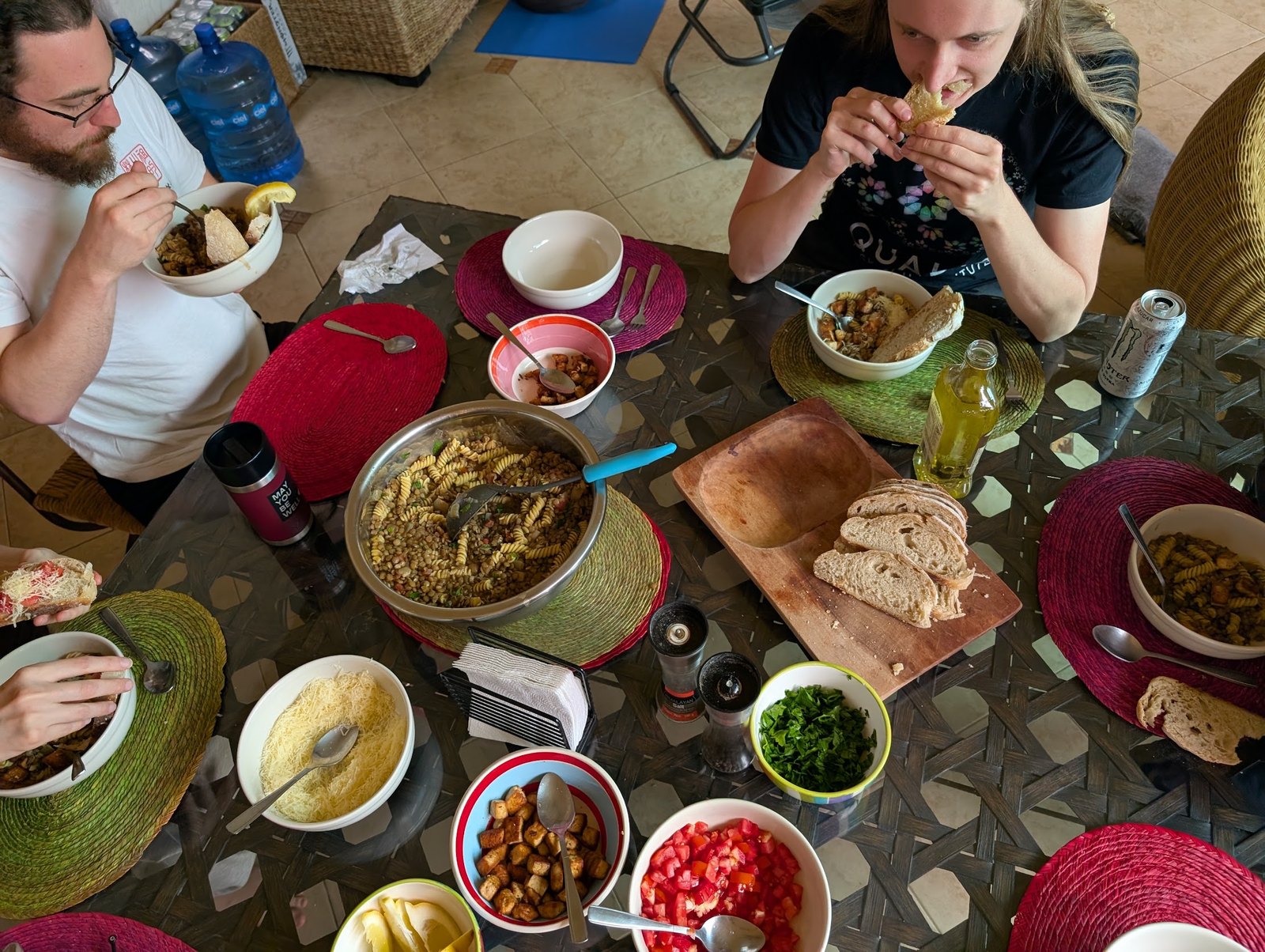
Wystan and Eliade eating home cooked food prepared by participants during the jhana retreat.
The chronology
Weeks 1 to 3 were focused on aligning with the rhythms of nature (very hippy in some sense), building research instruments, and meditating. The schedule was crafted together with Wystan, the main meditation coach, who strongly suggested that people meditate about two hours a day in preparation for the jhana retreat, because from experience that produces much deeper states of absorption. There is a momentum to meditation. So the schedule involved two 45 minute blocks of silent meditation, a half hour block of guided meditation, and a half hour block of exercise (strongly recommended) every day. We also had a daily activity called Skillshare in the late afternoon, where for an hour somebody would present something they are passionate about, or a skill they might want to share. For example, I presented on methods for extracting the most use for our purposes out of large language models, which you can read about on my Substack (part I, II).
We then had 10 days of jhana practice, aspirationally aiming at the formless jhanas, but about jhanas more broadly.
We then had about five days where we focused on gathering data and on creating jhana replications, including a little competition we ran between participants, and debriefing discussions about what these experiences were like. This is also when we did the microphenomenology assessments.
This was followed by the 7 days of 5-MeO-DMT exploration.
And then a week of filling out the questionnaires and research instruments, plus more vibe codes and continued theoretical development.
The final week was a bit more oriented towards exploring broad paradigms for how to hook various computational pieces together to generate the effects we documented, and then distill them into systems for which we could generate parameterized dynamic phenomenology (PDP) for future iterations.
An AI-native Study
At a high level, and not to sound a little bit buzzwordy, this was an AI-native research project. With all of our skills and all of our intelligence we could have done so much anyway. But with the power of AI, again, not to sound cheeky, we really took it to the next level.
Many of the skillshares were about software engineering and the use of AI for our purposes. For example, some of those who do software engineering for a living like Taru, Emil, Cube presented about how to best utilize Github, use mathematical software, and how to best use agents for sophisticated software projects. Hunter Meyer, Taru, and Sasha created the pipeline for onboarding people to GitHub and then to Claude Code (Hunter specifically suggested we call our shared repository Repozitlan). We even got Claude Max subscriptions for people who did not have one, for the period of the retreat and a little bit beyond, so they could participate in a very active way. We all contributed to the same repository over the entire research retreat. We broadcasted the general encouragement that if there is something you can mock up and show others very quickly by vibe coding it, please go ahead and do it.
There was never a pretense that if you vibe code an evocative replication, the precise math involved in that simulation is exactly what you are experiencing. But we do think it is suggestive. It is a hint, and a way into how to then distill the mechanics and identify a more general or more specific model that can generate those states in an elegant way that could then be connected to neuroscience or biophysics.
I also encouraged people to use things like the coupling kernel framework, since systems of oscillators can simulate so many things, and I gave workshops on how to think of dynamics in these terms: how to add levers that control the properties of the oscillators, notably the coupling constant for different distances in the graph of oscillators, so that you can instantiate specific global dynamics in a bottom-up way.
This research approach is incredibly rich. You can get chaotic dynamics by linking two lattices in an asymmetric way, where one lattice is trying to couple positively to the other and the other is trying to couple negatively, so that you have a self-organizing principle where one is chasing the other and the other is trying to differentiate. You can also create systems of oscillators of different dimensionalities, like a 2D lattice interacting with a line interacting with a single oscillator. Or you can lift an oscillator and reproject it onto itself, coupling it to its own projection to itself, and then modulate that coupling constant.
A lot of vibe coded animations would very quickly generate compelling dynamics. And it is less about the specifics of any one vibe code than about the speed of iteration, which really took off. It acquired a certain kind of group escape velocity.
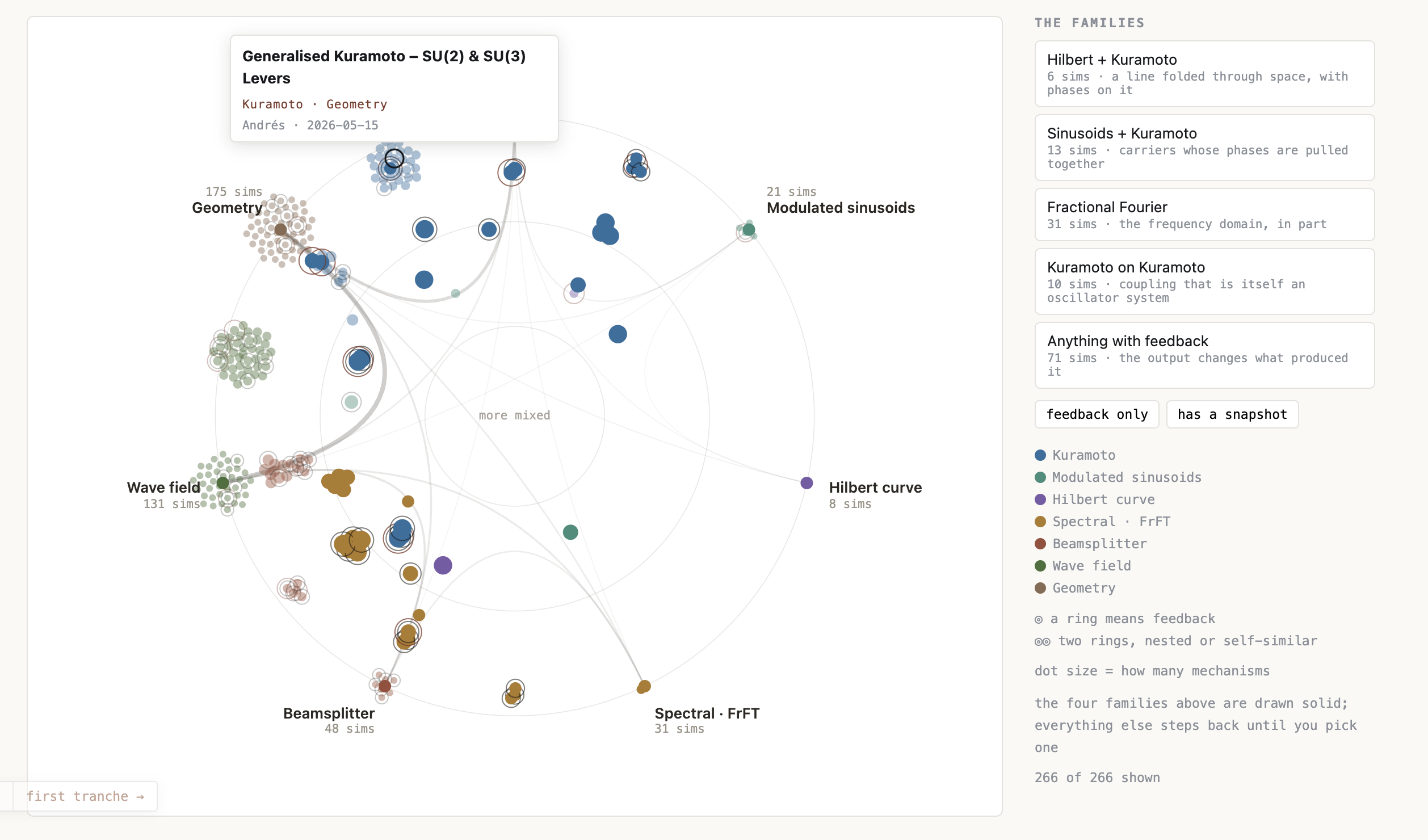
All of the simulations coded at this retreat and those derived from paradigms explored at this retreat. Will be available in future tranches of this research output.
The vase breathing day
As part of the AI-native push to empower the team to collaborate on building software replications of phenomenology, we did exercises that were generally very liked by participants. For example, the exercise we describe below was described as a highlight by many of the participants.
One day we were taught a meditation technique called Vase Breathing, which causes interesting lightheaded breathwork effects that are psychedelic-adjacent, and it does so very quickly. Thus we could all practice and notice interesting effects right away. The assignment that day was: the first two hour block of work everybody would try to vibe code or animate what they experienced. For the next two hours we showed each other’s work and did constructive criticism on it.
Based on what each participant did best, we then clustered participants into three groups. One focused on the specific dynamics and the mathematics of those dynamics. One focused on the timeline, meaning how the progression develops and what the stages of the experience are. And one focused on making the interface really work and be resonant with what we experienced. In the final two hours we presented each cluster’s work as groups, and some of us continued working on unifying these different frameworks.
This was one day of work, and I would not claim that the final simulation, which is admittedly a Frankenstein mashup of the collaboration of the three groups (and therefore of everybody), is especially accurate. What I claim is that this type of exercise generates momentum and a kind of group intelligence that I find incredibly valuable. One is mixing the best of a meditation retreat with the best of a phenomenology workshop, and software engineering practices and pipelines optimized for quick AI-enabled iteration (again, sorry for the buzzwords). One of the things this very much produces is that people become able to identify each other’s strengths very quickly; there is a collective intelligence that emerges with these exercises for how to collaborate most effectively.
Scaling up this approach, imagining even having a permanent basis for the Qualia Research Institute where we do these sorts of exercises as a team on a daily basis, it is pretty evident that we can take any particular strange phenomenology, let us say even migraines, and very quickly arrive at state-spaces that very likely capture the essence of these experiences. I think hundreds of peculiar failure modes of the human nervous system can be characterized in a matter of months, generating an atlas of medical disorders and strange satellite meditation states and different types of synesthesia. Visualizing what autism feels like, what schizophrenia feels like, what hyperphantasia feels like, what being an empath feels like, what stream entry feels like. The experience of this retreat makes me optimistic that we can power through these with the right resources and support.
Research instruments
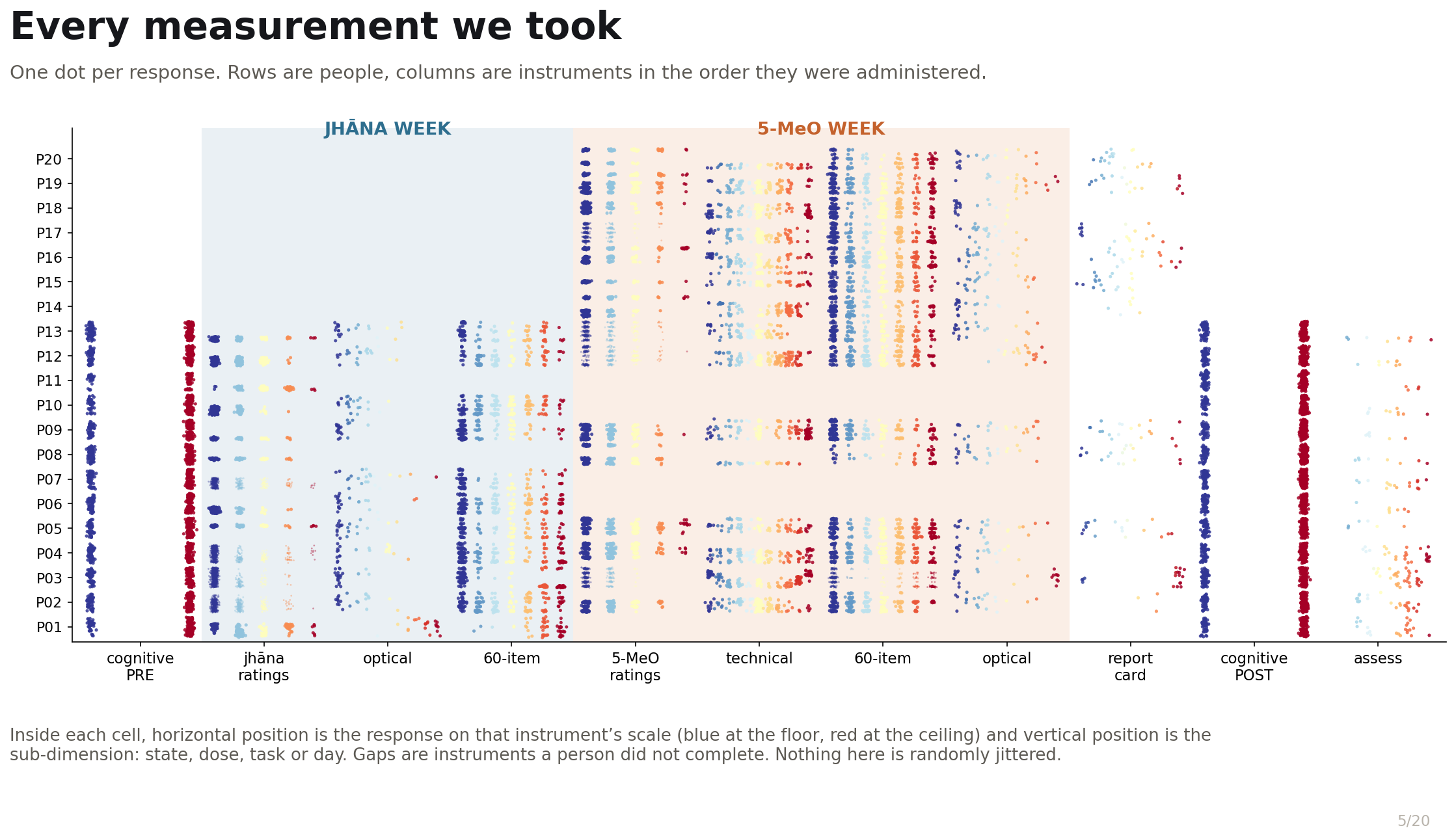
The instruments we prepared for the jhana retreat and the 5-MeO week were a big collaborative enterprise, with almost everybody building or co-building something.
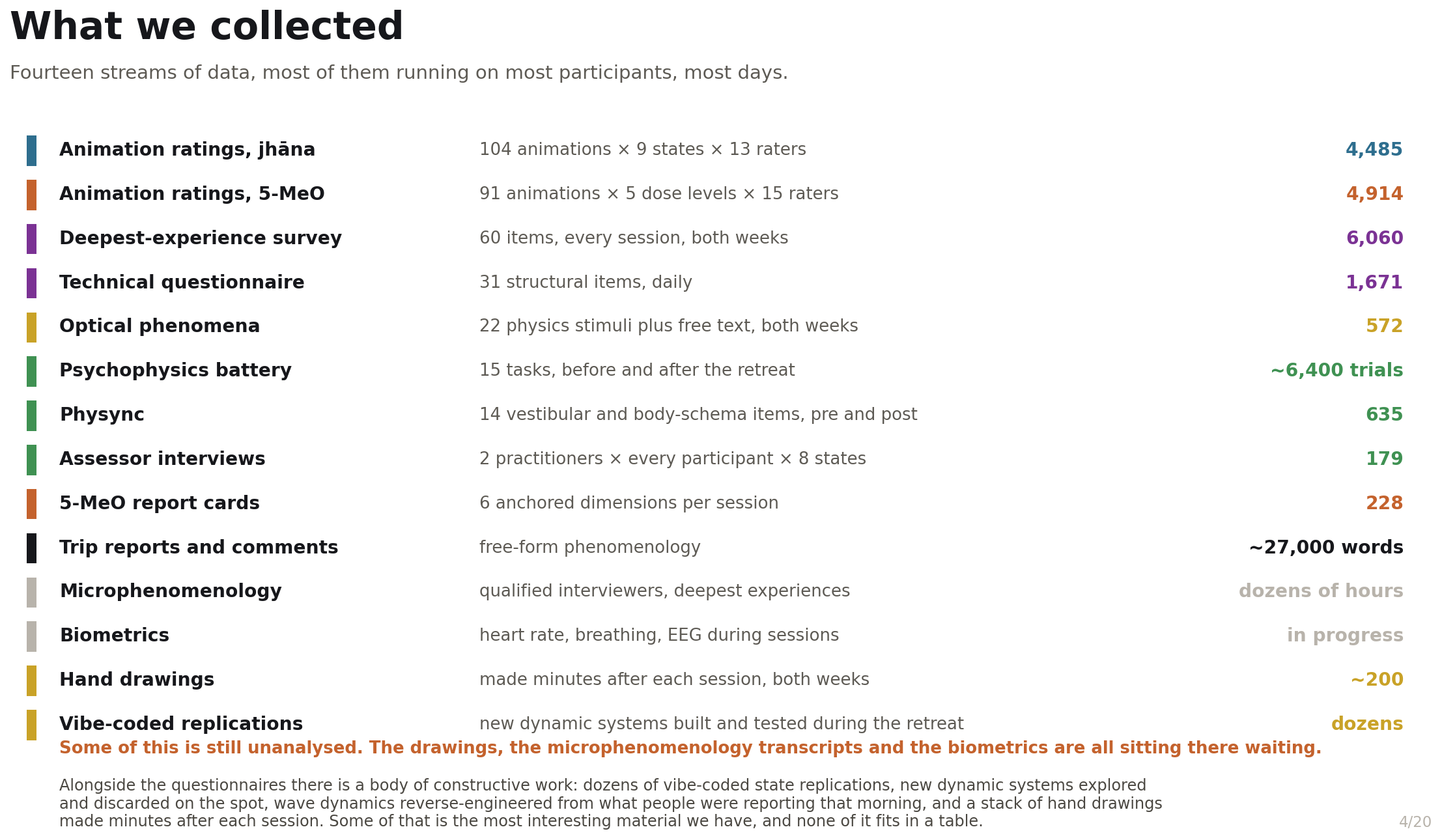
- The Research Pipeline itself was crafted by Emil and Aatu, who worked under significant time constraints to code the front end and back end of the survey instruments and did QA to ensure the data would be accurate and not be lost.
- A 60 question questionnaire that Wystan and James and I collaborated on, with the aim of being able to ping different levels of 5-MeO-DMT and different jhanas.
- A more technical and specifically structurally oriented questionnaire, from Ethan and Cube Flipper.
- A psychophysics pipeline that Ethan, Sasha, and I collaborated on. We came up with a wide range of tasks to perform that might tell us something interesting about these states, and he did the selection (and most of the tasks) for the psychophysics tests to apply to people right before and right after the jhana retreat. I added to the psychophysics side the selection of visual illusions and animations to look at on 5-MeO-DMT, as well as took care of most of the on-site logistics for data collection. Sasha helped with software engineering and QA for the pipeline for the 5-MeO-DMT week.
- A wide sampling of dynamics from Eliade and Taru, who took tools we had already produced at QRI (see: Oscillator and Tactile Visualizer), modified them, and used them to sample a much wider dynamic range, with an emphasis on topological defects in systems of oscillators: the way in which they form and cancel out, how they braid and unbraid, how they knot and unknot. This was a fairly wide net. Taru, for example, coded a wide range of physical processes, we didn’t only use the vanilla Kuramoto coupled oscillator, but also things that emulate precise physical media, which may have really interesting nonlinear dynamics. I also drew a lot of animations from previous studies we have done at QRI to enrich that dataset, such as the ones I presented last year at Frontier Tower about differentiating substances in terms of a coupling kernel applied to oscillators of different geometries.
- Non-Linear Optics Images curated by Cube Flipper were used in the pipeline.
- The gravitational phenomenology scale (GPS), from Beata and Hannah, which tries to characterize different states in terms of the subjective feeling of changes in gravity. It was actually quite successful at identifying properties of some of the jhanas.
- A study of synchronization in biorhythms, which Hannah and Beata ran during the jhana period, looking at breathing and heartbeat coherence within and between participants. They also used clickers for the study: for the 45 minutes in the day we had our biorhythms measured while meditating, we would click whenever we felt a significant transition, to see if there was the possibility that people’s clickers were correlated with each other.
- EEG, collected and organized by Sasha: both during the jhana retreat and the 5-MeO-DMT week. He collected data of participants deep in meditation, and then during the 5-MeO-DMT week from the one participant who was not too bothered by the headset while tripping, and who could be reasonably still during the state (thanks Wystan!).
- Daily surveys, both during the jhana week and during the 5-MeO week. In the jhana week you would say at the end of the day how much you meditated and with what technique, describe your most intense experience, and share whether you thought you experienced a jhana. In the 5-MeO week we also had people record audio privately right after a session, describing how it went, so we would have that as source material, and then fill out their daily surveys (same technical questionnaire used during the jhana week).
- Microphenomenology, from qualified practitioners: James on site (who was also a participant) and Jack Poole, online. For the jhana week and for a good number of the 5-MeO sessions, we were asked during the microphenomenology sessions to focus on our deepest experience, and then there would be a 45 minute to one hour session focused on just a short slice of time. The interview would prompt participants to relive the deepest moments, putting yourself in the frame where you experienced them, and then identifying pointers to the possible dynamic mechanisms involved. The goal here was to create a storyboard, which we could then transform into coded prototypes and then distill into what I call parameterized dynamic phenomenology (PDP). Once you have identified a dynamic that can be put in code and in math, and that generates dynamics that look like what you have experienced, you can fine tune those parameters. And likewise you can generate animations that explore the parameter ranges and ask participants to rate them, so that you can iterate on them.
- Drawings. Right after the microphenomenology interviews for the jhana week, participants would take their recording of the interview and then make drawings of their experiences focused on the core dynamics identified. Similarly, after each 5-MeO-DMT session, participants were first encouraged to record a brief trip report, and then draw their experience. We accumulated a lot of drawings, and some people got really into the activity. Some of them are, I think, very insightful, especially when it comes to the types of waves and dynamics that people experienced.
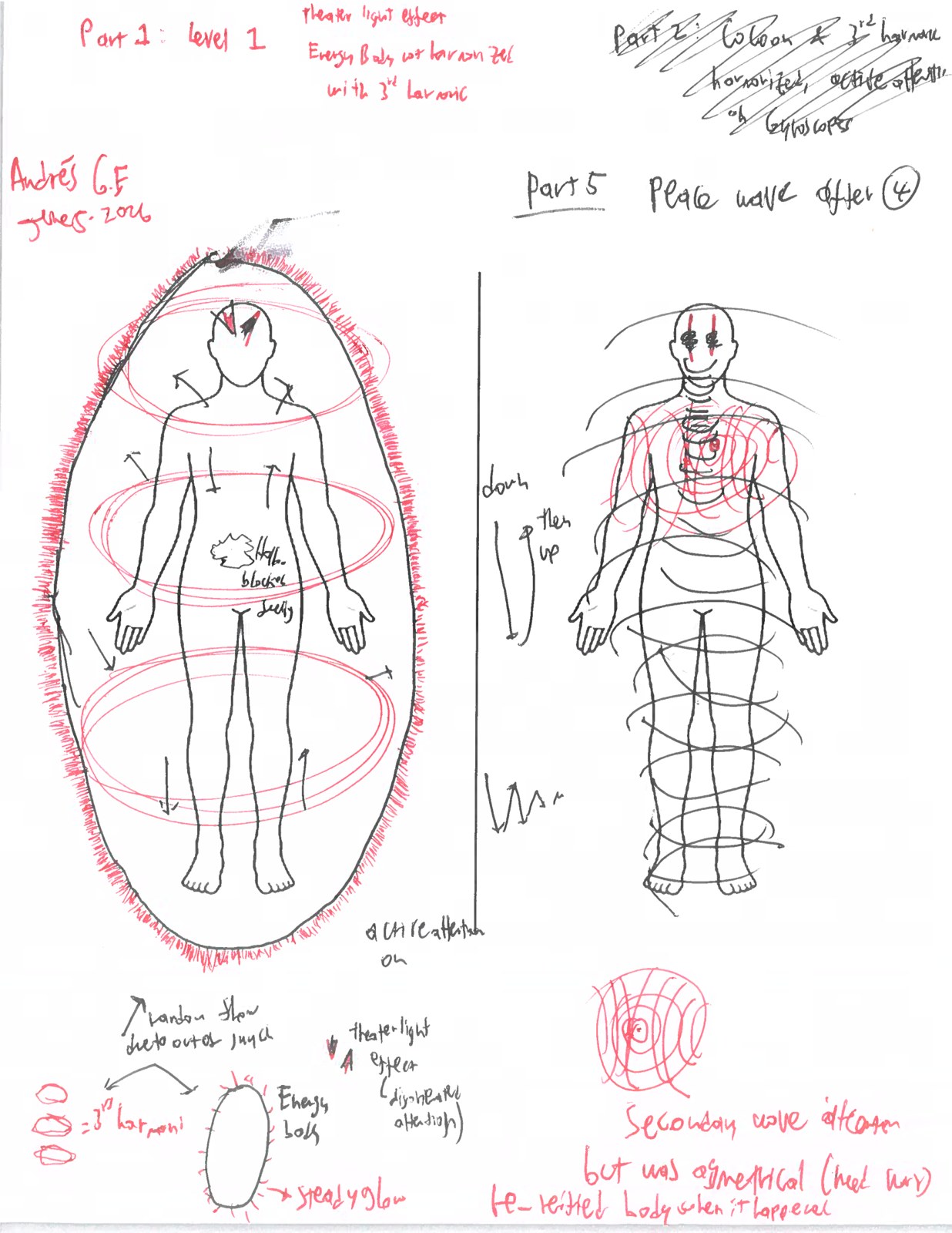
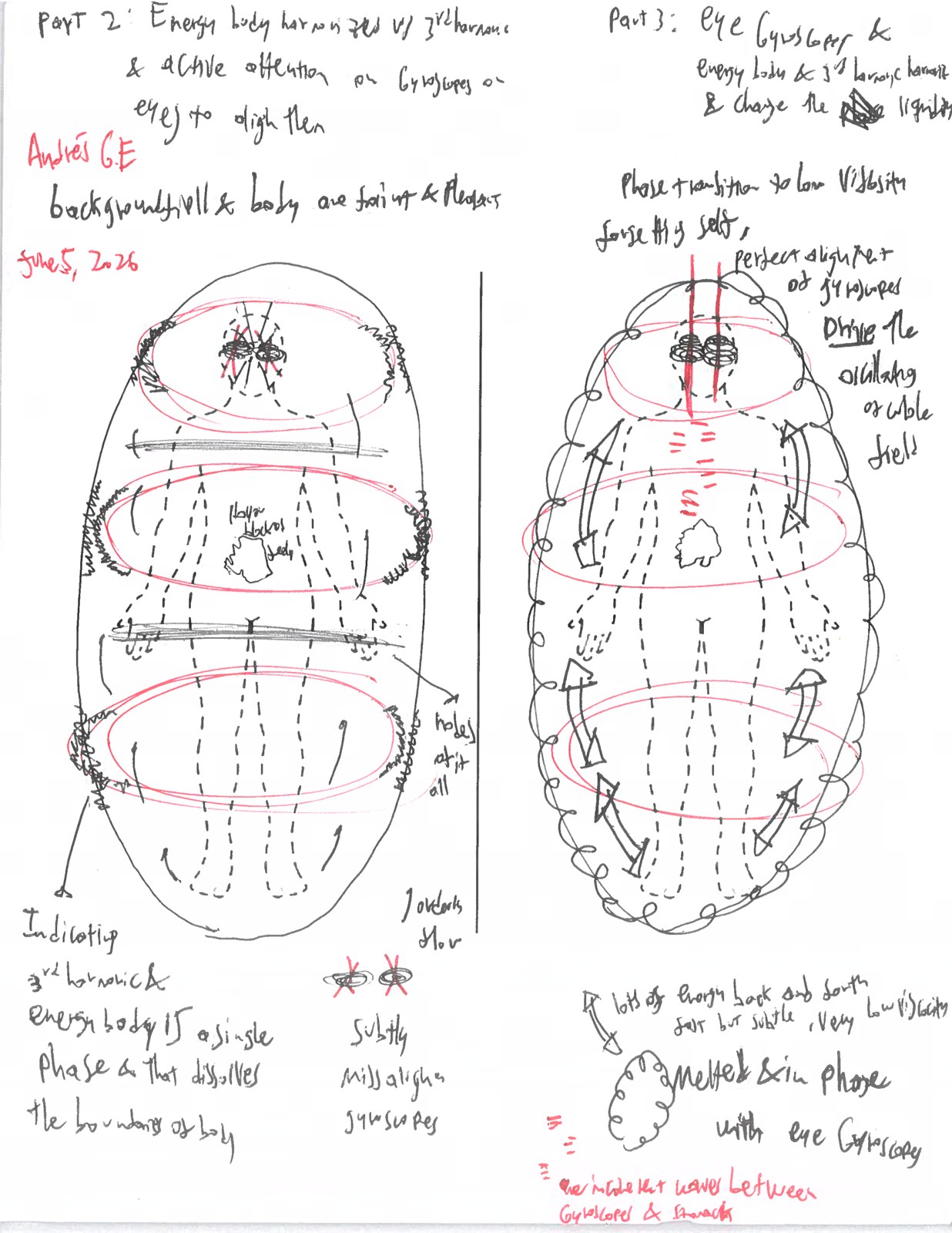
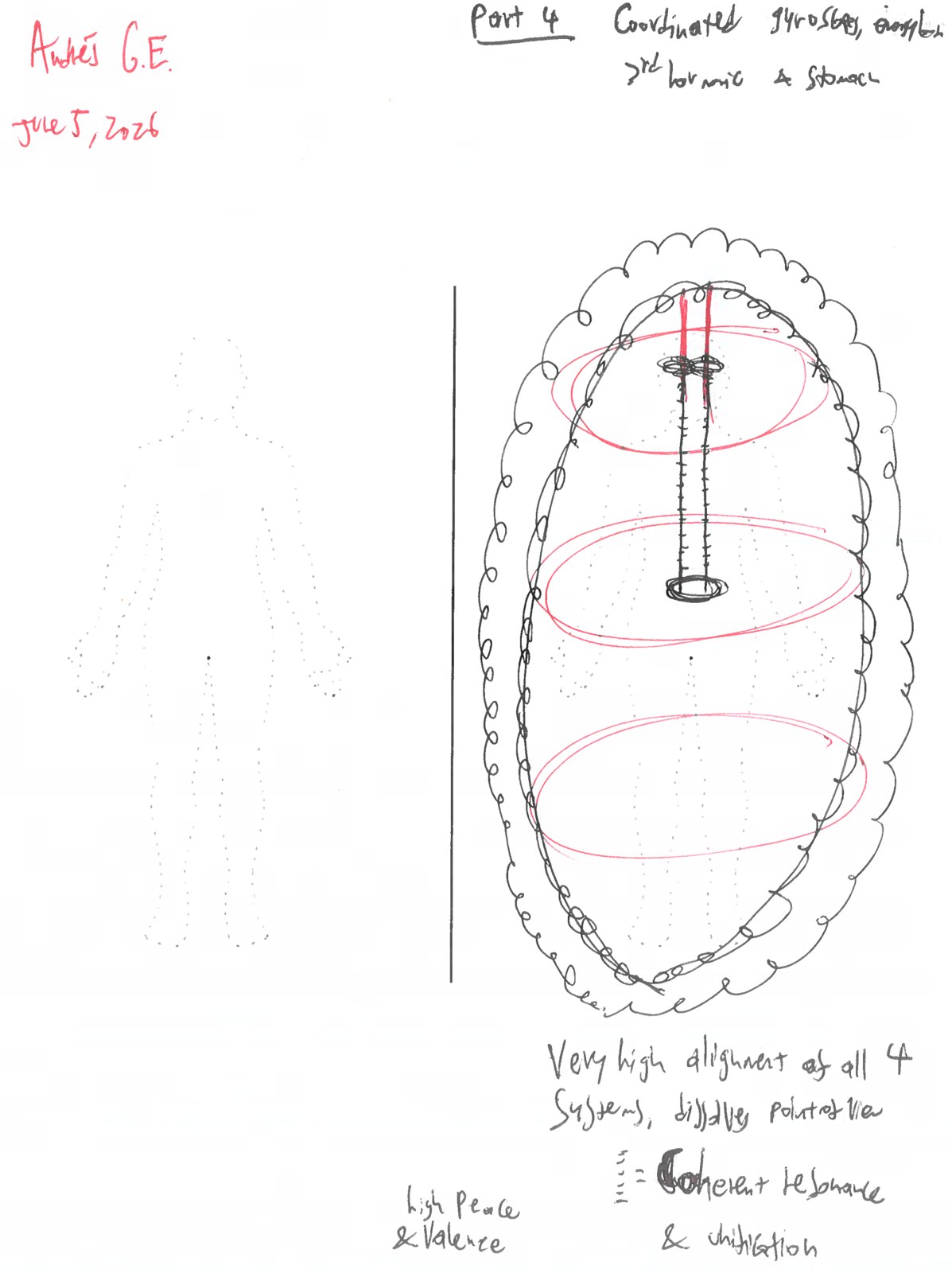
My drawings of the storyboard of meditative absorption based on my microphenomenology interview.
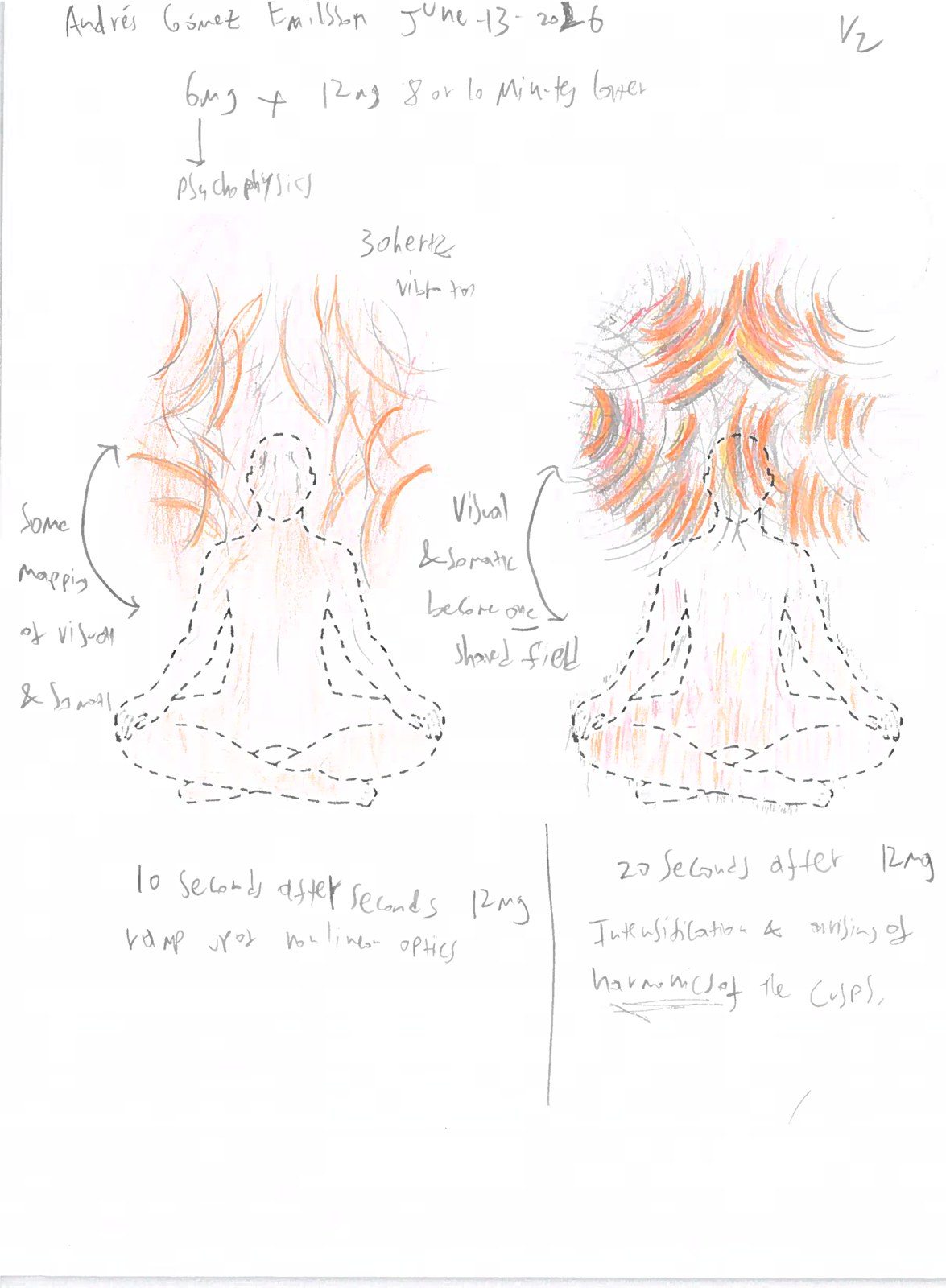
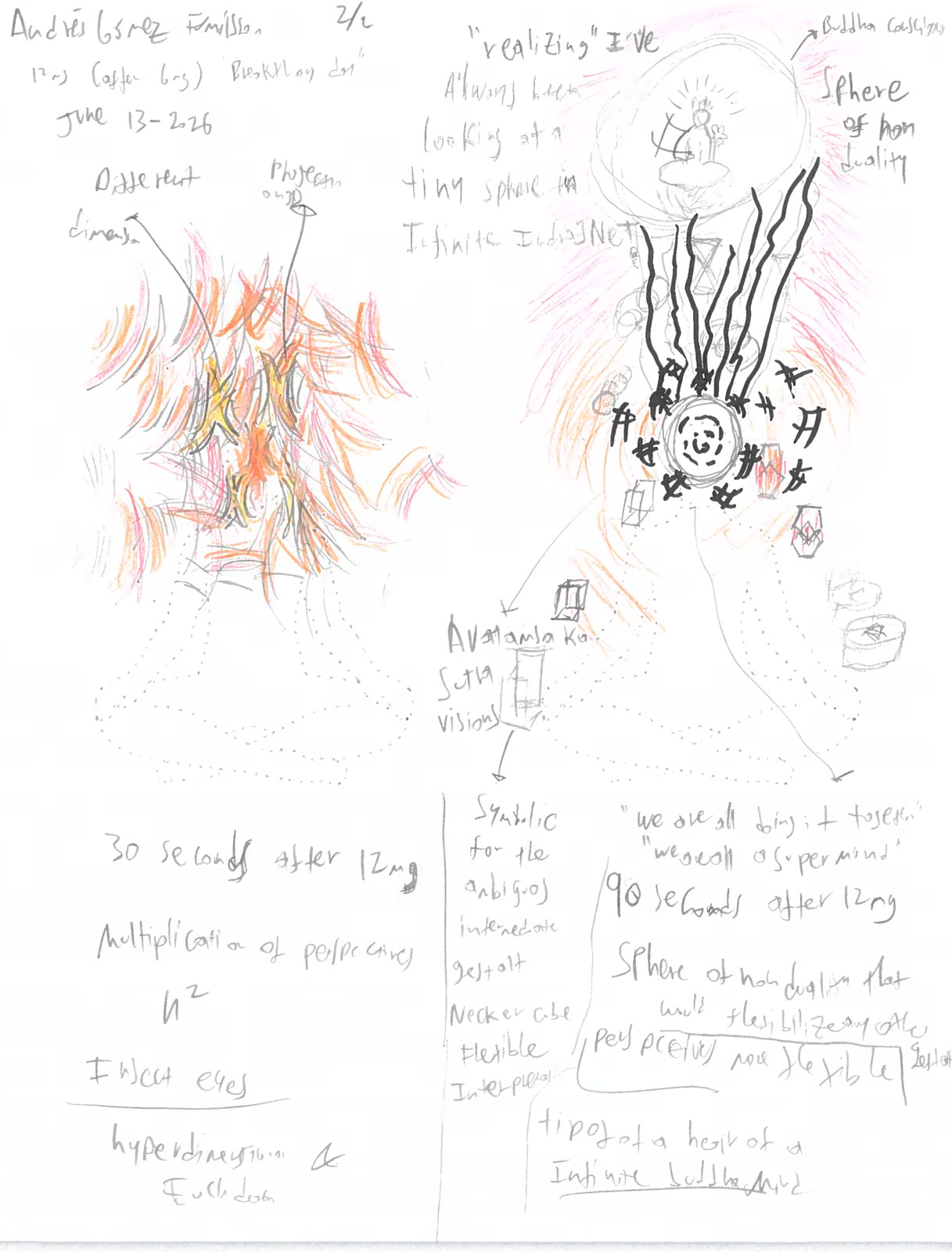
My drawings of my high-dose 5-MeO-DMT session (6 mg, then 12 mg about ten minutes later), at 10, 20, 30 and 90 seconds after the second dose.
We also had a lot of people tuning in from various places to give us advice. John Gorman talked about using 5-MeO-DMT for psychedelic meditation, which is essentially about experiencing rigpa, the quality of knowing of awareness independently of what you are aware of (I would note, though, that we had that call after the 5-MeO week, so it’s not a technique we specifically used during the study). Justin von Bujdoss talked about darkness retreat phenomenology. And Leigh Brasington, who wrote Right Concentration and runs a lot of jhana retreats, had a 2-hour Q&A with the team before our jhana retreat. He actually influenced a bit some of the PDP stimuli presented in the study, as he pointed out that in his experience very clean jhanas actually feel bilaterally symmetrical. So, for example, in our pipeline of animations to rate, we included versions of the animations that are bilaterally symmetrical and versions that are not.
Where the pipeline came from
Building all of this in a few weeks was a real technical challenge. What made it possible was that we had done a smaller version of it before. For the first empirical investigation of coupling kernels, we crowdsourced data with an online survey for psychonauts. It asked people to rate 90 animations, and 168 people took part, giving about 7,000 ratings in all. It was long and somewhat tedious, so many stopped partway, but 54 rated all 90, helped along by the offer of a QRI t-shirt for the first hundred people to finish. That pilot was the template for the retreat’s pipeline.
The survey data was consistent with the picture we had proposed. DMT looks like a Mexican-hat kernel applied to a wide variety of systems at once, producing competing clusters of coherence. 5-MeO-DMT looks more like a Gaussian kernel, where everything wants to connect with everything else in its neighborhood, perhaps together with a small-world network that links the whole system.
As far as I can find, only two studies come close to comparing meditation with 5-MeO-DMT. Timmermann et al. (2025) followed a single Mahāmudrā lama through nondual meditation and two doses of 5-MeO-DMT, and found that the lower dose overlapped with his meditation in both phenomenology and EEG, while the higher dose went somewhere else. Woollacott et al. (2024) found that fire kasina retreatants scored about as high on a mystical experience questionnaire as participants in an earlier 5-MeO-DMT study. Neither looked at specific jhānas, and equal questionnaire totals cannot tell you whether two states share a structure. What I find funny is that both studies were in the room with us: James Sanders, a co-author of the first, ran our microphenomenology interviews and helped design our 60-item questionnaire, and Niffe Hermansson, one of the fire kasina retreatants in the second, took part in our 5-MeO-DMT week.
This also answers a fair worry, that we had no registered predictions. We did state these predictions publicly before the retreat, in QRI Research Revealed in November 2025. They are pitched at a high level of abstraction. They concern the self-organizing principle that governs changes across the whole system, and say little about which particular pattern a given person will see.
This connects with recent work on visual context, and may be in an interesting tension with it. Aqil and colleagues (2025) found that psilocybin strengthens the Ebbinghaus illusion, and modeled the effect with divisive normalization, where each response is scaled by the pooled activity around it. For 5-MeO-DMT, Sasha and the other participants who noticed a change reported the opposite: the illusion got weaker. A naive reading of a Gaussian kernel would predict more contextual influence, not less. Either the kernel acts on the normalization pool in a less obvious way, or the global coherence of 5-MeO-DMT cancels local context through some other route. Working out which is one of the open questions I am most curious about.
It is important to say that with all of these research instruments, the goal was not exactly to nail down the differences and characteristics of these states as much as to probe what kinds of analysis are possible and viable in this kind of research environment. We wanted a high-level general picture, and especially a general picture of what research methods are agreeable with this kind of research and realistic to complete. It was a way of testing what analyses are even possible to perform. I aim to be very clear about this in the more technical writeups coming down the pipeline: the specific effects we found that are statistically well supported are really interesting, but the bigger value is to look at the big picture and notice the gestalt the dataset as a whole points to.
Very importantly, one of the other things we did was that I pre-selected two advanced meditators to interview participants after the Jhana retreat so they could independently give their own subjective opinion of whether the participant experienced the jhanas that they believe they experienced. We used these judgements as a gate for which of the PDP jhana ratings would count for the analysis.
The 5-MeO-DMT week
5-MeO-DMT is unscheduled in Mexico. Participants had these experiences as follows: everybody was screened thoroughly to participate in the 5-MeO section by Tandava Retreats, not only for possible medical reasons and contraindicated prescription medicines, but also for psychological state. Everybody touched base with the facilitators, who would only administer where the conditions were right.
These are very experienced facilitators with a very good track record. I know the 5-MeO-DMT community to some extent, and I have a very high bar for what I consider a good facilitator in that space, so I am very happy to say that the job the people at Tandava did was really extraordinary. I felt really comfortable with the overall process. They took care of planning for any eventuality. And I don’t mean just having a medically trained nurse onsite, which was always the case. What I mean is they had planned for any eventuality, based on their extensive experience facilitating 5-MeO sessions, such as what happens if somebody gets naked during the session. Before any of the high dose sessions, they asked participants what they would prefer in case that were to happen: should the facilitators look away, should they put a blanket on you, or should they just let you be (which is also perfectly fine, but should be agreed in advance). As experienced facilitators they do not get freaked out by any of the very common reactions that tend to happen on high dose 5-MeO-DMT, like moaning or screaming or heavy breathing. That is common and expected, and it comes with the territory.
The 5-MeO caused reactivation in some participants, especially after the high doses, and part of the process there was having them follow through with psychological help from the facilitators in case that would happen.
Dosing
Sessions would typically last 45 minutes, sometimes a little longer, and you would have the opportunity to dose in terms of numbers of seconds, with pens that are calibrated at different strengths. So approximately, on the first day, the Monday of that week, people had access to a total of about 1.5 milligrams, which they could distribute across three different pulls of the pen. Thus you could pace yourself in a way that felt comfortable. Of course that created variability in the intensity of the response, but this is a price to pay for maximizing participant comfort that we were very happy to pay. The second day the dosing was up to 3 milligrams, then up to 6 in principle, and then up to about 12.
In general people reported the first three days as being milder than they expected. Then on the fourth day some of the groups got a pen that was apparently stronger, so some of them actually had very strong experiences on that Thursday. The method can definitely improve in terms of standardizing the pens a little better, but there really was no problem. Variability is to be expected.
Sessions happened in groups of three, with two people supporting one person, and between four and five of those groups in the room at a time. People were supporting each other and taking turns.
Then people would sign up for the high doses. For the most part people had the option of one high dose. A couple of people had the opportunity to do the high dose twice, especially those who had an intense willingness or curiosity to do so, and ideally also a research question that was generative enough that they could get precise information for their write-up out of that second experience.
The high dose experiences themselves were customizable. After being advised by the facilitators, and based on how you reacted to the previous ones, you would get options of taking 6, 9 or 12 milligrams, with the possibility of redosing after approximately 15 minutes. The typical high dose session involved taking 6 milligrams first, and then taking another dose 12 to 15 minutes later. Some people had just 6 milligrams and that was it, which was absolutely an option, just as there was the option to cancel right before. There was no pressure to really do any of these sessions. But most people had two doses during these high-dose sessions. There was also the option of getting it intramuscularly, if one wanted a smooth onset and offset to the effects.
Recordings
We had the option to record audio or video of our high-dose sessions. This was interesting because what you think you’re doing in that state is often different from what it looks like from the outside.
I personally am experienced with the state, and my reaction tends to be very peaceful, at least partly due to cultivating equanimity in the state, though maybe also because I just fall in that cluster. I mostly sit quietly and straight while under the influence.
During my high-dose session, subjectively I thought I was perfectly still, but looking at the recording it turns out I was actually wobbling a little bit for most of it. So what you think you are doing on 5-MeO and what you are actually doing might diverge. Incidentally, even though this was supposed to be a “breakthrough dose”, based on my own chart, it came out as a high dose rather than a breakthrough.
In the case of some of the people who had more intense outward expressions of their process, they would sometimes be surprised to hear the recording. What was subjectively a powerfully ecstatic cosmic orgasm can sound, on tape, like somebody who is overwhelmed. And that is perfectly fine. The container was one where all of these reactions were acceptable and supported without judgement.
Psychophysics and visual illusions on 5-MeO
There was also on-site psychophysics during the 5-MeO week, which is where the visual illusions and animations I selected came in. Ethan suggested, and then together we selected, some specific tasks: identifying simultaneity, and testing the Ebbinghaus illusion, which is about how much context is influencing your perception of size. For the few people who got to it (this was not a huge emphasis, at least in this case) there was also the checker shadow illusion, where we subtly varied the shades to see whether you can tell that two squares are the same or a different color in terms of the pixel value being emitted, and whether you can tune out the context in order to make that comparison.
We also had as an option the ability to look at a tesseract, or rather a four dimensional lattice rotating in two ways at once, as you can do in four dimensions, which I have reported as being very interactive with the state before. Some people had really interesting explorations that way, which definitely deserve their own post.
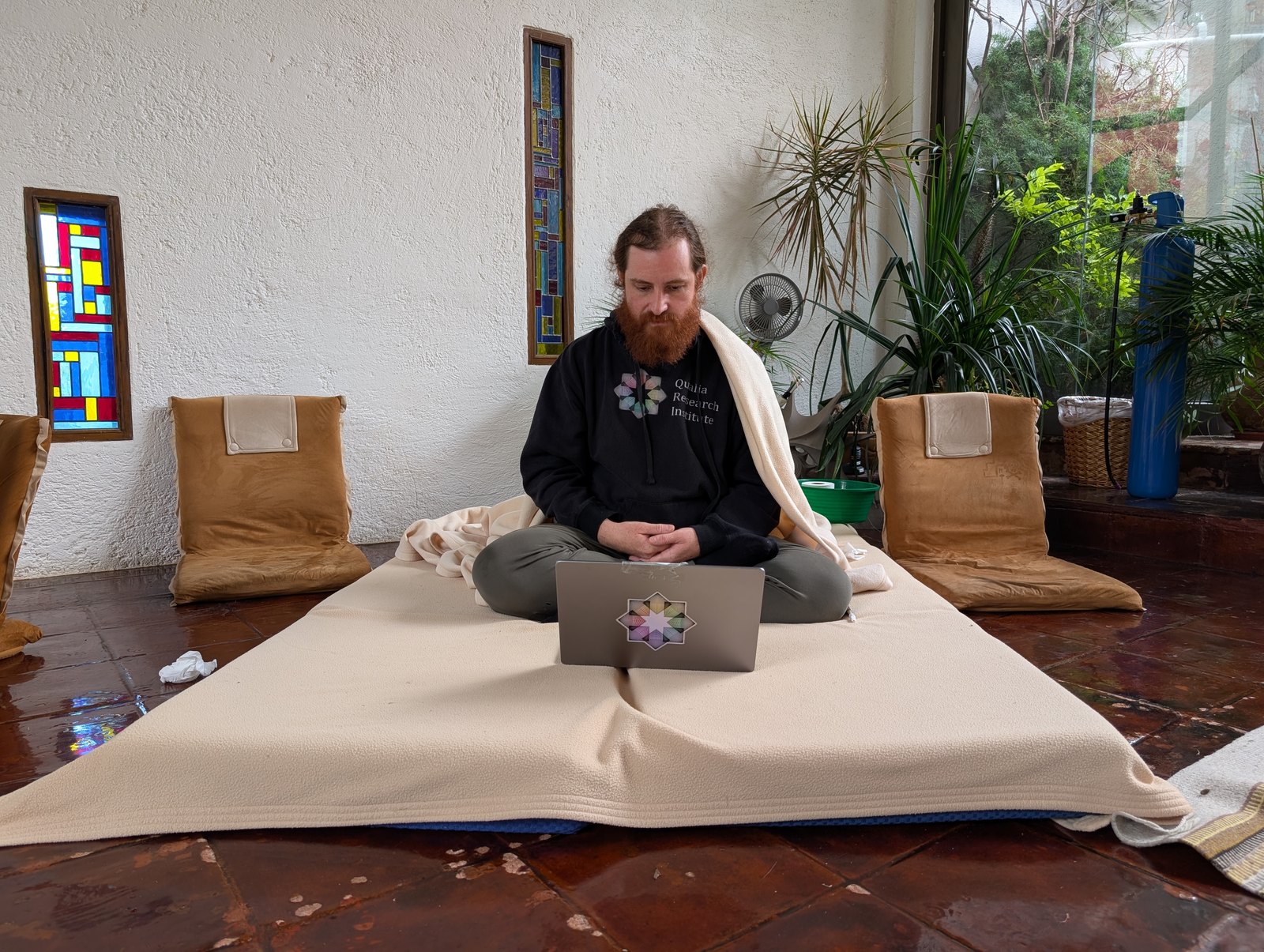
Me looking at the visual illusions on a medium dose of 5-MeO-DMT, and the rotating tesseract, one of the things we looked at in that state.
Contributions from the participants to this first tranche of artifacts
Below you will find brief commentary on the submissions we present in this first tranche of outputs.
I think it is awesome that participants had a lot of momentum and ideas of their own that they wanted to explore, and would explore together. I describe what each person brought, and the ideas from their work that I keep returning to. Note that there is more research in the pipeline, and additional participants will be contributing in further tranches too.
My own contributions
Among my own contributions, you will see a jhana contest write-up. One of the things we did was open up a jhana visualization competition a few months in advance of the retreat. There were not many external submissions, but we could contextualize the submissions we got together with submissions by participants who did not qualify to win precisely because they participated in the retreat proper. Participants didn’t really have an incentive to score their own submissions higher, since they were not qualifying for the prize. More so, the data does not show the presence of a self bias. That said, I still exclude a rater’s scores from their own contest submission for the analysis.
For me, one of the key research outputs of this writeup is the Stimulus Grid visualizations, which show all of the animations that were rated and where they fall along different axes: doses of 5-MeO and different jhanas. It also compares the nonlinear optics visualizations by how much they resonated with people’s overall jhana experiences and overall 5-MeO experiences, though not separated by dose levels or individual jhanas.
One caveat on what the grid can show. In personal communication, Wystan and Niffe both reported substantial similarities between high-dose 5-MeO-DMT and the formless jhanas (Niffe only took part in the 5-MeO-DMT week). They described states that were adjacent to, and sometimes nearly identical to, the fifth, sixth, seventh and eighth jhanas, but more energetic and mixed with other qualities of mind. The PDP ratings may have been underpowered to pick this up. We will unpack these reports in the second and third tranches.
You will also see a visual illusions write-up, which is a description of the debrief session we had right after the fourth day of 5-MeO-DMT, once participants had had the opportunity to look at some of these illusions. All of us commented in a meeting on what each of them looked like in the state, what was notable, and what could be visualized. I ended up visualizing how oscillators embedded in a vector field that responds to those oscillators look on 5-MeO-DMT, where the main insight is that you have a deformable sheet on top of the oscillators, on top of the vector field, that gets deformed and pushed around in the state.
Among the things we will produce is also a methods paper about how you can characterize phenomenology with this combination of methods and advance the frontier very quickly.
Emil
Emil approached the simulations structurally, starting from a question. He has spent years studying what waves look like on different substances, especially psilocybin, and building models that capture essential aspects of the phenomenology. So he was really well equipped to notice the waves in the state and identify their properties.
During 5-MeO-DMT he kept his attention on the details of the waves that emerged. We recorded his experience, and even at the highest dose he was very determined. Of course he “let go” and just experienced the state for periods of time. But for most of the time he was verbalizing key properties of the types of waves he was seeing. He would say things like “isosurfaces”, and describe how the waves would get slower around topological defects, converge onto them, then diverge on the other side. Very quickly right after that session we sat down together to vibe code a couple of simulations that hit a number of these properties, and a few days later we organized a meeting where he presented his work up to that point, so that we all had a chance to comment and speculate on what dynamics might explain what he was describing, and also to confirm that a lot of it very much resonated with our own experiences.
He approached this as a kind of logic puzzle, and did what we could call detective work to figure it out. He looked at very broad classes of waves and compared them against what he experienced. In particular, the wave equation and waves that arise in excitable media. He made the case that 5-MeO-DMT waves share some properties with these types of waves, but not all.
Let me give you an example. In an excitable medium, when waves meet in a frontal way they tend to cancel out, because the medium is exhausted in that local region. Whereas on 5-MeO-DMT the waves essentially just go through each other and cross each other, almost as if they are invisible to each other when they meet in that orientation, or orthogonally to each other. They are also not ordinary traveling waves, because they do not reflect off boundaries. Instead they wrap around boundaries, and they become slower around boundaries, which to us suggested a change in the index of refraction in some media.
He found that some of these wave characteristics actually emerge if we take the model of V1 in the visual cortex described in Bressloff and Cowan’s work on psychedelic form constants, tweak the model a bit, and simulate that as an excitable medium. These old research papers only figured out a small fraction of what psychedelic visuals are like, but it’s kind of remarkable that a very similar model turns out to give a good structural match to the broad wave dynamics of the entire field on 5-MeO-DMT.
Of course we still need to do a blind and controlled study where we isolate the different wave dynamics with the full affordances of the PDP paradigm. This is just the beginning of this research. There are a lot more fine-grained aspects of waves that we can explore in the future, and get really deep into, and surface the precise equations for different levels of the state. Inevitably we will also need to connect these to things like the dimensionality of the haptic field versus the visual field, how they couple together, and how 5-MeO-DMT affects that coupling. To a first approximation, though, it is a first step.
I should add Emil’s own caveats here: at the retreat the waves he worked on were based on just one person’s experience, and only on 5-MeO rather than on the jhanas, so putting them front and center would be a bit unbalanced with respect to the retreat as a whole. And they are still quite underdeveloped: none of the vibe codes so far really match his experience fully, although they point in the right direction. That said, the resonance for me and other participants is very strong, and they were highlighted as promising by many. To my knowledge, these look like some of the best code-based replications for the phenomenal character of 5-MeO-DMT that exist.
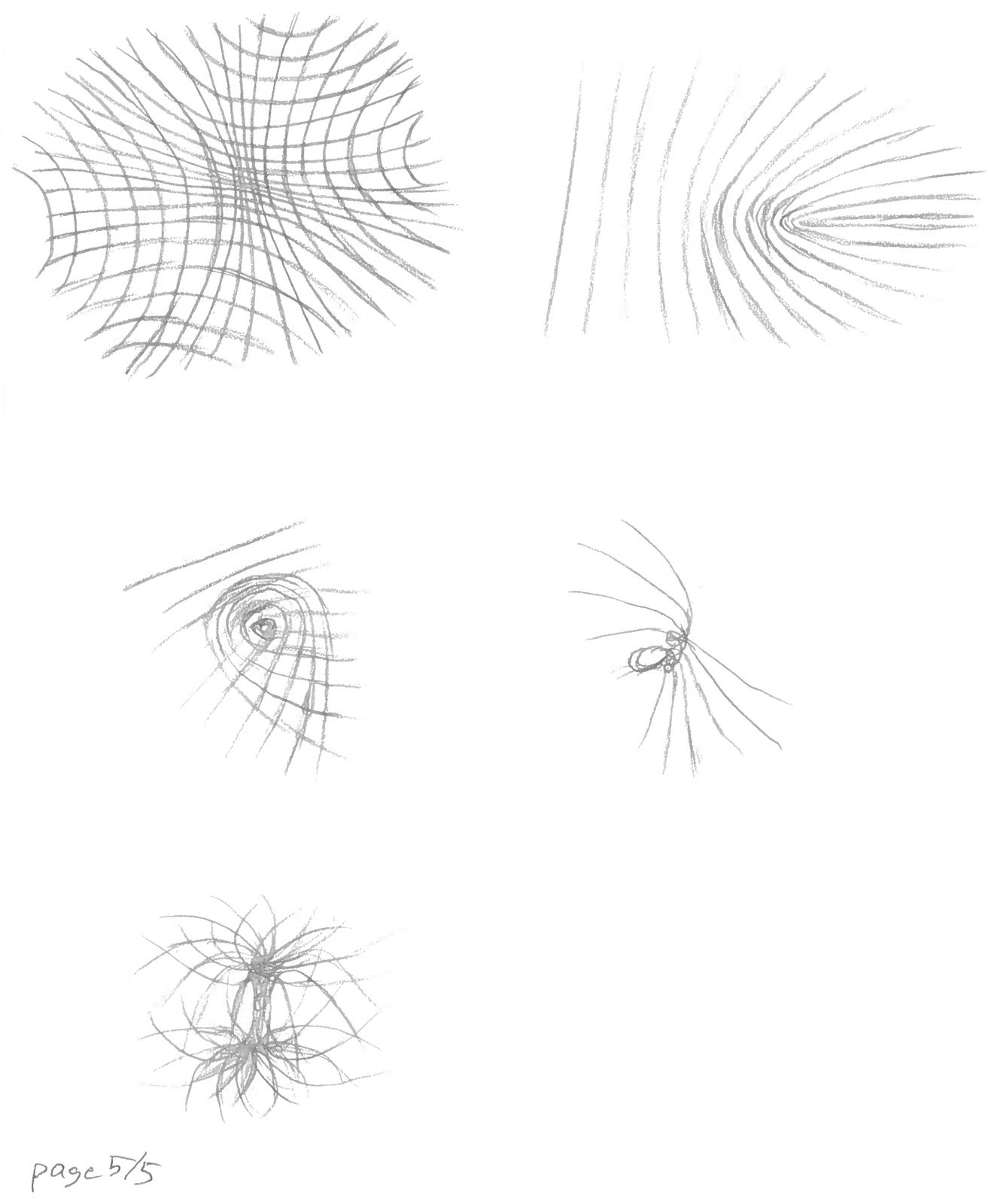
One of Emil’s scanned drawings of how the waves behave.
Field lines before equations
Emil’s work makes the case for the “field lines before equations” I have recently been proposing (e.g. at conferences, writeup forthcoming).
Some of this was already present in what we were doing. I asked Taru and Eliade to generate PDP inputs from many kinds of waves from different kinds of physical systems, so that we could span a large qualitative landscape of plausible dynamics. But what I was not doing was looking at the big categories and reasoning “okay, so if there is refraction but no reflection, then the wave equation does not fit”, or “if the waves meeting each other facing each other do not make them disappear, it is not an excitable medium”. The next phase of the work, in my mind, involves continuing to map the landscape of options and applying PDP to it, and in each iteration gathering more properties where we can apply that kind of detective work.
It is also just striking that the “slow down but do not reflect” property of at least one of the big attractors of 5-MeO had, to my knowledge, just never been pointed out.
Faraday made thousands of reports and countless drawings of field lines, over decades, before Maxwell was able to put equations to them. I think a lot of current work on psychedelics (for instance under the free energy principle) is a bit like taking one or two drawings and trying to put equations to them, without wondering whether more drawings might reveal more key details. Well, of course equations come together in the detective work. But really noticing and drawing and tracking and documenting the field lines, in analogy to Faraday’s work, becomes a clearly important task. In this case the waves are a kind of proof of concept: psychedelic science might very well go the way of the discovery of the EM equations, so let us explore that approach.
Cube Flipper
Cube Flipper interviewed many participants, focusing on the jhanas and especially the formless jhanas, as you can see in their write-up.
Cube, working in close collaboration with Ethan Kuntz, proposes that the phenomenal space in these different states has different specific invariants, so that you can characterize them in terms of different groups, and in terms of the presence or loss of different symmetries. A key starting point was Ethan’s proposal that in the eighth jhana the only thing that remains is continuity, then investigating what additional structure appears as you move through J7, J6, and J5, where there are reports of a very pristine three-dimensional Euclidean space. They initially explored this in terms of computational properties before turning to group theory. The end goal, as Cube puts it, is a “Rosetta Stone for consciousness” providing “fixed points for translating between subjective states and physical ones.” These relatively repeatable, increasingly simple states could allow us to identify phenomenal invariants and look for corresponding structure in neural activity, giving us concrete constraints for developing and testing theories of consciousness. Through this kind of detective work you can boldly try to make progress on the relationship between phenomenology and physics. Cube develops this direction in their posts on the form jhanas and formless jhanas.
Cube has also been investigating fractional Fourier transforms in relation to phenomenology, which was generative for the entire retreat, and which we explored quite a bit. I have coded quite a few feedback systems that use the fractional Fourier transform along with the beam splitter idea, some of which are intimations of phenomenal characters that I think might lead to a high quality model down the line.
I say more about where this leads in Attention moves as probes, below.
Wystan
Wystan was the main meditation coach and instructor during the jhana retreat, and did a review of the jhanas and 5-MeO-DMT. His writeup is a comparison of the two. He also collaborated with Symmetric Vision on making a high quality visualization of the jhanas across all of the levels (which, of course, did not make it into the contest). He contributed as well with a vibe coded simulation of all jhanas and 5-MeO levels, and multiple replications of visual illusions on 5-MeO-DMT.
He is an advanced meditator and has extensive experience with all of the jhanas and came to the retreat with significant familiarity with 5-MeO-DMT too. His observations are grounded in extensive contemplative study and practice.
The first two jhānas from Symmetric Vision and Wystan’s series. See all the levels.
Alfredo
Alfredo went to the 5-MeO section of the retreat and stayed for a little while longer. He has thought about these topics for years, and contributed a write-up that describes the importance and the phenomenality of equanimity and letting go in these states, and also their connection to reducing extreme suffering.
He works at ClusterFree, which we co-founded and which he leads. The organization aims to identify promising interventions to cure, treat, and prevent cluster headaches. Among those, DMT is currently the one that works best, although I am sure that in the future there will be better interventions that hopefully do not sound as crazy. The case for DMT is very strong, you do not typically need a psychedelic dose, and it is definitely not placebo. For a substantial number of the people who suffer from these, it takes the pain from 10 out of 10 to 0 out of 10 in 30 seconds with a very low dose. It is outstanding (see: Emerging evidence on treating cluster headaches with DMT).
Alfredo has faced the reality of intense suffering head-on, and his response has been research and concrete action aimed at drastically reducing the number of these episodes, and the amount of intense suffering in the world as a whole. Exploring these states while knowing that extreme suffering is real and urgent can be overwhelming; the knowledge does not go away when you are tripping. What he found is that taking effective, well-reasoned action against it makes it easier to let go on psychedelics. Knowing that you are doing your best, and that your actions line up with your values, leaves less room for helplessness, and that lets you surrender more deeply.
Alfredo also has a background in physics, including nonlinear optics, and his write-up explores how different waves may look on the state, trying out the PDP approach. It shows how someone who takes physicalist theories of consciousness seriously can reason about qualia.
Alfredo’s Voronoi replications.
Roger
Roger, who is also an advanced meditator, did not go to the 5-MeO section per se, but joined us in the last weeks, and we did a lot of brainstorming and very productive sessions together.
Some of this was about visualizing the jhanas. Especially, though, it was about visualizing and making sense of the coupling between the visual and the tactile, or what we could call the haptic field, and how that is related to meditation. Namely, how the sense of depth is mapped onto, and emergent out of, somatic sensations. Thanks to him and a few of the participants of the Canada 2023 retreat thinking deeply about visual-haptic coupling, QRI has taken this research area seriously, and it has informed a lot of the paradigms we explore.
I encourage you to look at all of the animations and the interesting ideas that came up there, all very generative. What he has written is just the tip of the iceberg of everything that we discussed, and undoubtedly there will be many more insights in this space as we continue exploring it.
Anna
Throughout the retreat, Anna took to heart contributing to the retreat by writing detailed phenomenology reports, both of her meditation and 5-MeO states, as well as made drawings and AI-assisted animations that we found very valuable. Participants’ ratings put her animations first for Jhanas 1 through 4, though as a retreat participant she was not eligible for the prize. In future tranches you will see the full curated body of that work.
For now, she has contributed a write-up of what the rotating snakes look like on 5-MeO-DMT, with her own visualizations. It is a step towards understanding how illusory rotation changes on 5-MeO-DMT, which is a window into brain dynamics we wouldn’t have otherwise.
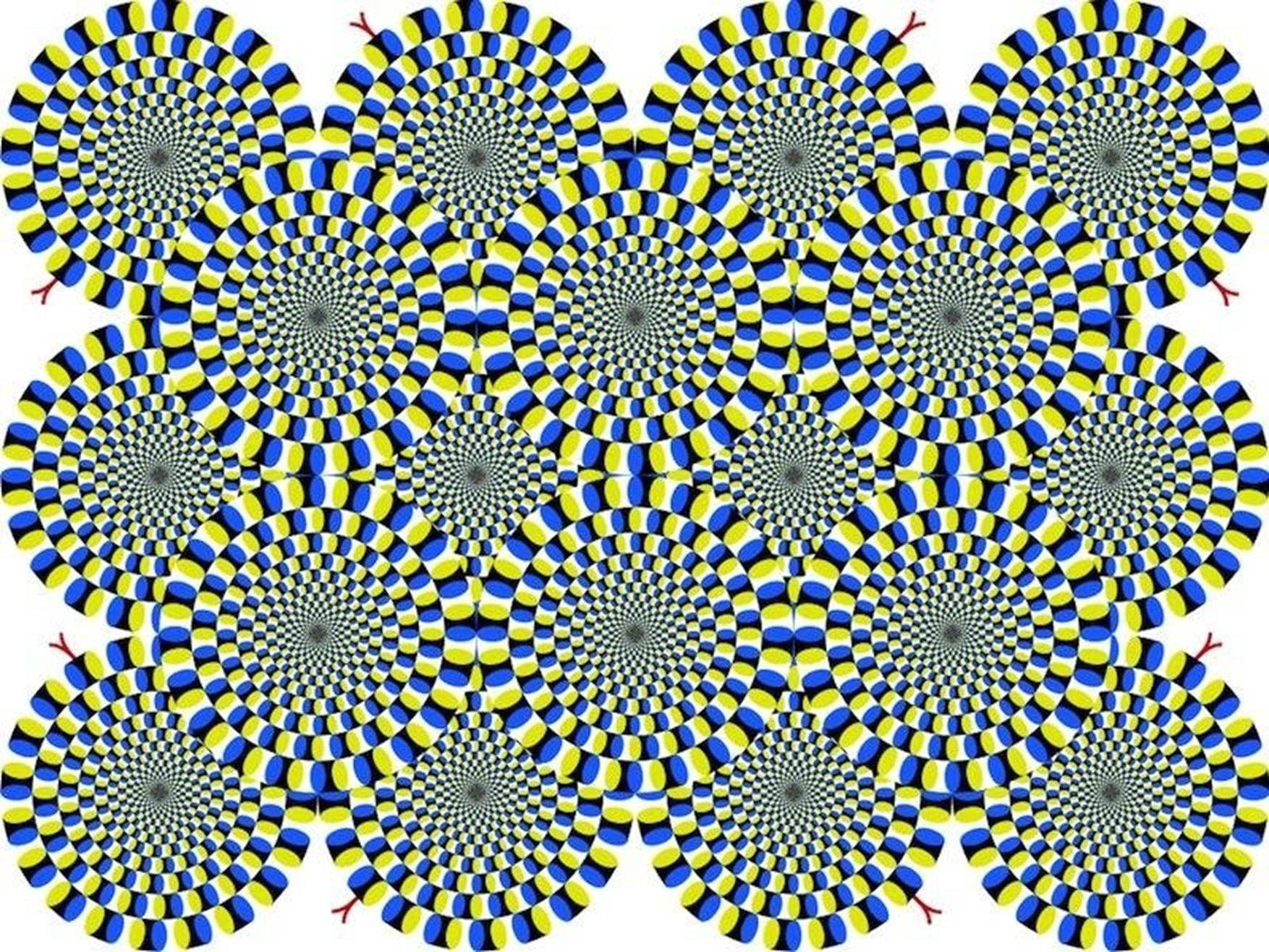
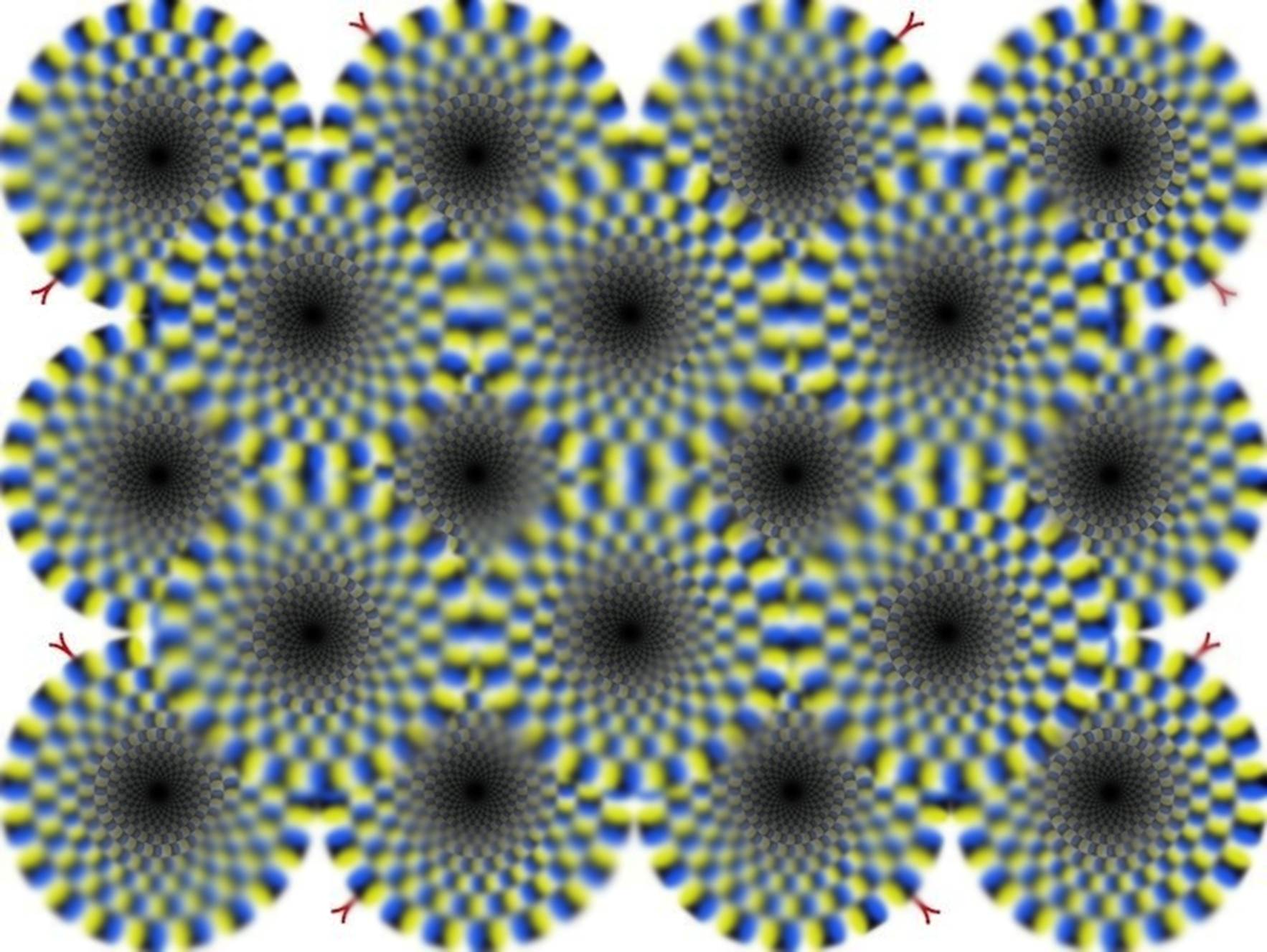
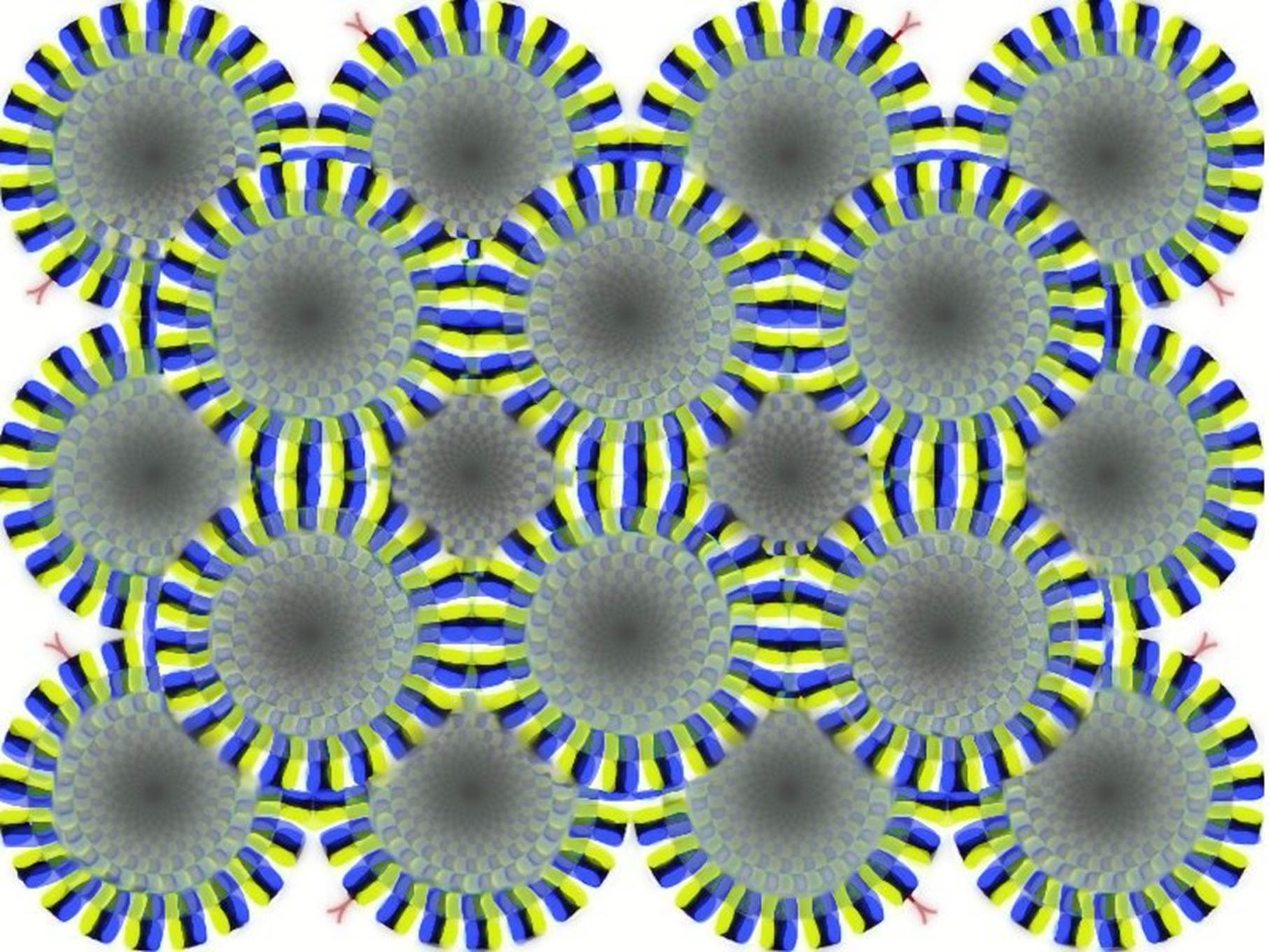
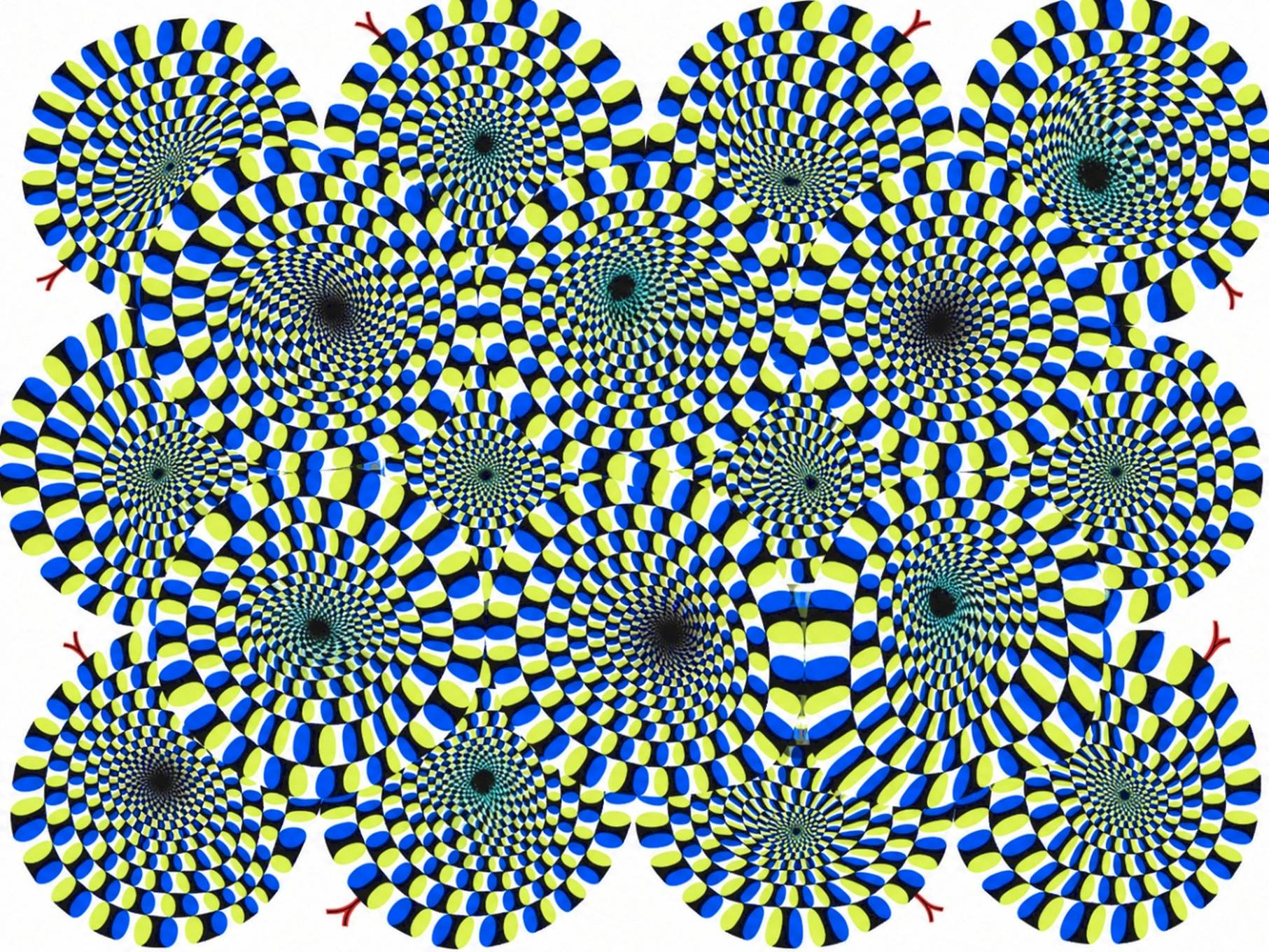
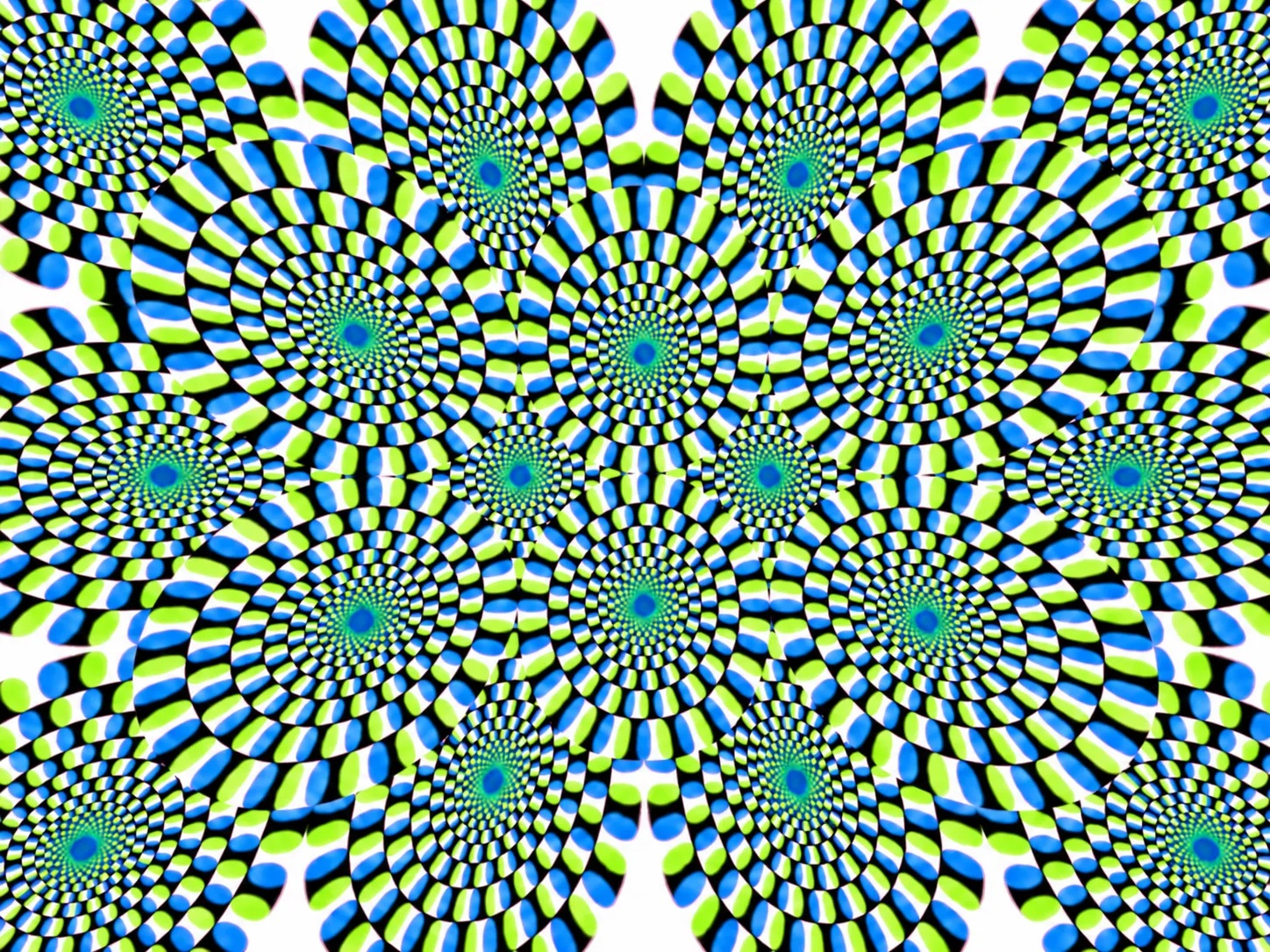
Anna’s rotating snakes replications next to the original illusion.
Sasha
Sasha’s write-up describes his attempt to speedrun the fifth jhana. He took to heart the idea that this meditation retreat was hoping to have participants reach the formless jhanas so that we could identify their properties, and optimized for that outcome.
I completely agree with him that the Buddhist tradition has not run randomized controlled trials on different meditation techniques. Meditation teachers, like doctors, are probably geared to provide advice that is very broadly applicable. So if an unusual technique actually does work really well for some percentage of people, there might be a systematic lack of exploration of it, since teachers and the meditation community as a whole may regard it as a distraction. More so, as Sasha points out, nobody actually knows what that percentage is. Whether a given technique works for 5% or 20% or 50% of practitioners has never been measured, so it is not as though these alternatives were evaluated and found to be slower for most people. They just have not been thought about in those terms. I would add that memetic competition between meditation schools may select for techniques that are aligned with the replication of the memeplex rather than the optimal valence engineering of its members (even if they do the latter fairly well in some instances).
He also points at an asymmetry that I think is a real problem. If an unorthodox technique like going directly for the fifth jhana does not work well for somebody, that gets taken as a problem with the technique. Whereas if the default instructions do not work well for somebody, that gets taken as a problem with the person, who was presumably not diligent enough or was doing something wrong. That said, a lot of Buddhist traditions do talk about skillful means, about how what is most effective for each individual is different depending on the causes and conditions that have brought you to be who you are. So clearly there is a lot of room for accelerating progress in various ways via customizing meditation practices.
He spent the jhana retreat trying to experience the fifth jhana while doing significant emotional processing somatically. Naturally, his experience of the retreat was quite different from everybody else’s, because the techniques he was applying were different.
He had said publicly beforehand that he would try this (speedrunning the 5th jhana), which is worth keeping in mind with any report of success, his or anyone’s. At the same time, as part of due diligence we had a number of conversations with the advanced meditators about his retreat experience. Nobody ultimately knows what others are experiencing, of course. One could make the case that he may have been experiencing a satellite state that shares a lot of properties with the formless jhana of boundless space, but that is maybe different in other ways.
In particular I would point out that if you have not been cultivating pīti and sukha (the happiness and body pleasure of the form jhanas), maybe one is missing out on some annealing processes that make the formless jhanas more stable. Some of the advanced meditators would say that when they experience the fifth jhana they are usually already in very deep absorption, and it is almost like they cannot move… they are practically locked into it for long periods of time. What Sasha described was brief episodes of boundlessness, many very noteworthy from the point of view of understanding exotic states of consciousness. They weren’t happening within a perfectly still state of absorption, and so the base seems different than traditional jhanas. But the brevity of these episodes does not make them inconsequential; he reported a profound sense of healing along the process, where the brief boundlessness episodes contributed to this effect. Boundlessness can be brief, yet synergistic with an expansive healing process across the retreat.
I think it is totally possible that this approach might develop into a fully stable, enduring, and settled 5th jhana. I encourage him to continue exploring, since those states of boundlessness can retroactively, in some sense, fill in the gaps that the first, second, third and fourth jhana would have provided. There are good reasons to think so: if you are tuning into this highly symmetrical state of boundlessness, then it can function as a powerful stress dissipator. The boundless state, even if brief at first, may function as an intelligent, very high-dimensional way of processing and unbraiding the body tensions that one has.
In general, all of the judgments that the advanced meditators made were tentative, and always prefaced with “time will tell”. Just as with how you feel right after a meditation retreat, the further development of practice and the stability of the states will make themselves known over months and maybe years afterwards. I am very happy that he took that exploration to heart and am eager to learn how it progresses. Because goodness knows, we need all types of techniques for every kind if we want the jhanas to become more broadly accessible (along with their healing properties).
He also worked on the 5-MeO side, including PDP replications of the illusory contour and the Ebbinghaus illusion. He wrote a piece on how 5-MeO-DMT seems to affect the Ebbinghaus illusion and produced a tool for estimating how strong the Ebbinghaus illusion is for you on a particular state.
Eliade
Eliade is the resident perfumer at QRI. I myself am very into perfumes and scents (we even have a line of perfumes by QRI, which you can find on the website). I think of scents as a very elegant and broadly accessible way of exploring the state space of consciousness in a way that shows how qualia is more interesting than what looking at color spaces might suggest. There are a lot of properties of how scents combine that suggest it is not a simple state-space: it probably has a peculiar and interesting geometry. I got familiar with many aromatic chemicals and how they combine via thousands of experiments (by which I mean, combining aromatic chemicals in different proportions and noting the properties of the emergent gestalt). He has taken the task of cataloguing the detailed phenomenology of aromachemicals much further, as you can read about in his Substack.
He participated in the jhana retreat, and in his write-up he talks about jhana-generating focus objects: the phenomenology of selecting different types of objects of meditation, their virtues and their drawbacks, and how they affect full body pleasure induction among other properties of jhanas. Think of it as a manual for a technically-precise type of meditation that is phenomenologically grounded. It is research output that can be built on and ultimately form part of a collection of meditation approaches for all kinds of people.

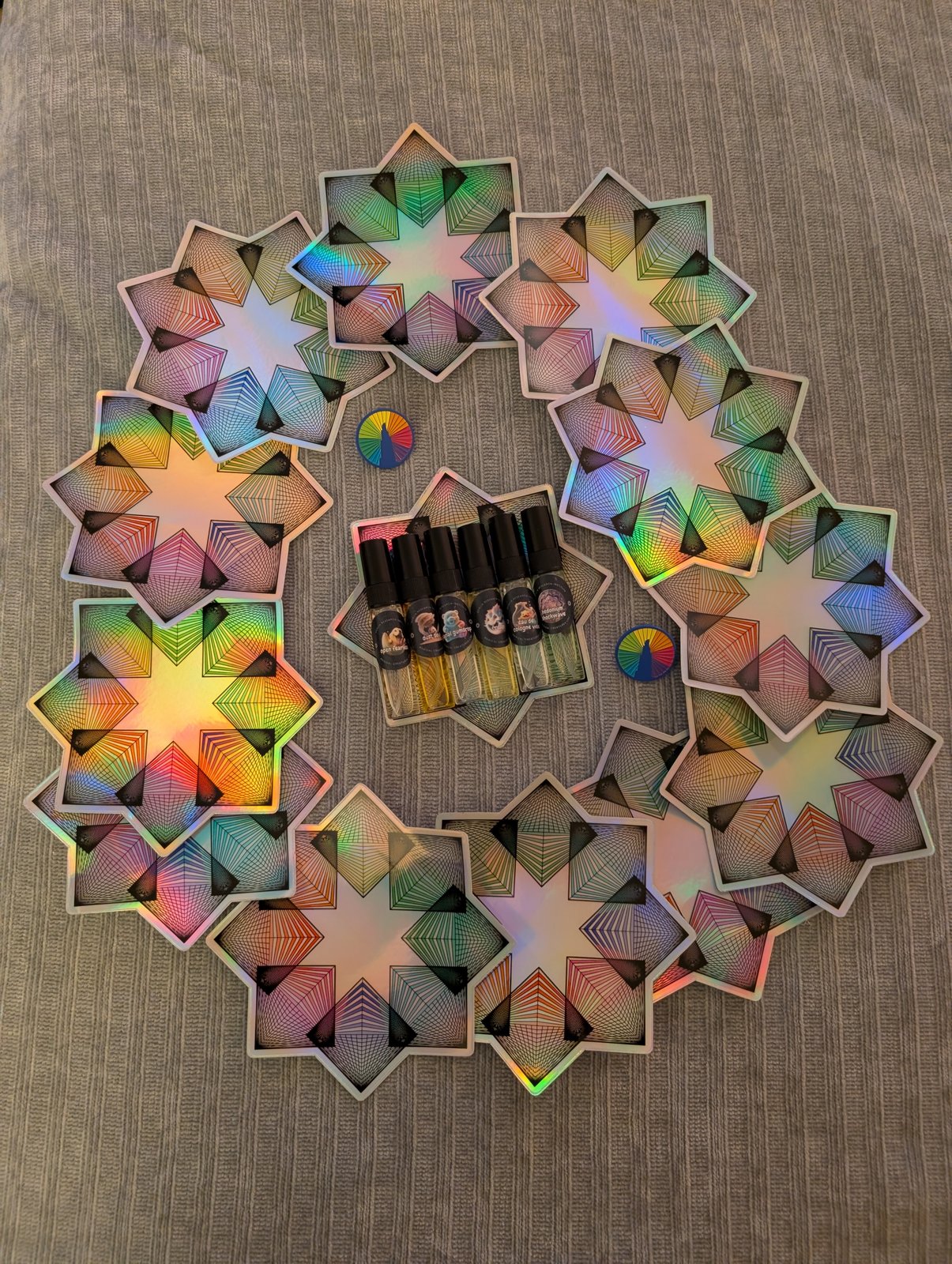
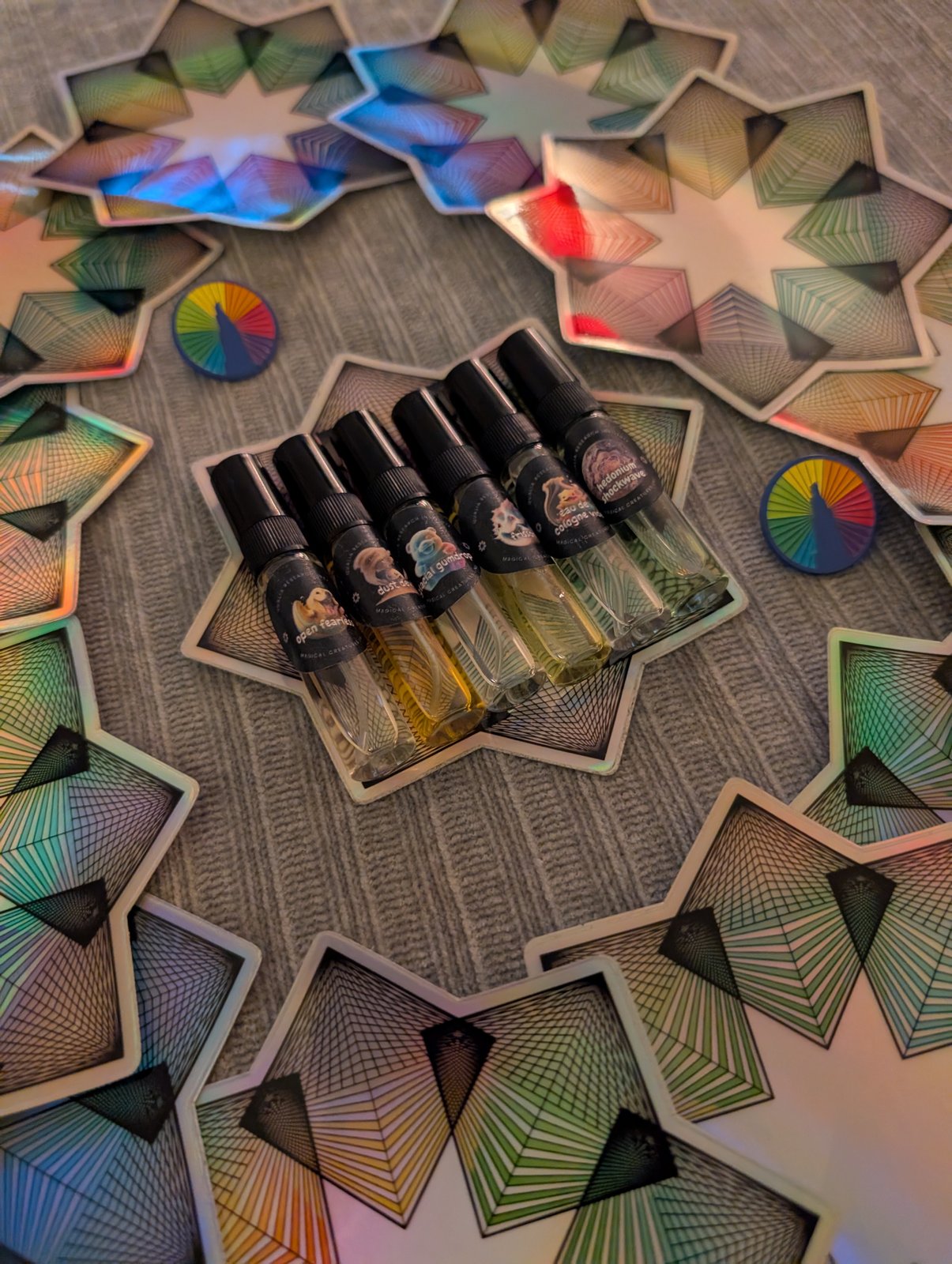
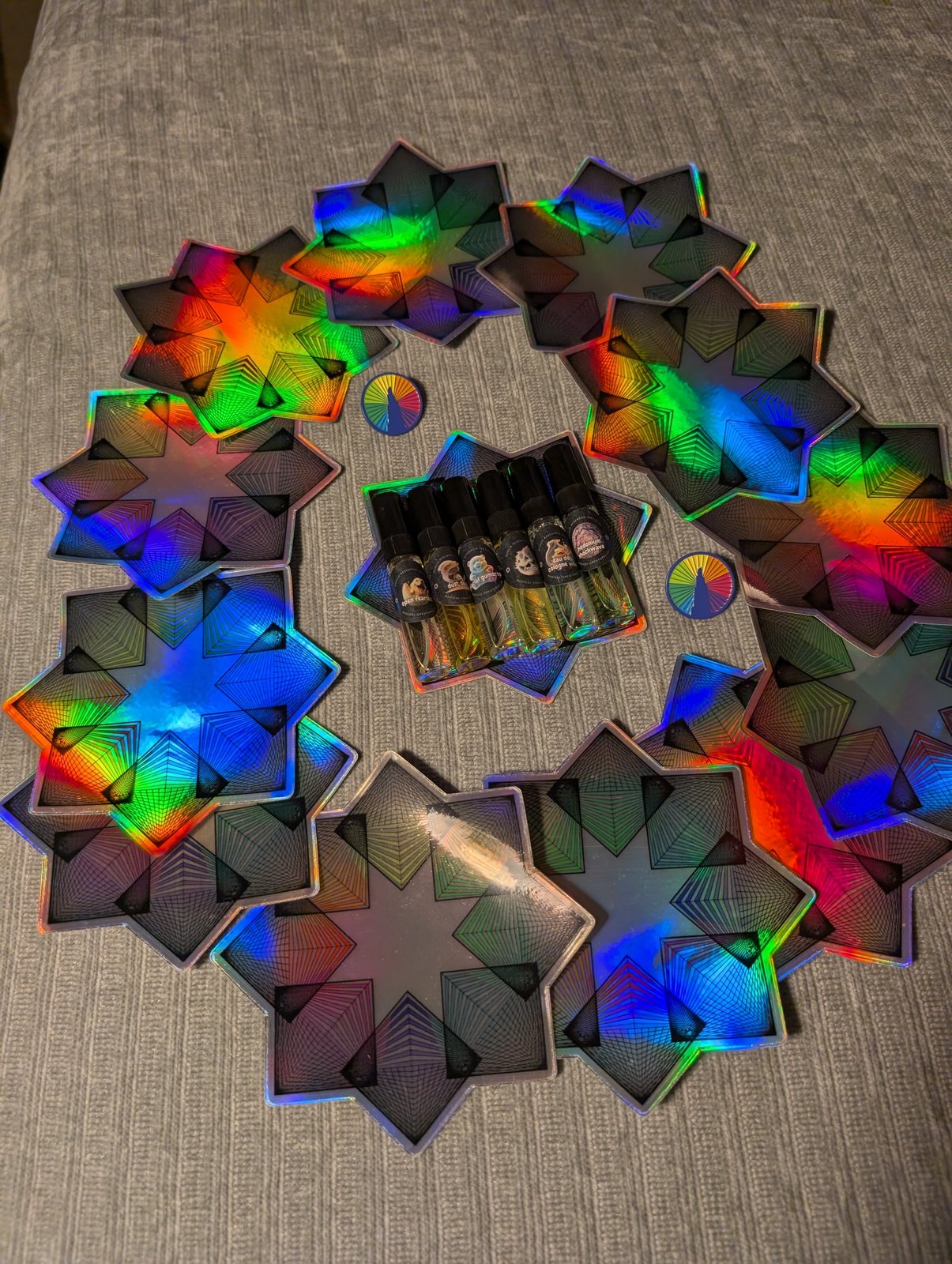
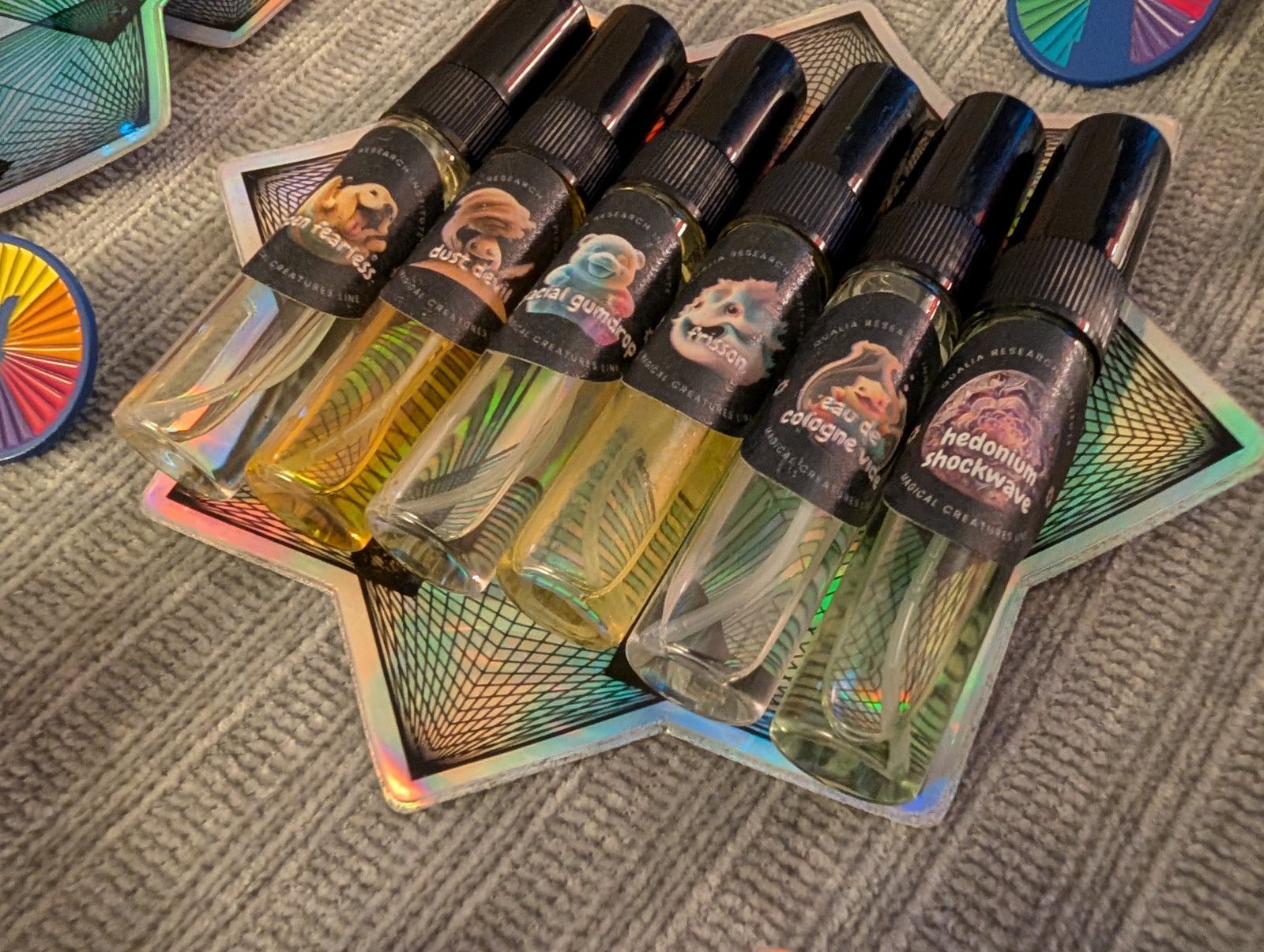
Magical Creatures: Perfumes designed to sample the unique, weird, and strange phenomenal effects that lie hidden in the state-space of scent qualia. Learn more
Persistent Fool
Persistent Fool contributed reflections on his experience in the QRI HEART retreat as a whole, plus replications of the scintillating grid illusion, with a detailed visualization of what it looks like on 5-MeO. Since many of the participants reported a very strong interaction between this illusion and 5-MeO-DMT, the replication is of theoretical significance.
I also want to thank him immensely for just how much he gave of himself to make the retreat successful. His contribution here, as with all participants in general, actually undersells the enormous overall contribution that was having him at the retreat.
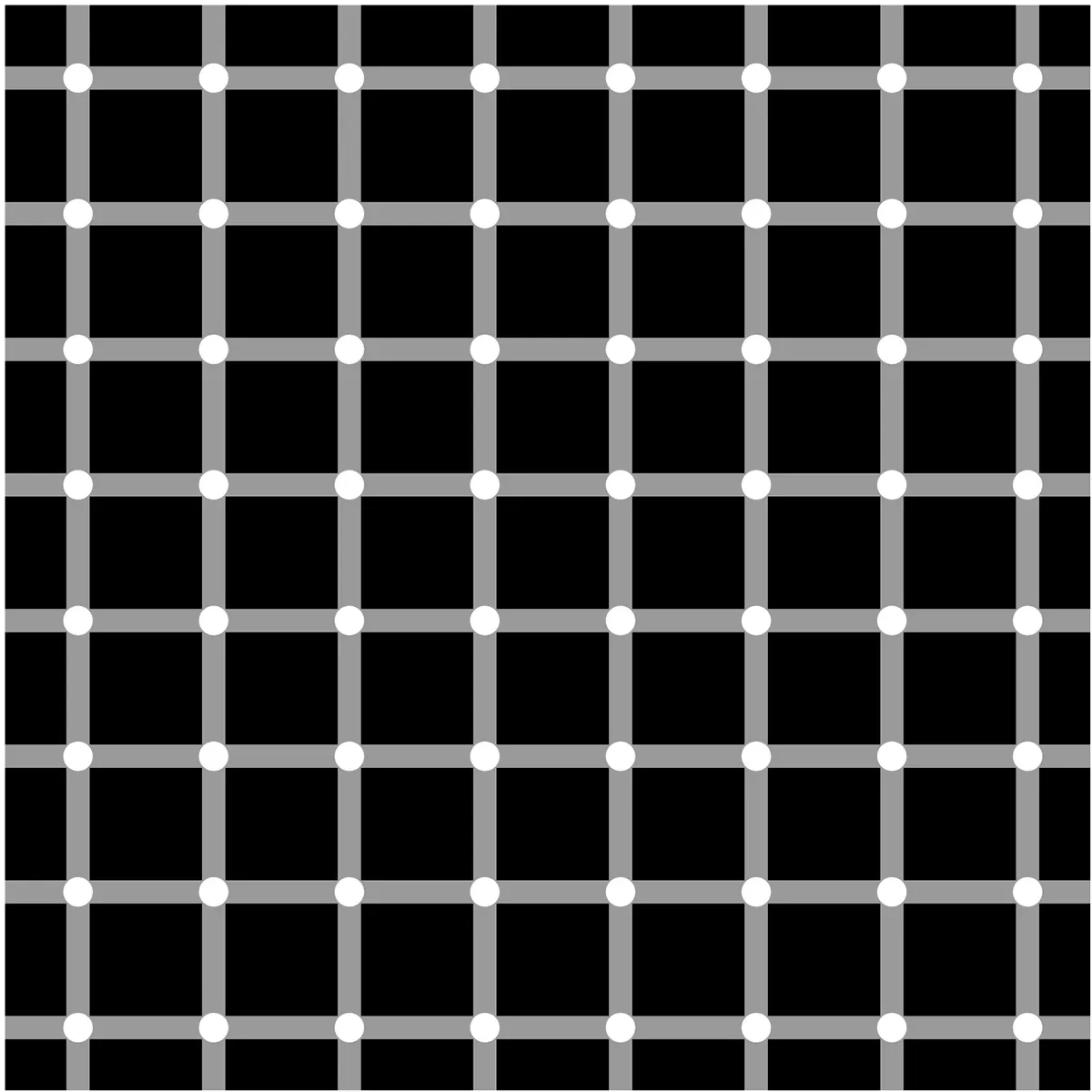
Persistent Fool’s scintillating grid replication, side by side with the original.
Beata and Hannah
Beata and Hannah contributed the Gravitational Phenomenology Scale (GPS) proof of concept, a twelve item self-report instrument about changes in the felt sense of gravity: weightlessness, ambiguity about up and down, upward flowing energy along the spine, release of postural muscle tension, and so on. Participants filled it out right before the retreat and again right after, and in the post-retreat version they also indicated which jhana, if any, each item was associated with for them. The framing comes out of Beata’s work on gravitational annealing, which builds on neural annealing (I, II) and on Mike Johnson’s vasocomputation, and gravity is a great candidate for this kind of study, being one of the most entrenched priors a nervous system holds, calibrated to a constant that has not varied in the entire history of terrestrial life.
The items order themselves. The intensity ratings and the jhana attributions were collected independently of each other, and neither was framed in terms of an expected sequence, and yet computing each item’s mean attributed jhana sorts the twelve along a single gradient: pressure and energy early, lightness and release in the middle, spatiotemporal frame dissolution late. It was very cool to see that structure fall out of the data. It is a pilot with eight matched pairs, so it is descriptive, which they are quite explicit about.
They also ran the biorhythm synchronization study during the jhana period, looking at breathing and heartbeat coherence within and between participants, with the clickers for marking transitions. Next time, to boost our chances of getting an effect size out of the synchronization between participants (assuming it’s a real effect), we could run the experiment during a period of the retreat where all participants are doing the exact same technique. This time people were encouraged to try a few techniques in the first days and then double down on whichever turned out to be most promising for them, which I think probably maximizes the chances of jhana for participants, but it does mean that at any given moment the people in the group are doing several different things.
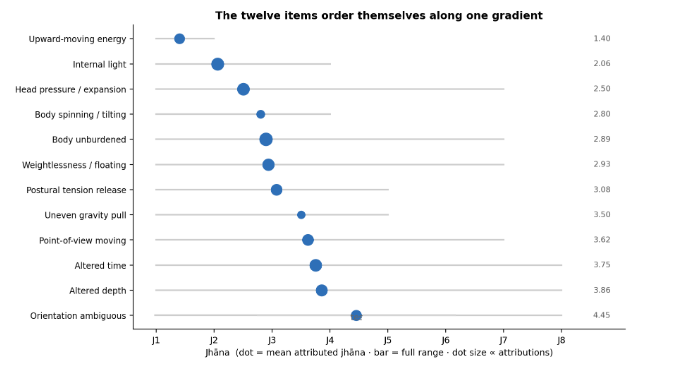
Figure 6 from Beata and Hannah’s report: the twelve items ordered along the gradient.
Scry
Scry arrived in the later part of the retreat, and participated in the exploration of exploratory software to study novel paradigms for visualizing phenomenology. He focused a lot of his efforts on understanding how to arrive at a sense of depth based on interactions of systems of coupled oscillators. It follows a complementary same line of inquiry into what Roger discusses in his writeup. This kind of work is very central to what we are pondering on at QRI, and is ultimately key for understanding the fabrication of phenomenal space.
It was very delightful to collaborate with him, and towards the later parts of the retreat also in collaboration with Andrés Silva, who is going to be contributing to further tranches with his substantial work on exploring state-spaces with intelligent parameter exploration.
Towards the end of the retreat it was very generative to combine what Andrés Silva worked on at the retreat (and has been working on for many years already). Namely, how to tune systems of modulated sinusoidals interacting with each other (modulating each other in terms of space and time and orientation and color and contrast). To me this clearly is part of what underlies a lot of phenomenology: these kinds of global sinusoidals can model the harmonics of the field, which are perhaps the functionally non-local aspect of sensory processing. Scry and Andrés and I spent quality time exploring how to combine this work with ideas Scry has been working on for years, such as Hilbert curves to account for the more fractal component of an experience.
This exploration ultimately led to what I think of as a Cambrian explosion of new frameworks. Combining these paradigms together with the kind of systems the Oscilleditor implements led to many kinds of pattern generators with unique psychedelic qualities that do not show up if you use any of these systems on their own (or at least not without torturing the system until it is so complex it can generate virtually anything). In the weeks after the retreat I made hundreds of simulations that combine Hilbert curves and modulated sinusoidals and Kuramoto oscillators and feedback dynamics and the beam splitter architecture and even fractional Fourier transforms trying to integrate the research threads these sessions sparked. All of this is to create very flexible frameworks that are able to replicate a very wide range of exotic phenomenology in relatively simple ways. I think this exploration is immensely valuable and there is much more to share about it in the future.
Symmetric Vision
Symmetric Vision won the jhana competition. He also collaborated with Wystan on making simulations and visual representations of the different jhanas.
Of course his contributions extend much further than that, though the intangibles are hard to really put in just a paragraph. He is very experienced with making a wide range of phenomenological replications as well as attuned to the fine details of experience (like the coupling dynamics that show up in psychedelic-induced synesthesia). He has built a large library of approaches for making phenomenological animations with software tools. In practice his contribution to the first tranche reaches many of the writeups: he was available to be consulted about how to use currently existing tools as shortcuts for making quality replications.
Attention moves as probes
One of the threads that came out of Cube’s write-up that I find really generative is Ethan’s use of attentional operations, such as stretching and zooming, to investigate the structure of the formless jhanas. Cube credits Ethan with developing particular ways of probing these states, and their discussion of what changes and what remains invariant provides a starting point for the account I want to develop here. In particular, I want to connect these operations to the pseudo-time arrow and to tracers: how the experienced difference between nearby moments can reveal phenomenal structure, and how repeatedly applying a probe might itself help generate the structure being measured.
For a claim like “the distance metric is preserved”, the mathematical object I have in mind is not the geometry of one instantaneous phenomenal field on its own, but that field together with a correspondence between nearby moments of experience. Or rather, the experience of combining such frames and thus the felt sense of phenomenal time (see: the pseudo-time arrow). You have the current phenomenal space, you apply some small transformation to it, and then the difference between the before and after states works as a “tracer” of what the transformation changed.
Zooming is a good example. Say you are in J5 and you voluntarily zoom by some amount. Say you know that you performed the operation, and that you can retain some sense of how much you zoomed, so the phenomenology of the difference between the normal and the zoomed state can be a probe of the space itself. Whatever relations stay exactly the same across the transformation are candidate invariants, and where something does change, the character of the change tells you what kind of structure was there. This is why, as described in Cube’s post, Ethan’s report that you can zoom indefinitely without losing track of how far you have zoomed is so interesting. It is not only that the field looks homogeneous before and after; the zoom generates a tracer that lets you compare the two states, which is what gives you evidence about whether scale, distance and direction are preserved or have disappeared.
The same logic applies to the loss of differentiation in the formless jhanas more generally. If several spatial or representational layers are perfectly aligned, you would not experience them as several identical layers, you would just experience one seamless field. But a small perturbation can make them diverge, and the pattern of divergence tells you about the structure that the symmetry was hiding. The transformation caused by the probe is part of what is being measured.
This gives a concrete interpretation of boundlessness. Perhaps the way we normally detect boundaries is by sending some kind of attentional or dynamical probe outward and detecting a change in the tracer that comes back, something like a wave propagating through phenomenal space, where a local change in geometry produces a discrepancy, a reflection, resistance, or deformation. If, in J5, every time you send the probe outward you get no local discrepancy back, then there is simply nothing there by which to identify a boundary. The metric keeps matching across the transformation, and the probe never finds a place where “here” behaves differently from “there”, which is quite close to the reports about sending attention outward indefinitely and never encountering resistance. Solidity might be the same story in reverse: the ordinary sense of a solid object could be implemented by a sufficiently abrupt local change in the geometry or the propagation rules of the field, where the probe hits a region that behaves drastically differently and that discontinuity is experienced as surface, resistance, or hardness.
5-MeO-DMT effects, especially as pertaining to the boundlessness of the state in high doses, might be the result of producing low frequency attentional probes at a high amplitude. Human EEG work finds a very large amplification and reorganization of very low-frequency activity under high doses, including roughly a fourfold increase in power around 0.5 to 1.5 Hz at the peak. These powerful slow dynamics could be acting like enormous tracers, or probes, of phenomenal geometry. As also suggested by the PDP animation ratings (with 5-MeO-DMT and formless jhanas agreeing on low frequency global waves) and the coupling kernel paradigm, the whole field is being swept and sampled all at once, repeatedly, for seconds or minutes at a time. If those waves keep failing to encounter local differences, boundaries, or metric discontinuities, then what you get is boundlessness. And this might be why 5-MeO can feel so close to the formless jhanas: as you progressively let go of the content and resistance, the solidity that these probes do encounter diminishes. This dynamic can thus be a gateway into increasingly symmetric states.
So the group-theoretic framing and the tracer framing fit together quite naturally. The group tells you which transformations preserve the relevant structure, while controlled operations like zooming, stretching, rotating, or sending attention outward are how a meditator goes and probes those invariants in experience.
The other half of this is that the probe itself is part of what fabricates the state. If you are probing the experience from many specific angles you get something like the sober state. But apply the “probe it all at once” move again and again and the spatiotemporal geometry of the experience becomes the trace of those probes, which can be highly symmetrical if the probes are rhythmic. It is kind of an artifact of a self-measuring system. This sort of explains why so many of these states show up when you apply attention diligently in very specific ways: those attentional moves end up becoming the very content of the experience, and the rhythm with which you apply them determines its texture. A formless state is a kind of eigenstate of a set of attentional moves.
Thus you can “collapse into a black hole of attention” or “dissolve into boundless space” in meditation, depending on whether you attend rhythmically to a point or to space as a whole. In very deep concentration where the move that got you there is focusing on the tip of your nose, you may collapse into a black hole, because your entire world simulation is the result of doing that again and again, so there is just one point and the symmetries that correspond to that one point. Attend to the entire field again and again and you may dissolve into boundless space, and from there the attentional moves may purify it even further. Psychedelics increase the tracer, but they also often add chaotic temporal dynamics, so the texture that gets generated can have quite complex geometry. 5-MeO in particular, due to that intense low frequency global probing, is the one psychedelic I know that creates boundlessness of a very regular kind, especially if you go in with the intention of paying attention to it. Which is to say: if you take a medium or high dose and go in with the intention of dissolving into boundless space, you are leaning into an attentional mode that your body is going to be doing automatically anyway, at an amplitude that overwhelms every other attentional move.
This connects to the beam splitter model, where the field is processed by making many copies of it, transforming those copies, and then predicting and compressing aspects of the field using transformations of the whole. This might be why, ultimately, “Indra’s Net” as a state can show up on DMT. You are reconciling many of these different compressions, and the compressions may involve different ways of coupling the visual and tactile fields, so you have multiple perspectives all trying to align with each other. Repeat the same broad attentional move enough times and you may end up in a world where all of the copies are transformed in exactly the same way and are compressing the entire field in exactly the same way, so that there is no difference between them left to find.
One more piece of evidence for the tracer story, which also came up in Emil’s work and in previous reports: on 5-MeO the color gradients of the tracers tend to be made of colors adjacent to each other, rather than sharply alternating between a color and its opposite the way they do on a classic psychedelic like DMT (blue, yellow, blue, yellow waves and checkerboards, as opposed to blue and a bluish green right next to it). States do not fluctuate between their configuration and its opposite, and features do not alternate with their complement. They hang out in their neighborhood, and they often converge on black and white, or on transparent or rainbow colors, and then on that sense of nothingness that is like a center of mass, or beyond something or nothing.
The bottom line is that I believe the pseudo-time arrow, plus the beam splitter, plus attention moves as probes, can make the group interpretation of the higher jhanas much more grounded in experience. I find this exciting, and I look forward to continuing thinking about group theory in relation to the formless jhanas. Many thanks to Cube Flipper for investigating this connection and proposing specific mathematical relationships. More to be uncovered here.
Organizational lessons
The main one is that next time I will hire a full-time on-site logistics person for the duration of the retreat. Somebody who speaks both English and Spanish and understands the work, but who is not a researcher themselves, at least for that period, so that the rest of us can focus on the practice and the research. My own time ended up divided between logistics, group coordination, research direction, product management, and a fair amount of keeping everybody’s motivation aligned. It worked, but it is not the most sustainable way to run something of this size.
It was also one of the busiest yet most meaningful working periods of my life. I used to do data science for HR products, analyzing engagement surveys and performance reviews, so I know that a job can be demanding in all sorts of ways and still rate very highly on satisfaction when it loads heavily on meaning. This was a clear case of that for me.
There is a lot of research output from all of this, though ultimately my sense is that the higher value part is the team, the momentum, the opened paradigms, and the culture that formed around the exploration, along with the demonstration that a modest budget can go a long way in this kind of work. Bringing together people who are technically capable and philosophically conversant, and having them work from direct experience to build the research instruments as well as gather the data, is the most productive setup for this research that we have tried so far. I look forward to running it again next year with the lessons we have learned, and I remain hopeful that this approach can get us to precisely reverse engineer phenomenological state-space and arrive at candidate mathematical frameworks for the structure of experience faster than any alternative.
Huge Thanks
I want to thank all participants, the people who helped behind the scenes (shoutout to Hunter Meyer) and who were available for consultation any time (shoutout to Marcin!), and of course to the supporters of QRI, in particular Winslow Strong, Olaf Carlson-Wee, and Eugene Jhong, who have been absolutely instrumental in making this a reality and in supporting us along the way. Winslow even attended the retreat towards the end, so he got to experience the synergy in the group directly. All supporters, big and small, thank you! Thank you to David Langer, our advocate, supporter, hyperconnector and strategist throughout. And thank you to Maggie Wassinge, our guardian angel.
David Pearce and Anirban Bandyopadhyay also visited us in the first part of the retreat, before the meditation started, and we profusely thank them for their numerous contributions including discussions and skillshares and fun times. I also want to individually thank every participant: Aatu Koskensilta, Alfredo Parra, Andrés Silva, Anna Eiserbeck, Arturo Gutiérrez, Beata Grobenski, Cube Flipper, David Lobser, Eliade Weismann, Emil Hall, Enrique Chiu, Ethan Kuntz, Giovanni Rabuffo, Hannah, James Sanders, Lisett Edstrom, Niffe Hermansson, Persistent Fool, Roger Thisdell, Sasha Putilin, Scry, Symmetric Vision, Taru, Victor Ochikubo, Wystan Bryant-Scott, and 𝛙. Thank you to Jack Poole, our microphenomenologist, who ran back-to-back microphenomenology interviews with us online, and to Joel Brierre and Victoria Wueschner of Tandava Retreats, who held a beautiful container and kept everything safety-first. Thank you to my parents, Elin Emilsson and Luis E. Gómez Sánchez, for their support throughout, and to my mom for renting QRI, at market rate, the house that served as our headquarters. Thanks to July, our neighbor, who kept us informed about the town’s activities. And thanks to Ricardo, our gardener. And to Napoleón and Bellota (RIP), for being such good dogs. Thank you also to the Airbnbs that hosted us, especially Casa Cosmic and Casa del Sol. Finally, the people who also made the retreat possible onsite: the cooks, who expanded their repertoire in this retreat, to make healthy and delicious vegan and vegetarian Mexican food for participants, Verónica Rivera Martínez and Eva Rojas Rabadan (if you want to try their food or hire them for an event in Tepoztlán you can reach out to them via Eva’s Facebook).
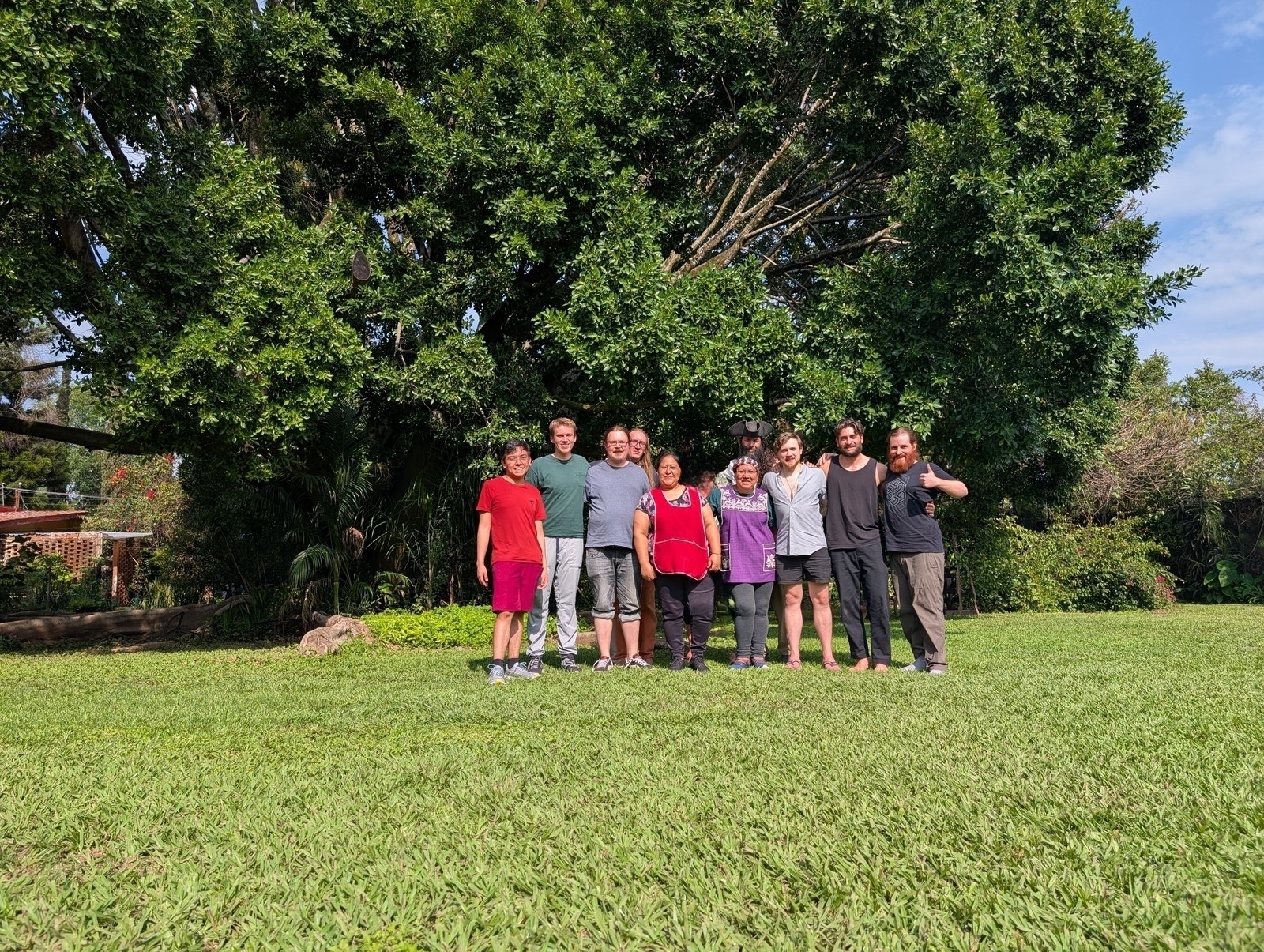
Avataṃsaka and Buddhapop
QRI is not a Buddhist organization, but thanks to conversations during the retreat that made it relevant, we brought up the Avataṃsaka Sūtra a good number of times. For some of the guided meditations we listened to Bob Thurman’s reading of some of its chapters (a highly recommended, if quite entrancing, experience: I, II). Some of us discussed it quite extensively. Well, it might not be possible to discuss it extensively, given that you may need as many kalpas as there are atoms in an ineffable number of realms to even start properly characterizing the full state-space of experiences and their relationships and their ontological properties hinted at by this sutra.
QRI does list Buddhism as one of its lineages, on the basis of its extraordinary phenomenological depth, explicit quest to reduce suffering, and amount of high-quality systematic phenomenology. Personally I am agnostic about the details, though I lean skeptic (e.g. on claims about reincarnation or psychic abilities).
That said, if a tradition or framework has rich phenomenology and is psychoactive in a way that feels wholesome, mind expanding, aligned with the research, and not epistemologically compromising, I’m happy to explore it. I personally found those conversations and meditations very inspiring.
Curiously, one of the things that emerged out of this retreat was Buddhapop, a term coined by David Pearce. In its current incarnation, it essentially consists of taking poems from the Avataṃsaka Sūtra and turning them into music with AI (as cheesy as that may be!), so they can be turned into playlists that are uplifting and inspiring and mind blowing. After the retreat I made a playlist of Buddhapop songs based on the Avataṃsaka Sūtra. I plan to make more of this (perhaps recorded with real humans) for a variety of other texts in the tradition. But really, a wave of music whose content discusses understanding consciousness and improving valence, that is inspired and aligned, is fair game. Perhaps you can also look forward to a wave of JhanaPop, NeuralAnnealingPop or JainPop. :-)
I had a really fun time. Thank you everyone! That is a wrap.
Citation
For attribution, please cite this work as:
APA
Gómez-Emilsson (2026, October 1). The QRI Tepoztlán Retreat of 2026. https://heart.qri.org/retreats/2026-tepoz/andres-gomez-emilsson/retreat-report.html
BibTeX
@misc{gomezemilsson2026retreat,
  author = {Gómez-Emilsson, Andrés},
  title = {The QRI Tepoztlán Retreat of 2026},
  url = {https://heart.qri.org/retreats/2026-tepoz/andres-gomez-emilsson/retreat-report.html},
  year = {2026}
}