Written by Andrés Gómez Emilsson on 11 September 2026.
This post is a contribution to the third Qualia Research Institute psychophysics retreat, which took place from May to June 2026 in Tepoztlán, Mexico.
Table of contents
- Visual Illusions and Psychophysics on 5-MeO-DMT
- Rotating snakes
- Ruled surface
- Scintillating grid
- Illusory contours, four panels
- Nine classic geometric illusions
- Neon colour spreading (Varin)
- Spiral coupling kernel in a field
- Vertical coupling kernels
- Tracer tool
- Grid symmetrification stimulus
- Simultaneity task
- Size comparison task
- Checkerboard shadow
- Tesseract
Visual Illusions and Psychophysics on 5-MeO-DMT
This is the group debrief from day four of the 5-MeO-DMT week, where we described what fourteen visual stimuli had looked like on 5-MeO. Each stimulus is shown first, followed by the discussion about it. Four of them were tasks, and each links to a version you can run. The last, the tesseract, was left for a session of its own.
Not everyone looked at every stimulus. People often glanced at one and moved on, partly to save time and partly because the first impression suggested there would be little to report. Sometimes a stimulus simply did not agree with the state, and that had less to do with 5-MeO-DMT as such than with each person: their idiosyncrasies, and where their internal dynamics happened to be at that moment. Which stimuli felt agreeable to whom may itself tell us something about those states.
Speaker 1 (00:00): Starting a recording. This is day four, comments as a group on the visuals we saw on 5-MeO-DMT. Popcorn style: if you have something to say, hold the mic, it makes a real difference to the recording. A lot of people want to talk about the snakes, and I have a fair amount to say about them myself. Let’s cap this to an hour as a group. If people want to continue afterwards they’re free to, but let’s set that expectation now and get through as much as we can. So, the snakes.Started a recording, which is day four comments as a group on the visuals that we saw on 5-MeO-DMT, and so I think, yeah, just kind of like popcorn style. If you have like something to say, yeah, probably like hold the mic. I’ve been listening to some recordings, and it definitely helps if the mic is like closer, so the snakes, a lot of people want to talk about it. I also have a bunch to say. Let’s keep it brief. Let’s cap this meeting to like one hour, so that we actually should be well, if people want to continue afterwards, they’re free, but like as a group, let’s set the expectation this group one hour after that. Feel free to go and do whatever, so let’s try to get through as much as we can. Okay, so on the snakes,
Speaker 2 (00:49): I also have a voice recorder. I’ve written it down and uploaded it in much more detail, and I sat with it for a long time.yeah. Also, I have, I have a voice recorder,
Speaker 1 (00:51): yeah,
Speaker 2 (00:52): I have it written down, and I’ve uploaded much more detail. I sat with it for a long time.I have it written, I have it written down, and uploaded much more detail, but I sat with it for long, and
Speaker 1 (01:01): more for the group for us, I don’t
Speaker 2 (01:07): I don’t know that I can speak very well in terms of technique, in terms of how to replicate it. Should I pass for now? I can think about it.know if I can speak very well in terms of techniques, how to, how to replicate it. Should I, should I pass on? I can
Speaker 1 (01:15): think about it.
Rotating snakes
01:17
Akiyoshi Kitaoka’s peripheral drift illusion. The apparent rotation is driven by eye movements.
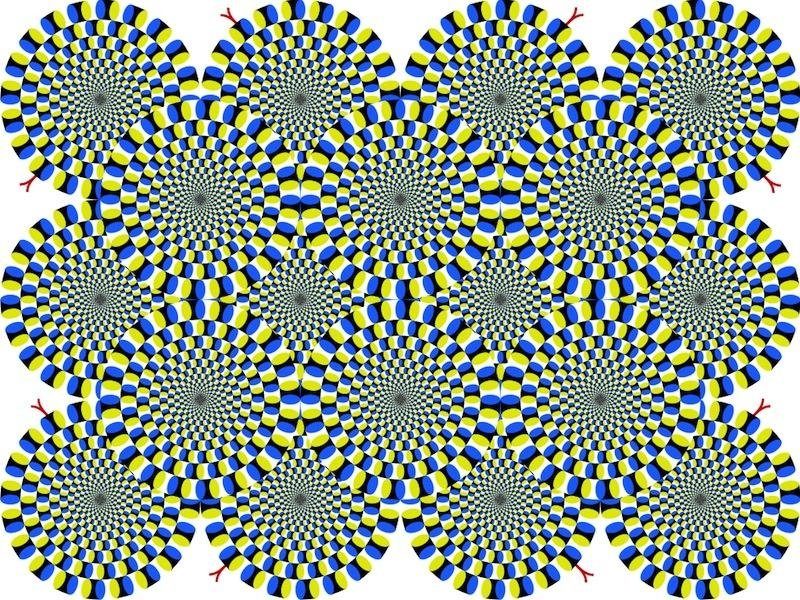
Note: This was the stimulus people had the most to say about. Speaker 6 tested the mechanism in the room by holding their gaze still, and the rotation stopped.
Speaker 3 (01:17): The snakes just look stronger than normal. They looked like they were turning around 22 and a half degrees, which is quite a lot.Okay, the snakes just look stronger than normal. The snakes look like they were turning probably around 22 and a half degrees or so, which is quite a lot, not
Speaker 4 (01:30): Others might have a different impression.they might have a different impression.
Speaker 3 (01:32): How do you mean?How do you mean?
Speaker 4 (01:34): From further away, and from an angle, they look different in isolation. You might get a different impression that way.As in, I think from afar and from an angle they look different in isolation, you might have a different impression.
Speaker 3 (01:42): That’s fine. I’ve seen this image a thousand times and it simply looks stronger. I don’t have anything additional to report. If someone were replicating this, I’d recommend finding a way to reproduce the sober effect and then turning it all the way up, to the point where the snakes are rotating somewhere between 22 and a half and 45 degrees.I’m, it’s fine. I’ve seen this image a zillion times. It just looks stronger. I don’t have anything additional to report. If someone was replicating this, I would recommend simply figuring out a way of, like, replicating the sober effect and, like, turning it all the way up to the point where, yeah, the snakes look, they were rotating somewhere between 22 and a half degrees and 45 degrees.
Speaker 2 (02:08): Now that you say it, that contrasts with my impression. I saw the rotation at the beginning, but then my attention was captured by the dark centres in the middle, and it felt natural for attention to become more diffuse and softer. The dark centres came to the forefront of perception. They felt like they had a shine around them, a circle, and attention felt very uniformly distributed, so that I had all of the dark centres equally in perception at once. When I achieved that, the movement stopped completely. It was a gradual build-up until it fully stopped, and I felt in control of it. That was the first phase.
There were several phases after that. Next the coarser, colourful parts came to the forefront and the black centres went to the back, so it looked as though a grid was in front. There was still no rotation, but the movement I could perceive was a psychedelic wobbling, expansion and dilation rather than rotation.
Then it gradually gained dimensionality. At first the image started to look more three-dimensional, with the dark centres appearing as entrances or portals. The dimensionality seemed to keep increasing. First there was a general three-dimensional feeling, then it felt odd, as if it did not quite add up and could not be something that exists in reality, an in-between space. Then the dimensionality seemed to increase further still. I haven’t experienced hyperbolic geometry, but that was the term that came up for me. When I reached it, it felt very harmonious and fitting, and although it was unusual and not something I’m used to from normal perception, it felt more peaceful and harmonious than any of the other states. That was the deepest I got.Now that you said it, it’s a contrast to my, to my, to my impression. So I saw the rotating in the beginning, but then automatically my, my attention, the got captured by the by the dark centers in the middle and automatically, so it felt natural that the attention got more diffuse and softer, and I saw the dark centers, they came more to the forefront of perception, and they felt like they had a shine around them, like a circle, and attention felt very uniformly distributed, and I had all of the dark centers equally in my perception, and when I achieved that, the movement fully stopped, so it was a gradual build up until it fully stopped. I felt control over that. That was the first phase. There were several phases of what happened when I reached that. Afterwards, the coarser colorful parts they came to the forefront, and the black centers, they went to the back, and so it looked for me like a grid was in the forefront. Still, there was no rotation, but now the movement I could perceive was like a psychedelic wobbling, so expansion and dilation, but no rotation, and then I got gradually it started to gain more dimensionality, so at first the image started to look more three dimensional, where I perceived the the dark centers like entrances or portals, and it seemed to increase in the dimensionality, so, so first it was a general three dimensional feeling, then it felt odd, like so, as if it does not quite add up, and could not be something that that exists in reality, and then, so this felt like an in between space, and then dimensionality seem to increase even more, and I, I don’t know, I haven’t experienced, I think hyperbolic geometry, but this term came, came up for me, and it felt like, so the same. I reached it, felt very harmonious and fitting, and even though it was, it felt unusual, and something that I’m not used to, from from normal, normal perception, it felt more peaceful than than any of the more peaceful and harmonious than any of the other states, and that was the deepest I got.
Speaker 5 (05:30): I had some overlap with the first thing Anna was describing. When I looked at this, it didn’t take long before the dark centres of the circles became the point of focus, and the colours and the movement were simply irrelevant. I don’t think I paid much attention to them at all.
When I look at the stimulus now, I can’t appreciate all of the dots at once; my attention ping-pongs around. In that state all of the central dots together were steady in attention, and it was really resonating. I could almost feel it in my body. The dots seemed to make a dimension, and I was seeing into a space that was mapped out by them. It had a feeling of gravitas to it. With a lot of these stimuli I’ll end up talking about the scope of attention and about foveation, and here it was much more diffuse and stable than it is looking at it now.I was just going to say I had overlap with the first thing that Anna was discussing, so when I looked at this, it didn’t take very long before the dark centers of the circles really came to be the point of focus, and the colors and the moving was just really irrelevant. I don’t think I even really paid much attention to it, because when I look at the stimulus now, I can’t appreciate all of the dots at once. I find my attention really ping pongs around, but in that state all of the central dots together were steady in attention, and it was really resonating. I could almost feel it in my body, and the dots really seemed to make this dimension I was really seeing into this space that was mapped out by these dots, and it felt really like it had a feeling of gravitas to it when I was looking at it, so yeah, I think with a lot of these stimuli I’ll talk about the scope of attention and kind of foveation as well. It was really like much, much more diffuse and stable than looking at it now.
Speaker 1 (06:50): I’ll echo the same, quickly. The dark spots became a lattice several times, much as Anna described, with a tunnelling, hyperbolic feeling and a stability over the entire percept. If anything the movement of the illusion was suppressed, but there was an enhancement of a different kind of movement, which was the way my attention flipped between things, including seeing the entire lattice at once.
The main phenomenological characteristic I’d want to describe is that it broke down into several phases, each of which seemed to have its own spatial frequency. Sober, my visual field can crisply discern a gradient of spatial frequencies as you approach the centre. In the state it was more like discrete bands: the frequency of the external circles, another frequency in the middle, and then the dots. It was as if my visual field had fewer elements, fewer basic building blocks with which to construct the scene, but was optimised to see more things at once. I could see the competition between the different phases, and in some cases what got highlighted was the boundary between them. I’d count three main phases.Yeah, I’ll add very quickly, I will echo the same. The dark spots became a lattice several times a lot of what Anna said, actually, and even kind of like tunneling, and kind of like a hyperbolic feeling, also stability over the entire percept, the movement, if anything, like I think, like the movement of the illusion actually was suppressed, but there was an enhancement of movement, but what that was kind of like the way in which my attention was flipping between things such as, like, oh, seeing the entire lattice at once. In fact, the main phenomenological characteristic I would want to describe is that it broke down into several phases that seem to have kind of like their own kind of like spatial frequencies, so if I look at it sober, my visual field can like very crisply discern, oh, there’s a gradient of spatial frequencies as the approach of the center, whereas in the state it was like, oh, there’s like these frequencies of the external circles, and then there’s like another kind of like frequency, kind of like in the middle, and then there’s like the dots, and so it’s kind of like, oh, like my visual field, as if it had fewer elements or fewer kind of like basic building blocks to actually construct the scene, but it was kind of like optimized to be able to see more things at once, and in fact I saw kind of like the competition between the different phases, and even in some cases the thing that would get highlighted were like the boundaries between the different phases, and I would count, really, just kind of like three main phases.
Speaker 6 (08:27): One hypothesis is that my group got a slightly less powerful effect because of something to do with the pens, so I may have been in an in-between state. I want to agree with what several of you have said, but position it as a milder version, probably because of dosage.
The illusion was still there in my state. The rotation illusion happens when you move your gaze, and that was very clear; I played with it and confirmed it. The way to make the illusion stop is to stop darting around with your gaze and instead widen, not the focus of the lens in the eye but the attention, so that you take in more of the space at once. You can do that sober as well. I tried afterwards and it is possible, but it seemed much easier in the state. You can snap into that space, and once there it’s fairly stable, whereas sober it’s quite hard to maintain that wider focus.So one hypothesis is that my group got a slightly less powerful effect due to something with the pens, so I might have been an in-between state. I want to agree, but also like position what I agree with what several of you have said, but in a slightly milder way, probably because of dosage, maybe there is some.. there was the illusion was still there in my state, and the illusion, the rotation illusion happens when you move your gaze, right? That, that was very clear. I played with that and conclude. Yeah, that, that seems to be happening. The way to make the illusion stop is to stop darting around with the gaze, and, like Anna said, instead widen your, like, not focus, as in lens focus in the eye, or anything more like attention, right? So that you can take in more of that space at once, and you can do that sober too. I tried afterwards, and it’s possible to do sober too, but it seemed much easier to do in the state. It seemed to have more of like you can kind of snap into that space, and when you do it, it’s a bit stable, whereas while sober, it’s quite hard to maintain that wider focus. Yeah,
Speaker 3 (09:56): A small thing to add: I completely neglected to dial into the dots, even though sitting across the room here that’s fairly easy to do. Coming closer, as I tested just before, it was hard to encompass all the dots within the fovea. All I really saw was rotation.I got a tiny bit to add, which is just I completely neglected to dial. Into the dots, even though sitting across the room here, that’s pretty easy to do. Coming closer to it, I just tested before, it was pretty hard to encompass all the dots and the fovea. All I really saw was rotation.
Speaker 7 (10:14): A brief comment. I passed over this quickly and noticed that the form factor was different from how it is now, which I only realised on seeing it again; my memory of the form factor was completely different, flattened.
The most salient thing was that there was something like snakes moving between the rotations, in fields of darkness. They would disappear in between another rotating element and be replaced by another snake starting somewhere else and moving around the grid. It was as if dark worms were moving through the figure, which I don’t normally see.Just a super brief comment, I kind of flashed by this and noticed that the form factor was different than it is now, which I didn’t notice until I saw it now, that the memory of the form factor was completely different. It was flattened. There was also the most salient fact was that there was something like snakes moving between the rotations in fields of darkness, and then they disappeared in between another rotating thing to be replaced by another snake that started someplace else and then moved around the grid, so it was as if moving darkness worms through the thing, which I normally don’t see.
Speaker 1 (10:59): Sasha, and brief comment.
Speaker 4 (11:01): Much of what has been said, I agree with. I didn’t have a very involved experience of this illusion; I looked at it and wanted to get to the interactive parts. It didn’t look much different at the time. Then I came down and it was spinning like mad, whereas on 5-MeO it was spinning only a little, and only when I moved my gaze.Yeah, I think a lot of what’s been said. I agree, I didn’t have like a super intellectual experience of this illusion. Kind of looked at it, I wanted to get to the interactive parts, so I’m like, kind of said it. It was like an illusion. Okay, didn’t look much different, but then I came down lovely, and it was spinning like crazy. What the fuck? And on 5-MeO was spinning only a little bit when I was, I guess, moving my gaze a bit.
Speaker 8 (11:28): Yeah,
Speaker 4 (11:29): It’s much less inclined to settle into a single thing right now, after paying it some attention.and I think, yeah, it’s not in way less into like a single start right now after, yeah, paying some attention. Yeah,
Speaker 1 (11:37): yeah, [Persistent Fool],
Persistent Fool (11:39): Briefly, echoing James’s description: when I looked at it, it was completely still and completely stable. I could see all of the black dots at the same time, and I actually thought there was nothing interesting about the image. It was just a stable image, and I didn’t understand what I was meant to be seeing.[Ed: The diariser folded this turn into Speaker 1. It is Persistent Fool, called on by name in the line above.]yeah, just briefly just echoing kind of James’s description. When I looked at it, it was like completely still, completely stable. I was able to see all of the black dots at the same time, and I actually thought there wasn’t anything interesting about this image. I was like, it’s just a stable image. I don’t understand.
Speaker 1 (12:05): On a lot of that: if you look in the heart.qri.org repository there’s an article by Murat, one of the participants from the Canada and Brazil retreat, hypothesising that one of the key effects of 5-MeO is that it suppresses saccadic motion, along with a good deal of automatic repositioning of the body. So some portion of these effects may come down to your eyes becoming completely still, at least for longer periods. That checks out with what we’re describing.Yeah, cool. A lot of that, if you look in the heart.qri.org repository, there’s one article by Murat, one of the participants in the Canada and Brazil retreat, and he hypothesized that one of the key effects of 5-MeO is that it suppressed kind of like saccadic motions, as well as, like, a lot of, I suppose, like automatic kind of like repositioning of the body, which may be a portion of the effects have to do with like your eyes actually getting, becoming completely still, at least for like longer periods of time, and I think like that. Yeah, that kind of checks, checks out. So, shout out to Murat. Yes, of course.
Speaker 9 (12:39): I didn’t see what was special about this illusion. To me it moved exactly as it moves when I’m sober. I think I said out loud that it was moving, swirling, rotating, and that there was nothing new I could perceive about it, and I moved on to the next one.So, I didn’t really see what was special about this illusion. I mean, to me it moved in exactly the same way as it moves when I’m sober. So, I just.. I remember, I just think I said out loud, like, ’Okay, it’s moving, so it’s just like swirling, rotating. There was like nothing new that I could perceive about it, and I just moved to the next one.
Speaker 4 (13:03): A couple of words about application. Perhaps there’s a way to adjust this illusion so that the effect doesn’t appear, for instance by giving it a grey outline that rotates, so that the viewer doesn’t get the illusion. If you want to study a visual illusion you have to be able to adjust it.I’ll add a couple of words about application. Maybe there’s a way to make this illusion adjusted such that it not appears this illusion, maybe like giving it like a gray outline that rotates. So that’s our, like the viewer’s visual illusion is not getting this effect right, since you forget, like, a visual illusion, you have to, I guess, adjust it. Okay,
Speaker 1 (13:29): Anything notable about this one?cool. Thank you. Anything notable about this?
Speaker 4 (13:33): I didn’t notice anything special about it.I didn’t notice anything special about it.
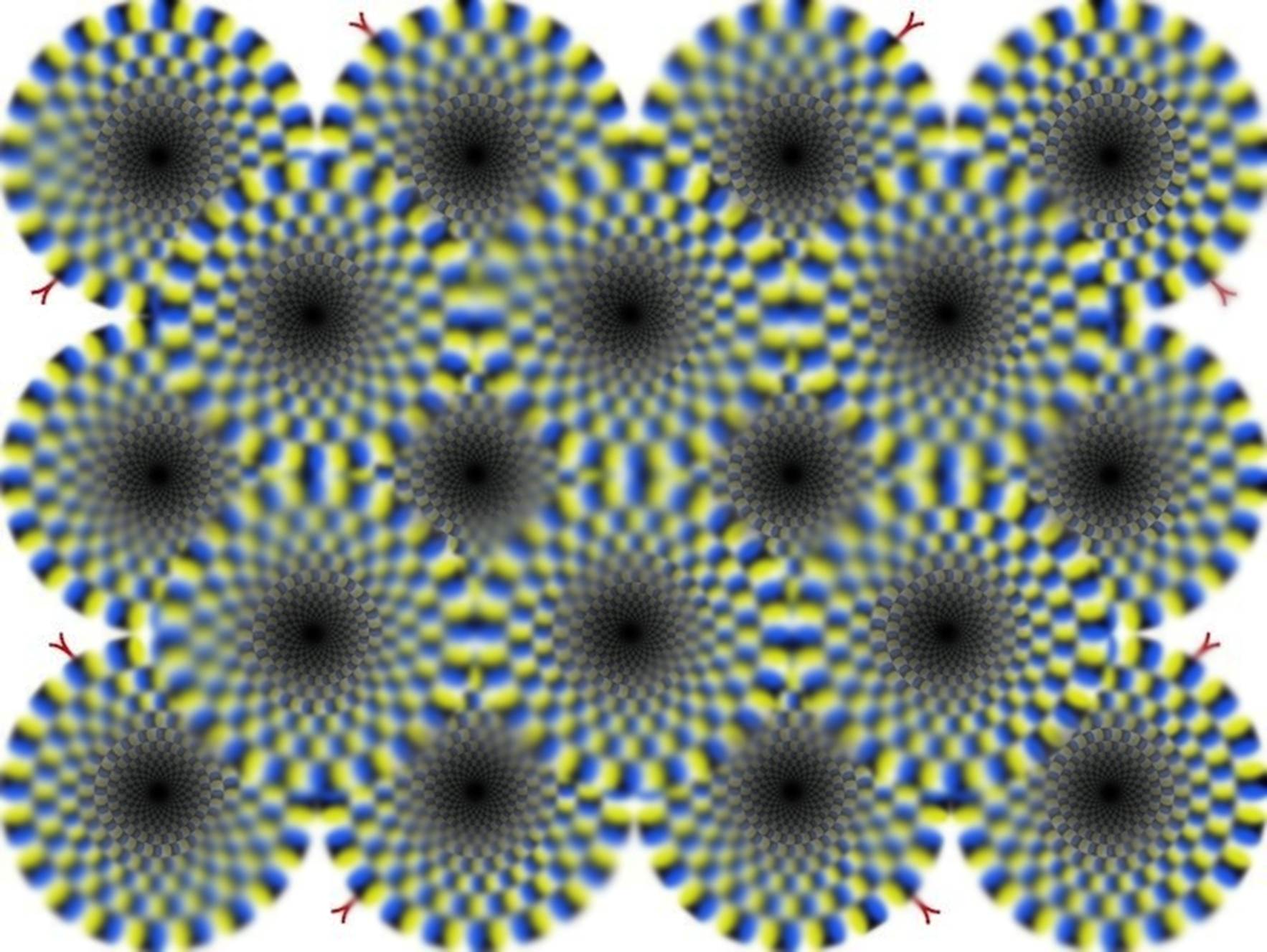
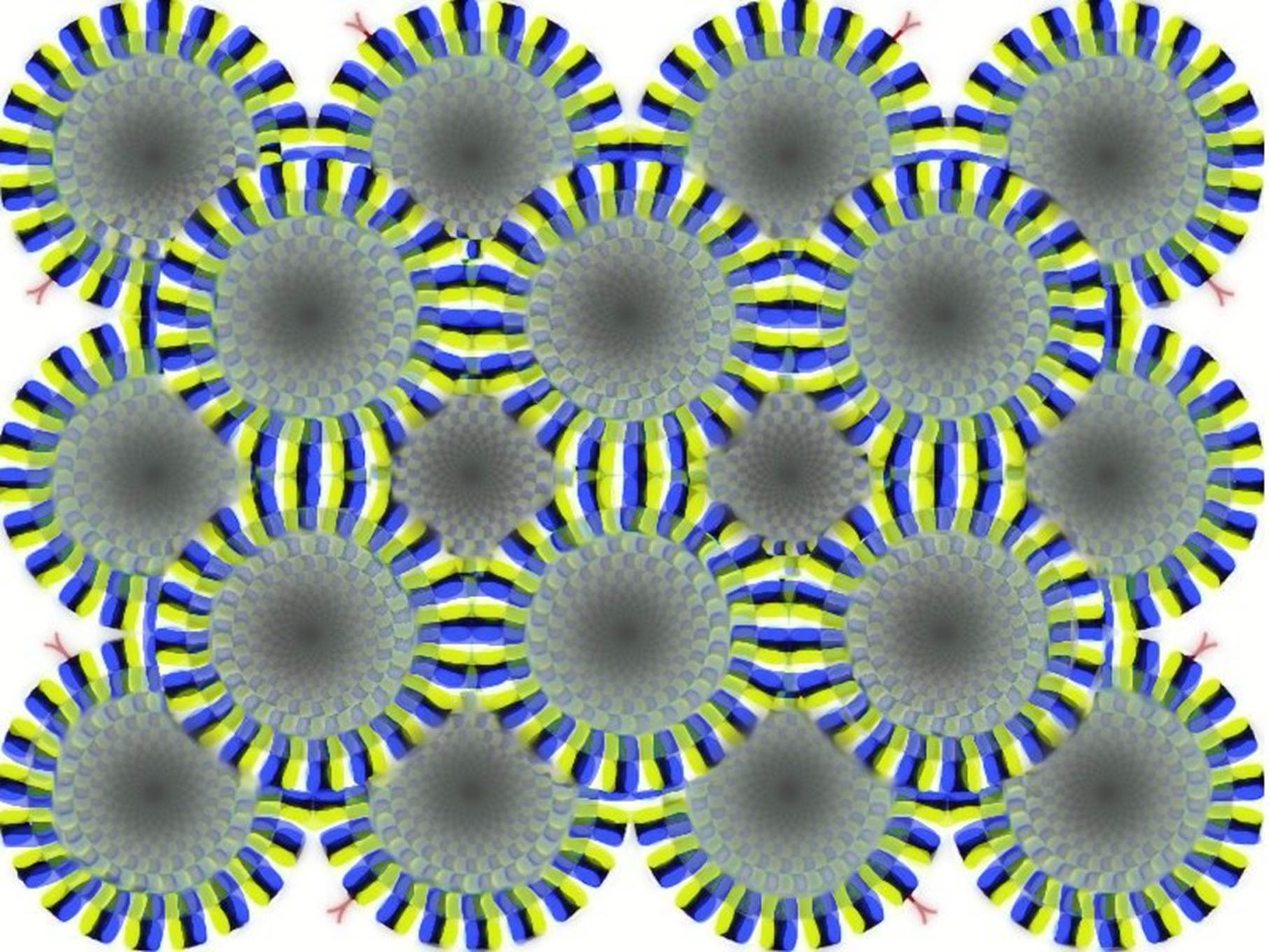
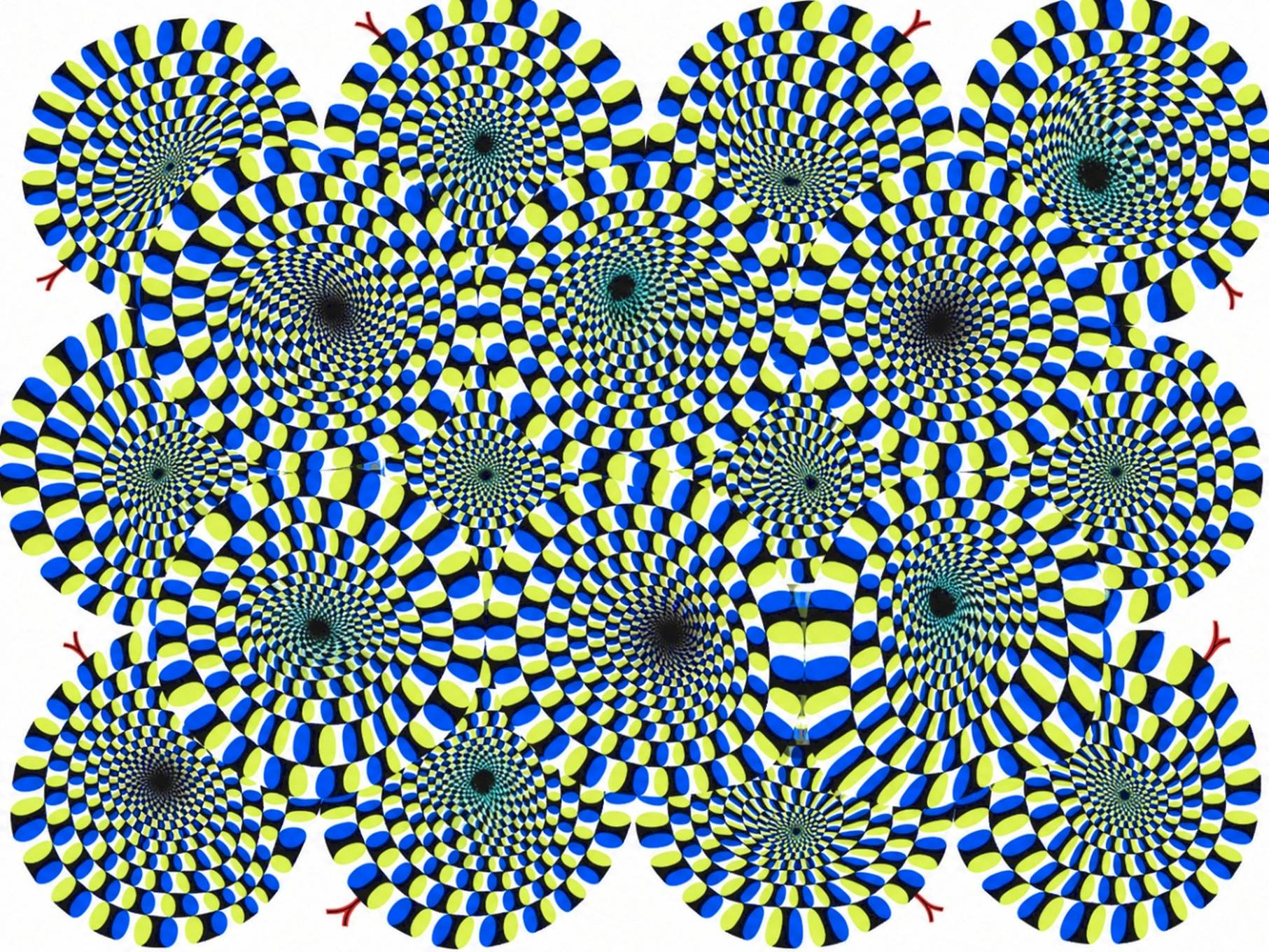
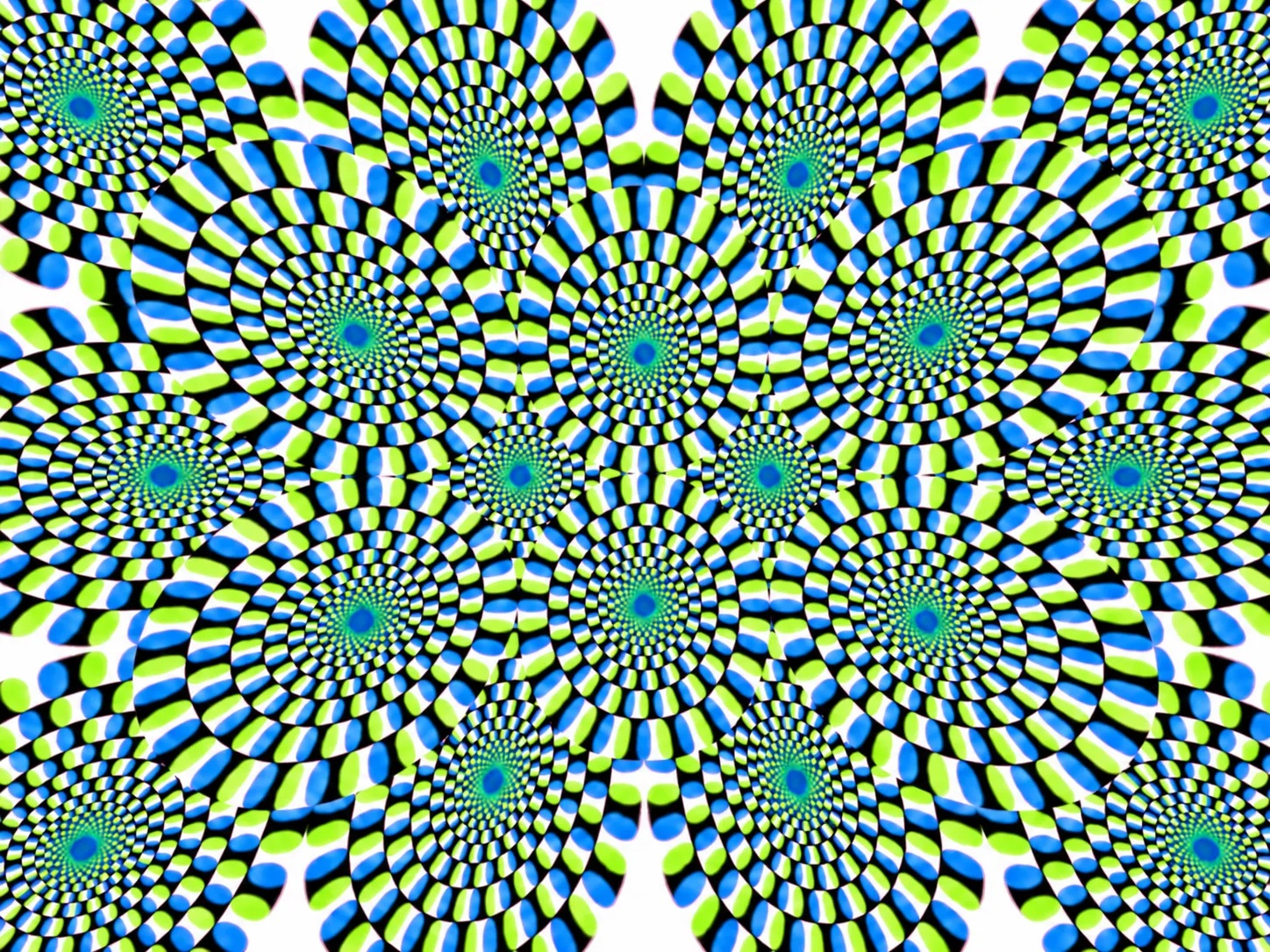
Anna’s reconstructions of how the rotating snakes changed over her session, phases 2 to 5. Her write-up goes through each phase.
Ruled surface
13:35
An animated curved surface made entirely of straight lines.
Note: This one is animated, so the counterclockwise lines and the pull on the head that Speaker 9 describes were following motion that is really there.
Speaker 1 (13:35): This is the ruled shape.So, this is the ruled shape.
Speaker 9 (13:40): This one was pulling my body sensations. It was pulling my consciousness too, almost pulling my head, and something behind my eyes, in the swirling motion. When I looked at it I didn’t notice all of these lines. I picked up only on the lines that were inclining, the ones moving counterclockwise. I didn’t see the other lines at all, so for me some of the lines were simply not visible.Yeah, so this one was pulling my body sensations, so I was like also kind of pulling my consciousness, almost like pulling my head, and like something behind my eyes in the swirling motion, and when I was looking at it, I didn’t notice all of these lines, I picked up only on the lines that were inclining, what is this? What is this direction like moving counterclockwise? Yeah, moving exactly, moving counter counterclockwise. And I didn’t, I didn’t see the other lines, so for me, like some of the lines were not visible. Interesting. Yeah,
Speaker 3 (14:21): I didn’t get a great deal out of it. There was a hint of it becoming three-dimensional, which was characteristically different from the sense of three-dimensionality I’d normally get on other tryptamines, mushrooms or ordinary N,N-DMT. That was hard to put my finger on. If I took a hit of N,N-DMT and looked at this, it would go very much “you’re on DMT, check it out in 3D now.” This was subtle and sober by comparison. Similar things were going on with the D panel, but I’ll come to that.yeah, kind of. I didn’t really get a huge amount out of it. There was sort of a hint of it becoming three dimensional, which was like characteristically different to the kind of like sense of three dimensionality I would normally get on like other tryptamines, like say mushrooms or regular N,N-DMT. That was very hard to put my finger on. I think, if I took a hit of like regular N,N-DMT and looked at this, it would like go very in a very sort of like, “Hey, you’re on DMT, check it out on 3d now. Whoa, oh my god, kind of way. Whereas this was like very subtle and sort of sober by comparison, similar stuff going on with the d thing, but I’ll get. To that,
Speaker 2 (15:02): For me the top looked very three-dimensional and the bottom looked flat. Not enormously different from how I perceive it now, though. Slightly enhanced.for me, the top looked very three dimensional, and the bottom looked flat. Yeah, but not so super different from, from my perception. Now, slightly enhanced.
Speaker 1 (15:18): Visually it didn’t look all that different. This is where I first noticed the visual-somatic coupling, though. I could tell it was pulling my body image downwards, creating a somatic illusion of downwardness.My, my main comment is that visually it didn’t look all that different. However, already here’s where I noticed, like, the visual somatic coupling, and I could tell, like, oh, there’s like it’s pulling my body image like downwards, it’s kind of creating this like somatic illusion downwards.
Speaker 4 (15:34): It didn’t look much different to me either, but I think it snaps into a gestalt better now than it did on 5-MeO. On 5-MeO it was more like separate lines. That’s in retrospect.I will add that I think it didn’t look much different, but I think now it’s snapping into like a big style better than 5-MeO, whereas in 5-MeO it was more like lines to me, but this is in retrospect, I think. Yeah,
Speaker 1 (15:51): okay,
Speaker 9 (15:53): Hearing that this isn’t three-dimensional for some people is interesting, because for me it is three-dimensional both sober and on 5-MeO. I also felt a bit of radiation from it, light radiating out.yeah, and now hearing that for some people this is not three dimensional, for me it is three dimensional, both sober and on 5-MeO, and and I also felt a bit of like radiation, like light kind of radiating from it. All
Speaker 3 (16:08): On somatic-visual coupling, which I know you’ve mentioned before: I very rarely get bodily sensations from visual stimuli. They have to be particularly ugly to generate anything like that, and when they do it’s usually unpleasant sensations in the head.right, just want to add like things like this. You might mention, I mean, I’m sure I’ve heard you’ve mentioned in the past, like somatic visual coupling, when someone looks at, say, like a visual stimulus or like covered oscillator type stuff, I very rarely get any sort of light bodily sensations from visual stimuli. They have to be particularly fugly to like actually generate that sort of thing, and generally it’ll be like unpleasant sensations in the head of some kind
Scintillating grid
16:40
A grey lattice on black, with white discs at the intersections. Speaker 3 looked up its name during the discussion.
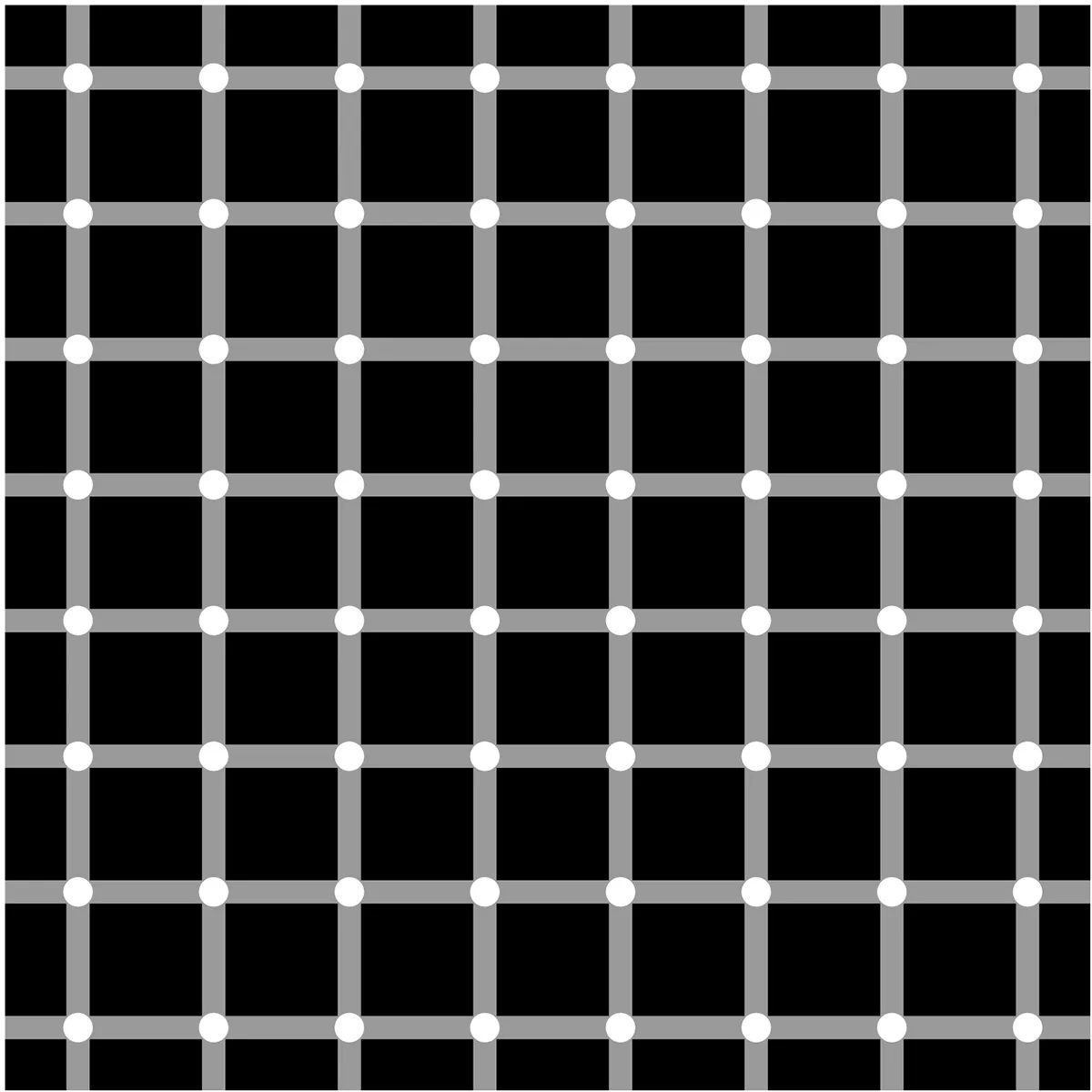
Note: This one produced the strongest and most varied reports of the set.
Speaker 1 (16:40): This one was also a highlight for me. Immediately I could perceive all the white dots at once. This was as I was coming up more strongly, and it alternated: sometimes all the white dots, sometimes all the black ones. It isn’t that the illusion went away, more that there was a strange segmentation where I could see the entire gestalt at once. That’s where I felt it: yes, this does symmetrify. The field really wants to see something symmetrical, a cube or something flat and coherent.
There was a threshold, too. Because I was coming up during it, I noticed that if the dose hadn’t been that high the effect simply would not have happened. It clicked at a certain point, and then it was clearly interacting with the state.next illusion, what is this called? It’s like this is like the illusory black dots illusion. I do want to start it for me. Also, this was one of the highlights. Immediately I noticed that, like, I could perceive all the white dots at once, like this, is also when I was like coming up stronger. The other ones, like, I was still thinking the process of coming up, and actually the alternated is like I could see all the white dots, and sometimes it’s like all the black dots as well, like it’s not like the illusion went away, it’s more that there was like some kind of strange segmentation, like I could see like the entire gestalt at once, and that’s where I felt like, oh gosh, yes, actually, this does, like, kind of like symmetrify, like the field really wants to see, like, just something symmetrical, like a cube, or like something super flat and coherent, and I noticed, like, there was a threshold, like, if I, like, because I came up during, like, during it, like, I was, like, really coming up, I noticed that, like, if the dose hadn’t been that high, like, that effect would just not have happened. The effect kind of, like, started to click, and it’s like, oh, wow. Okay, this is actually super interacting with the state. Okay,
Speaker 4 (17:53): I didn’t have a dramatic gestalt effect there. What I experienced was far more black dots than usual. There may have been some grid-like effects, but nothing as pronounced.I’ll add that I did not have a crazy gestalt effect there. I, what experience is like way more black dots than usual, like just like tones with them. There might have been some kind of interesting, yeah, like grid-like effects, but not as pronounced, for sure. Yeah, okay,
Speaker 9 (18:11): I noticed a big white area in the centre. There was black as well, of course, but the whiteness was really prominent and I had a feeling of brightness. Within the white lines there were even brighter dots. Only in the periphery, if I focused on the centre, could I notice some of the dots getting darker. I was surprised by how bright it was, because I didn’t remember it being that bright.yeah. For me, like, I noticed a big white area in the center. I mean, of course, there was the black, but somehow all the whiteness was really prominent, and I just like had this feeling of brightness, and then like also within the white lines there were even whiter, like even brighter dots, and only in the periphery I could maybe kind of, if I don’t look at the, if I just like focus on the center, I could notice that in the periphery some of the dots were getting darker, but I was surprised by how bright it was, because like from my memory I didn’t remember it so bright,
Speaker 7 (18:49): We picked this illusion for the logo of the Tracer Institute, so when I came to it there was a burst of joy associated with that, which may have mattered. I was drawn right into it.
The most salient thing is that normally there’s a very strong chasing effect for me with this illusion, where the eye wants to go to the place the black dot just was. That was completely absent. There was a sense of just looking at a three-by-three grid of white dots that didn’t do anything at all, while the rest of the field went on doing its thing with a great many black dots coming in. There were so many black dots that occasionally the foreground and background flipped, and black dots seemed to be replaced by illusory white ones. That kept flipping back and forth, and still with no chasing effect, which I found quite surprising.so we picked this visual illusion for the logo for the Tracer Institute, so when I came to this, there was this burst of joy for sort of associated to, you know, anyway, it’s I think it might have mattered. So I was very drawn into this, to the illusion. The most salient thing for me is normally there’s a very strong chasing effect in this illusion for me, that I’m looking at something and then the the eye wants to go to the place where the previous, where the, where the black.is and that was completely absent, so there was a sense of just looking at a grid, like a three by three grid of white dots that didn’t do anything at all, and then the rest of the field was just doing its thing with a bunch of black dots coming in, but there was so much black dots that occasionally it seemed like it, the foreground background flipped, so occasionally it seemed like there was black dots that were replaced by white by like illusory white ones, and that kept flipping back and forth that that effect, and still with no chasing effect, which I found quite surprising.
Speaker 2 (20:06): I went through several phases with this. At the beginning I saw white and black dots, everything filled with dots, slightly irregular, shifting with my saccades. I noticed the black dots had a faint white outline.
Then I focused on perceiving only the white dots, and it became a meditative exercise. At first I could perceive about nine at a time; I counted. As I focused further on seeing only the white ones, the black squares came into the foreground and the white lines took on some depth, as if the image were slightly three-dimensional. I could hold all the white lines in my vision at once, and over time the number of white dots I could see increased. At one point I counted sixteen. As I focused further still, there was a moment when one of the white lines, or perhaps a few of the vertical ones, disappeared.I went through different phases with this. In the beginning, I saw white and black dots. Everything was filled with dots, and it was a bit irregular, and it shifted with, I guess, my saccades. I also noticed the black dots had a faint white outline, and then I focused on perceiving only the white dots, and it became like a meditative exercise for me, and so I could, I could at first, if I, if I focused on, on only perceiving the white dots, at first I could perceive about nine of them at a time, I counted it, and then, so I focused more on just seeing the white dots and not the black ones, and what, what happened in this, in this process with this intention is the the black squares, they appeared more in the in the forefront, so and the white, the white lines, yeah, were like it became a bit like three dimensional, as if there was some depth, and so I could have all the all the white lines in my, in my vision, and I could with time the number of white dots I saw increased in between I counted and I was at 16 and as I focus on it further there was a there was a time where we’re one of the white lines, or maybe a few the vertical lines disappeared. Yeah,
Speaker 1 (22:11): awesome.
Speaker 10 (22:14): Briefly: wherever I looked, there appeared to be a whitish circle, everything white within a radius of about one to two lines, and everything outside that just black. If I looked at any corner there would be a little white circle in that corner and the rest would be black.Yeah, just briefly for me, I found that wherever I looked it appeared that there was like a whitish circle, or like everything was white within a circle that had a radius of like one to two lines, and then everything else was just black, and so if I looked at any corner, there would be like a little white circle in that corner, and then everything else would be black, which was interesting.
Speaker 5 (22:41): When I look at this now my attention is very jerky and angular. It jumps around and doesn’t settle anywhere. In the experience it was far more blobby. It was still irregular and asymmetric, but it was as though the spotlight of my attention had been liquefied and was morphing. The colour of the lines and squares and dots was very irregular, changing between black and grey and white, and I was starting to get some green and some red lines as well. Attention itself was melty and morphing, and the colours changed along with it.I would just say that when I look at this now, my attention is very jerky, like it’s very angular, and it kind of jumps around, and it really doesn’t settle anywhere. In the experience, it was way more blobby, and it was still very irregular and asymmetric, but it was like the spotlight of my attention had been liquefied and was morphing, so the color of the lines and the squares and the dots was very irregular and changing a lot between black and gray and white, and I was also starting to get some green and some red lines in it as well, and everything was kind of like the attention itself was very melty and morphing, and the colors kind of changing along with that
Speaker 6 (23:36): Quick data point: I got nothing. It looked completely normal.quick data point. I got nothing, it looked completely normal.
Speaker 3 (23:42): This one was strange. I’ll confess I did a poor job of memorising what was going on. What I can tell you is that within the spotlight of my attention, a circle maybe four or five white dots in diameter, the illusion looked normal, the way it does sober. Outside that region something about it was flipped or inverted, or the black dots were simply much more intense than usual. I’d have to look at it again to record what was happening. For the record, I looked it up: this one is called the Scintillating Grid illusion.Yeah, this one was weird. This one was.. I remember seeing you staring at this one, saying this is a yoyo, but, like, I will confess, I actually just did a bad job of memorizing what the hell was going on. What I can tell you is that within the spotlight of my attention, say maybe about four or five white dots in diameter. Imagine drawing a circle that size. The illusion looked normal, like it would do sober. It was outside of that region. It was like something about the illusion was like flipped or inverted, or somehow, or maybe the black dots were just simply much more intense than usual. I’d have to like look at it again to record was going on. For the record, I looked it up. This one’s called the Scintillating Grid illusion, that’s the actual name for it.
Persistent Fool’s replication of the scintillating grid as it looked on 5-MeO-DMT. Try the interactive version, or read his retreat reflections.
Illusory contours, four panels
24:30
Four panels: (A) a Kanizsa triangle, (B) an illusory curved form, (C) an illusory sphere and (D) an illusory snake.
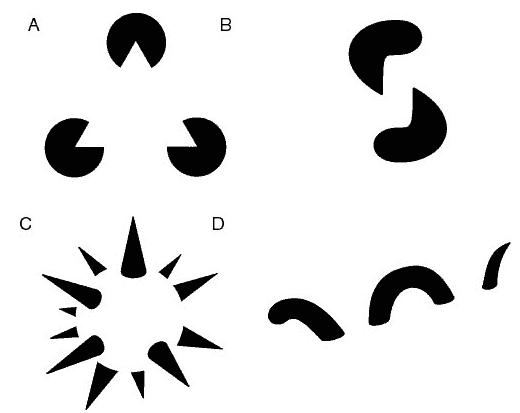
Note: In the discussion, the sphere that looked more three-dimensional is C, the snake that broke into three segments is D, and the triangle that felt stronger is A.
Speaker 4 (24:30): For me A, B and D didn’t produce anything interesting, but C produced an enhanced sphere, more three-dimensional than usual. The sensation and the gestalt were weakened for me, particularly in D. Looking at it yesterday my mind would build the curves of the snake, whereas on 5-MeO I perceived it as three separate parts and had to squint, metaphorically, to see it as a single snake. Even right now I feel like I’m seeing three separate parts, and it’s somewhat bistable.
I wonder whether for C, the ball, 5-MeO had a flattening effect on depth. If it flattens depth during the trip, perhaps it flattens it here too.All right, I’ll move to the next one. I’ll just say real quick that for me A, B, and D didn’t produce anything interesting, but C produced an enhanced experience of a sphere, like the sphere was like more three dimensional, essentially. I think the sensation and gestalt was weakened for me, particularly in the D. I remember looking at it yesterday, and my mind would like build like the curves of the snake, whereas on 5-MeO I would perceive it as like three separate parts, and I’d have to kind of squint, metaphorically speaking, to see this is single snake, and even right now I feel like I’m seeing three separate parts, and it’s a bit of a dual, like what is called bistable picture, a was vegan B, and to understand what gestalt was supposed to be seen. See, I think was last d, it was just d, yeah, but now it looks like d is popping out. I wonder if that’s really, I wonder that for C, the ball, the 5-MeO DMT had some kind of the flattened depth effect, so if it flattens depth for you at the trip, it flattens also this visual MC
Speaker 6 (26:13): I agree about bistability in the illusory contours. With some voluntary control I could say, now I’m really seeing the illusory contours, versus suppressing them, and that shift felt easier to control in the state than it does normally. The illusory contours were also a bit more glowy, which would be quite easy to replicate.agree about about bistability, illusory contours, and with some voluntary control, could I think, could be like, okay, now I’m really seeing the illusory contours versus kind of suppressing them, and that shift felt easier to control in that state than normal. Also, the illusory contours were a bit more glowy, which would be quite easy to replicate.
Speaker 3 (26:45): Nothing to report. This one was unremarkable on 5-MeO.Nothing to report. This one was unremarkable. In 5-MeO,
Speaker 7 (26:50): I agree with the previous speaker.agree with previous speaker.
Speaker 2 (26:53): For me A felt stronger, a more pronounced triangle sensation. C also felt stronger and more three-dimensional. I didn’t quite understand B while on the substance, though I see it clearly now.For me, a felt stronger, so I got a more pronounced triangle sensation. C also felt stronger. It felt more three dimensional. I didn’t quite understand B on the substance, but now I see it clearly. So, so this one seems better. A normal, yeah. an
Speaker 4 (27:25): illusory
Speaker 2 (27:31): For D there was no difference. One interesting effect: after looking at it for a while it felt as though the black parts were cut out from paper. Again I had that depth sensation.cylinder, so for D, no, no difference, and one interesting effect was that I, after looking at it for a while, it felt like the black parts, it’s something that, that is cut out, like in from paper, so I, again, I had this depth sensation.
Speaker 8 (27:52): Yeah,
Speaker 5 (27:56): They felt quite strong and jumped off the screen a little, partly because these shapes felt resonant with the space, with the curves and the contrast between black and white. Enhanced, but only mildly. And there was the sense that the black parts were not flat with the screen the way they are now, but on a separate layer further forward.just for me, I found that they felt quite strong and kind of jumped off the screen a bit, I think. Also, just because these shapes felt really quite resonant with the space, with the kind of curves and the contrast between black and white, so really just a bit enhanced, but only mildly, and yeah, the sense that the black parts were like not flat with the screen like they are now, but actually like on its separate layer further forward.
Speaker 4 (28:33): One thing I’m realising is that we should think about the size of the picture on the screen. Right now it isn’t taking the full size, and that may actually be good, because if you spread the picture out the gestalt becomes less obvious. So it’s an open question for all of these images: how big should they be? If you have feedback, let me know.Yeah, one note that I’m now realizing, maybe some of them, you and I have probably should think about, like, the size of the picture on the screen, because right now, right now, it’s not taken the full size, and maybe that’s actually good, because if you spread out the picture, the gestalt is going to be less obvious. So, yeah, the question for all those images, how big they should be? If you have feedback, let me know.
Speaker 1 (28:58): Cool,
Nine classic geometric illusions
29:00
Delboeuf, Ebbinghaus, Hering, Judd, Müller-Lyer, Poggendorff, Ponzo, vertical and Zöllner illusions.
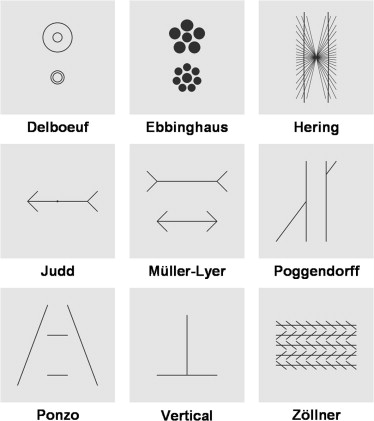
Note: The image was small, and two people found it too small to judge. Ponzo and Ebbinghaus are both in this figure.
Speaker 4 (29:00): This one should definitely have been bigger.that this one should have definitely been bigger.
Speaker 2 (29:02): Yes. This was just annoying.Yes, yeah, this was just annoying. Okay, yeah,
Speaker 1 (29:08): That falls on me, I was trying to throw too many things at once. I spent two or three seconds on each of these, and they were mostly unremarkable except Ponzo. There the illusion felt less strong. The top line is supposed to look longer, and in the state I could tune into the two lines and see them as the same length more easily.that falls on me. That was just kind of trying to throw too many things at once. I will report that of all of these ones, I spent like two or three seconds on each of them, mostly unremarkable, except Ponzo. I noted that, like, the illusion felt less strong, although right now I also doesn’t feel like it’s very strong, like it’s supposed to be like the top line should look like bigger or, sorry, smaller, and I think on the state or longer, sorry, longer, it’s supposed to look longer, and I remember in the state I could just like tune into those two lines like looking the same more easily
Speaker 4 (29:47): At some point in the trip I heard James laughing very hard at the laptop, and he said the Ebbinghaus illusion was funny because he could flip it.I have at some point of the trip I heard James laughing really hard about the laptop and I remember that he said that the gosh What is those the. Ebbinghaus illusion was really funny, that he could flip it at real inside Google. Who said that? I remember you explained why you laughed, and it was something about visual illusion. Did he did the, but this one about the circles
Speaker 5 (30:17): That was yesterday.one I did yesterday. Yes, yesterday says that’s
Speaker 4 (30:20): what I’m saying. Yesterday, you said that
Speaker 5 (30:22): I wasn’t flipping it deliberately. It was changing spontaneously, like a Necker cube.I wasn’t flipping it, it was like spontaneously changing, like a neck a cube.
Speaker 4 (30:26): So I went to look it up, the usual version with two orange circles, and I learned to flip it, and I think I have a reasonable model of how to replicate it. It felt as though there were bubbles pressing on each other, containing some force. If I moved my attention away from the centre of either dot and held the two of them separately in attention, they would try to equalise, not quite to the same size but towards it. It feels as if there is a simple mathematical model of two forces acting on each other, and we could try to work out the parameters. Move attention away and they equalise, but there is a pressing force, and some stable equilibrium that comes out of those two.Yes, yes, yes. Like, so I went to check it out in the Google, that the better, better visual, usually like two orange circles, and I kind of learned to flip it out, and I think I have a pretty good model of how to replicate it. It felt like there are so bubbles pressing on each other, a bit like right, and they kind of contain force, and if I moved my attention away from like any center of the dot into the kind of like two hell holding them to them in my attention separately, they would try to equalize, not quite to the size, but yeah, essentially it feels like there is some kind of simple mathematical model of like two forces acting upon each other, and we could like try to figure out parameters, right? You move attention away, they equalize, but there is like this pressing force, and there is some kind of stable equilibrium that comes from those sources, yeah.
Speaker 6 (31:26): I agree about making the Ponzo illusion disappear with some voluntary control, and being able to flip back and forth. I can still do it sober, but it seemed easier in the state. That parallels the bistability and voluntary control we saw earlier.Agree, that agree about like making the Ponzo illusion disappear with some voluntary control, be able to flip them, flip back and forth, can still do it while sober, seemed easier in the states, seeing parallels to some of the previous, like bistability, voluntary control thing,
Speaker 3 (31:48): I got annoyed with how small it was, made it bigger, and then found myself staring at a great many illusions at once.I just got annoyed with how small it was, and then I made it bigger, and then I was just staring at a bunch of entire
Speaker 4 (31:55): liaison, so
Speaker 7 (32:00): I skipped that one.yeah, I just skipped that
Speaker 1 (32:02): Same.same. If you don’t have
Speaker 4 (32:11): anything to add, you don’t need to say that this one.
Sasha found that on 5-MeO-DMT he could cancel the Ebbinghaus illusion by moving his attention to the space between the two groups of circles. He describes this in 5-MeO-DMT sometimes cancels the Ebbinghaus illusion, and his replication lets you move the point of attention yourself.
Neon colour spreading (Varin)
32:16
Four groups of concentric circles whose inner arcs are blue. There is no blue disc in the image.
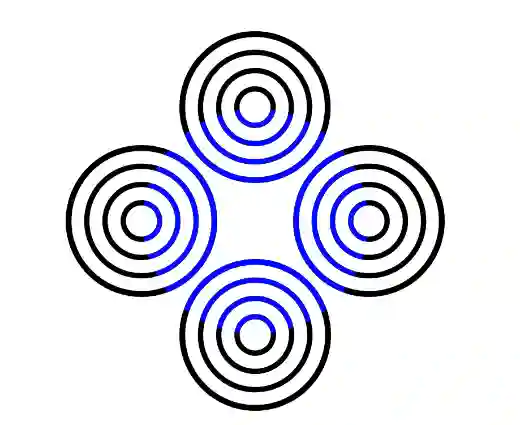
Note: Someone noticed faint blue pixels inside the disc, and they are there. The image compression added a slight blue tint in that region, too faint to notice consciously, while the corners of the image stay pure white.
Speaker 1 (32:16): This one was significantly intensified for me. At some point I knew metacognitively that there was no blue circle, but in the moment, if I hadn’t known, I would have felt someone was tricking me, that they had actually put a blue circle there.This one was like significantly intensified in my case, to the point that, like, at some point, I mean, I knew metacognitively, okay, like, there’s no blue circle, but in the moment, if I hadn’t known, I felt like somebody was tricking me, and it was like, oh, they, you actually put a blue circle there, oh my gosh, like,
Speaker 4 (32:36): It’s not blue, it’s just an illusion. They only coloured the lines.holy shit, it’s not blue, it’s just like an illusion, they just color the blinds, yeah,
Speaker 9 (32:41): I don’t follow. How does that work?well, I don’t, I don’t get it. How does it help? Like,
Speaker 1 (32:45): The lines are blue, but the centre is exactly the same as its surrounding, and there is nothing connecting the blue lines between the circles.I mean, the lines are blue, but the center is exactly the same as its surrounding, and there’s like nothing connecting the blue lines between the circles,
Speaker 7 (32:55): There’s no blue in between the lines either.and there’s no blue in between the lines either.
Speaker 1 (32:57): Exactly. In the state it was remarkably intensified for me, and the blue circle also seemed to sit at a different layer, either closer or further away. It almost felt as though somebody had tricked me and there really was a blue circle there.Exactly in the state, it was like very for me, remarkably intensified, and the blue circle even also seemed to be like kind of like at a different layer, kind of like either closer or further away from me, and almost felt like, did somebody trick me, and this is like actually there’s actually just a blue circle there. Okay,
Speaker 4 (33:18): I was thoroughly taken in by it, and I’m only now realising there is no blue circle. There was a blue circle on 5-MeO, and it was quite strong. Right now it isn’t strong at all.I was really tricked by the illusion, and now realizing that there is no blue circle. I should have taken the red pill. Yeah, I think there was a blue circle in 5-MeO, and I think it was quite strong. And my impression is, yeah, right now it’s not strong.
Speaker 1 (33:38): This is great data.Okay, this is great data. I love it. Okay, and I
Speaker 2 (33:42): Are there some blue pixels? I had a strong impression of it. I can see some very light blue pixels in between here.just wanted to ask, are there some blue pixels? Because I had a really strong impression. I’m seeing some very light blue pixels in between here, and yeah, we can
Speaker 1 (33:57): We can do an image analysis on that.do a Photoshop analysis
Speaker 2 (34:02): now. if you look
Speaker 4 (34:03): Look very closely. Closer than that.very, very closely, you might notice even closer than that. Look very, very close, even closer than you are looking now, like this, even closer. If she’s any closer,
Speaker 7 (34:21): If she gets any closer she’ll be on the other side of the screen.she’ll be on the other side of the screen, but it looks
Speaker 2 (34:22): It does look like there’s something there.like there’s something.
Speaker 1 (34:24): I wonder whether there are compression artifacts.I wonder if there’s like compression artifacts. Yeah,
Speaker 2 (34:28): I think there’s something. And that sense was really enhanced.I think there’s something. And this got really enhanced the sense of,
Speaker 1 (34:39): There is something. They’re not blue, they’re slightly green. Something in there is not perfectly smooth.well, there is. They’re not blue, they’re like slightly green. I think we should have five. Yeah, there’s something that is not perfectly smooth.
Speaker 3 (34:49): It’s covered in JPEG artifacts.It’s covered in JPEG artifacts, exactly.
Speaker 1 (34:51): I should have found a higher resolution version.So, I should just have found a higher resolution
Speaker 2 (34:56): that really got.. I perceived it good by.
Speaker 1 (35:00): A quick comment on that: in general, not only here, I’ve found that JPEG compression artifacts interact in very strange ways with the visual field on 5-MeO. I’ll put it on the table that this sounds like a viable method for a new kind of psychedelic cryptography.It, I guess, like a quick comment on that is that I also, not in this case, but in general, I have found that JPEG compression artifacts on 5-MeO”>5-MeO interacts in very strange ways with the visual field, which to me I will just put on the table, this sounds like a possible viable method for a new type of psychedelic cryptography. Okay, anybody else on this illusion? Yes,
Speaker 9 (35:25): For me it was vibrating very beautifully, forming something like an orb, and it had glitter. I found it very pleasant, and I even got the sense that aliens were coming through, or that a portal was opening. It was groovy. I wanted to keep watching it, and then I became aware that I was supposed to be doing a test.yeah. For me, it was vibrating very beautifully, and it was like forming almost some kind of orb, and it had glitter, and I found it very pleasant, and I even got this sense, oh, aliens are coming through, or like a portal is opening, like, so it was really groovy. I was like, I want to keep watching this, but then I became aware, okay, I’m doing a test here.
Speaker 11 (35:47): Yeah, what do you
Speaker 4 (35:51): mean?
Speaker 6 (35:54): A little enhanced, and slightly more glowy than usual.Maybe a little bit enhanced, also a bit more glowy than usual, slightly,
Speaker 12 (36:00): June. so
Speaker 3 (36:03): When looking at images with bad JPEG artifacts on N,N-DMT, I generally find that they get smoothed over by the natural symmetrification effects of the drug, and I think something like that was probably going on today, because I noticed no JPEG artifacts on 5-MeO.
The illusion itself was strikingly strong, and it would be straightforward to replicate in Photoshop in about five minutes. Draw a blue circle, set the transparency to around five to ten per cent, perhaps five. Make sure the blending mode isn’t one that simply layers maximal blue over the white; it should make the white more saturated. If I were being fancy I’d use Illustrator and its extended gamut features.
One important detail: there was a blur at the edge of the blue circle, of roughly one to two times the width of one of the black lines. I’d apply an ordinary Gaussian blur to that mask.when looking at images with like terrible JPEG artifacts on them, I actually do generally find on, say, like N,N-DMT, that stuff tends to get smoothed over by the natural symmetrification effects of the drug, and I kind of think something like that was probably going on today, because I did not notice any JPEG artifacts on the 5-MeO. The illusion itself was like very strikingly strong. I think would be very straightforward to like replicate in Photoshop in like five minutes, so like over to describe it, I would say that like yeah, just like draw blue circle in Adobe Photoshop, set the transparency to, like, I don’t know, five to 10% or something like that. Yeah, maybe 5% Ensure that the blending mode is one that doesn’t just, like, mindlessly layer, like regular, like maximal blue over the white. It should actually make the white more, like, saturated. Maybe even, like, if I was getting fancy, I’d use, like, Illustrator, yeah, I’d probably use, like, the extended gamut features, just to, like, kind of wank off and Photoshop a bit. I would also add, this was an important detail, there was, like, a blur to the edge of the blue circle, of maybe around, like, maybe around, like, if you take the, like, width of one of the black lines, maybe it was like one to 1.5 to maybe 2.0 times the width of one of those black lines. I’ll just apply like a regular Gaussian blur to that mask.
Speaker 1 (38:16): Something like that, yes.I think. Yeah, something like that. The
Speaker 7 (38:21): body keeps a strobe, so, so it would vibrate from the circle being fully there to something like this, like to the ring, to the thing coming back to the ring, and extremely stably like that, and the vibration was quite attractive,
Speaker 1 (38:39): like you get the
Speaker 2 (38:46): awesome, thank
Speaker 5 (38:49): I basically can’t see the illusion now and I couldn’t see it then either, but I had an interesting effect with this one, similar to the first. Now, looking at it, my attention bounces around. In the experience the four centres of the circles were in attention at the same time, really locked in, and it became significant, as though the thing were looking into my soul and had an intelligence.
What I’m remembering with this one, and with the first one, is the gravitas these dots take on. It’s a bit like visualisations of spacetime being drawn down into a funnel at a black hole. There is a sense of spatial deepening, a bend in space going in towards the centre of the dots, and it’s felt in the body. It really captures you.you for me. I basically can’t see the illusion now, and I couldn’t see the illusion then, but I did have really interesting effect with this one, which was similar to the first one, where now, when I look at it, my attention bounces around a bit, but in the experience it was this, the four centers of the circle were kind of in attention at the same time, really locked in, and it became really significant, and like this thing was looking into my soul, and like, it had an intelligence, and he has something that I’m remembering with this one, and with the first one as well, is it’s that that gravitas that these dots come to take on, it’s almost a bit like when you see visualizations of like space time, you know, getting sucked down into a funnel at a black hole, you know, there really is this sense of some sort of spatial deepening, there’s this bend in space kind of going in towards the center of the dots, and that that being. Felt in the body like you can, it’s yeah, it really captures you when you feel that.
Speaker 3 (40:45): it is
Sasha’s neon colour spreading PDP, with a color gradient and flicker I added. Adjust the tint until the real disc on the right matches the illusory one on the left; the tint you settle on is a measure of how strong the illusion is for you. Open it on its own.
Spiral coupling kernel in a field
40:48
Note: Six cycles a second falls in the theta range, below alpha. If the idea raised at 45:40 is alpha entrainment, this stimulus was driving a slower rhythm than that.
Speaker 1 (40:48): These are all on GitHub and on the Drive.
This is the spiral coupling kernel in a field. I spent a good deal of time on it, probably at the peak of that session. It interacted strongly with my somatic field, less through the colours than through the flow of the pseudo vector field. It also felt extremely electromagnetic, and it purified and simplified my sense of space, as though there were a mirror image of it inside my body. In some sense it was flattening, it made my body a little flatter, and at the same time it felt healing to look at. Very harmonious, and very much the spiral of life.on GitHub, I mean, all of these are, yeah, and on the Google Drive. Awesome. Thank you. Thank you. I, this is the spiral coupling kernel in a field, I spent a bunch of time on this, and also probably at the peak of my trips during that session, and I just noticed, like, it really interacted with my somatic field, less of the colors, and just like the flow of the kind of pseudo vector field sort of thing, and it also felt extremely electromagnetic to me, and kind of like would purify and simplify my sense of space, and literally as if it was kind of like there was like a mirror image of these, but in my body, and in some sense it was kind of like flattening, it’s kind of like made my body a little bit more flat, at the same time, it actually felt kind of like healing to look at this, and it was like very harmonious, very kind of like meta-like, and very kind of like the spiral of life sort of thing. Anybody else on this one? Yes,
Speaker 4 (41:54): I didn’t get much from it. I felt some coupling in my body, but that was all. The Hopf cube yesterday was stronger, though I also stared at that for longer. There was definitely some coupling here, but very mild.I didn’t get anything that’s done. I did fail some coupling in my body, but that’s it. I would say that the Hopf cube yesterday was stronger. However, I also stared at it for longer. It was definitely some coupling, very mild.
Speaker 9 (42:13): I also felt the coupling quickly, but it made me a little dizzy. It twisted my sense of perspective, or of balance, so I moved on quickly. I watched it for a few repetitions and could clearly feel the coupling, but sitting up I started thinking I might fall over or lose my balance, so I wanted to move to the next one.Yeah, I also felt very quickly some coupling, but for me it was making me a little bit dizzy. Also, like it was kind of twisting my sense of perspective or balance, and I very quickly moved to the next one. So I looked at this one for a few repetitions, and I could like clearly feel the coupling, but as I was sitting up, I was thinking, okay, maybe I will fall over, or maybe it will kind of cause me to lose balance, so I, I wanted to move to the next one, and then the next one. Okay, we can comment that later. Can you
Speaker 4 (42:52): Can you say where in the trip you were when you looked at it?imagine the point in the trip? You can imagine the point in the trip that you will look at.
Speaker 1 (42:59): More useful than that is how high you were, from zero to ten.I think even more than that is just like, how high you were from zero to 10.
Speaker 4 (43:02): I was definitely coming down, relatively close to baseline. Ten or fifteen minutes later.I was definitely coming down, and was relatively baseline. It was like,
Speaker 1 (43:07): yeah,
Speaker 4 (43:08): 1015 minutes later, yeah,
Speaker 8 (43:10): a lot. This
Speaker 1 (43:11): This was at my peak, so about a four out of ten for 5-MeO, which is a lot.was like on my peak, so it was kind of like a four out of 10 effects, as far as kind of 5-MeO, which is a lot.
Speaker 13 (43:17): This is making me a little nauseous, so I’m going to step away for a while.This also making me a little nauseous, so I’m just gonna go for a while. comment
Speaker 9 (43:24): On dose: I took one puff, and this was at the peak of it.on the dose, yeah. So, for me, I took one puff, and this was like at the peak of that. So,
Speaker 6 (43:33): Nothing much to report. It’s a wave, and I felt waves, but this particular wave didn’t feel resonant with any of the waves I felt.nothing much to report. It’s a wave. I felt waves. This particular wave just didn’t feel particularly resonant with any of the waves I felt,
Speaker 3 (43:44): This one did absolutely nothing for me.yeah, this one did absolutely nothing for me.
Vertical coupling kernels
43:51
Screen recording, at the same 6 Hz as the spiral before it.
Note: This is the central-channel stimulus. Since it runs at the same frequency as the spiral, frequency alone probably does not explain why some people found it pleasantly embodying and others nauseating.
Speaker 1 (43:51): This is the vertical coupling kernels I talked about in my session, and I made a drawing of it, so I won’t dwell. It felt healing and electromagnetic, and it simplified my energy body. I’m interested in exploring it further. It read as a gestalt: rather than my attention darting between dots, the whole thing cohered. I was at maybe four or four and a half out of ten, so fairly intense.Then this one, which is the vertical coupling kernels I talked about in my session, and I made a drawing about this, so I’m not going to dwell on it, but this one felt like healing and electromagnetic, and like simplified my energy body, and like overall interested in exploring this further. It looked like a gestalt, so like rather than my attention just kind of like darting between dots, it was just like the whole thing, and just like everything cohering into it, and I was maybe at four out of 10 or 4.5 out of 10, so like pretty intense. Anybody else on this one? This
Speaker 7 (44:24): This one felt really pleasant along the central channel. Andrés had primed me to look for the central-channel effect, or I overheard him mention it to someone. It had the odd effect of feeling so naturally inside my body that I kept closing my eyes to be with the experience, which made the experience go away. So I would open my eyes, and it was extremely pleasant, so I would close them again to be with it. That repeated three or four times before I got the message.one felt really pleasant along the central channel. Andrés primed me for looking for the central channel effect with it, or you mentioned it to someone and I overheard it, or something like that. It had this interesting effect of feeling so incredibly naturally inside my body, that I kept closing my eyes to be with the experience, which made the experience go away. So I opened my eyes, and it was extremely pleasant. So I closed my eyes to be with the experience, and that repeated maybe three or four times before I got the message
Speaker 3 (44:57): Did absolutely nothing.again. Did absolutely nothing.
Speaker 14 (45:00): Okay, no response. Yes, cool.
Speaker 9 (45:05): I had a similar experience to the previous one, and I was probably primed by your saying we should focus on the central channel. It was very intense, and coming after the previous stimulus I remember thinking first that it was brilliant and I wanted to play with it further, and then that I wanted to play with it outside this experience, because I wasn’t sure whether I would get nauseous, or lose my balance or my sense of direction. So I moved on.Yeah, I had a similar experience as with the previous one. I think also I was primed by you saying that it was kind of that we should focus on the central channel, but again, like it was very intense, and in this moment, especially after the previous one, I remember thinking, first, oh, wow, this is really brilliant. I want to play with this further, but then I thought, okay, I should, I want to play with this outside of this experience, because I’m not sure if I’m gonna get nauseous or not, like, or if I’m gonna lose my balance or lose my sense of direction or something like that. So that’s why I moved on.
Speaker 4 (45:40): I’ve spent a little time thinking about creating visual stimuli tailored to your brain waves. If you read someone’s alpha rhythm and tailored the frequency to it, that might produce something, since alpha is fairly heavily implicated in visual processing. I don’t know.I led that I spend a little bit of time before thinking that of creating those visuals, visual stimuli tailored to your brain waves, like maybe if you read your alpha rhythm and then tailored the frequency to your specific alpha rhythm, they may produce something, because alpha rhythm is pretty heavily implicated in visual processing, but I don’t know,
Speaker 1 (46:03): You’re suggesting a kind of biofeedback interaction.suggesting like some kind of like biofeedback interaction
Speaker 4 (46:07): With feedback, yes.with feedback, yeah.
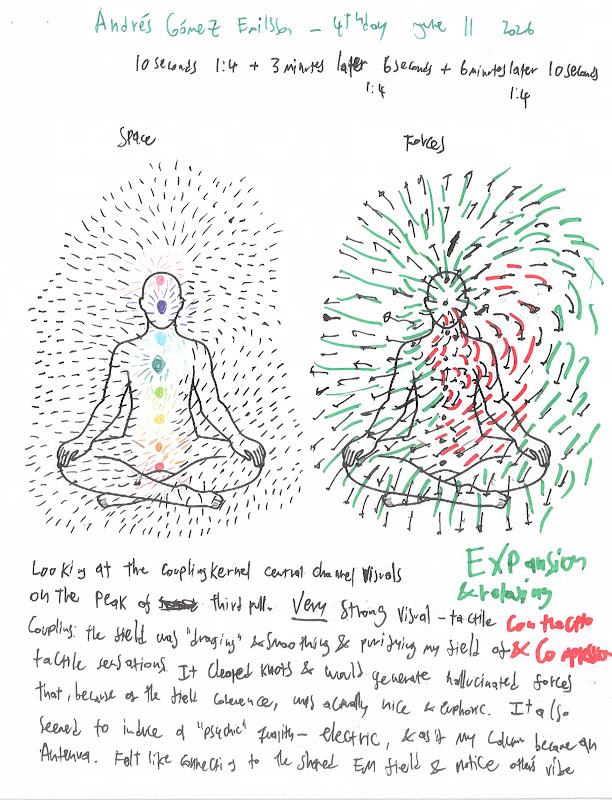
My drawing made right after looking at this stimulus on 5-MeO-DMT: the field as space, and as forces, with expansion in green and contraction in red. More in Coupling Kernels Embedded in a Vector Field on 5-MeO-DMT.
Tracer tool
46:10
A blue ball moving around a central fixation cross. The ball is drawn as a many-sided polygon.
Note: The ball follows a Lissajous path with two upper lobes and a lower point, so its overall shape is in fact heart-like, as Speaker 9 saw. Each lobe takes about a second and a half, close to Speaker 3’s estimate of their own tracer rhythm.
Speaker 1 (46:10): Next, the tracer. I’ve seen this before on 5-MeO, but this time I took the time to get a clean picture. It was strobing, and it was monochrome, so less of a replay effect, and strobing fairly fast.
The field at that point wanted to be black and white. The blue was almost noise, as though my field wanted to see it as either black or white and the colour was an extra input evaporating. Any time I did notice it was a blue dot, the tracer was monochrome blue, with an aura around it that was white or transparent. By monochrome I mean simply blue, as opposed to alternating between blue and other colours.Okay, awesome. Next one, the tracer real quick for me. I’ve seen this before on the 5-MeO, but I definitely took the time to try to get a clean picture was strobing, and it was like monochrome, so like less of a replay effect, and yeah, I’m actually kind of like strobing fairly fast, and the field at this point wanted to be actually black and white and monochrome, so like the blue was kind of like a noise sense to some extent, it’s kind of like, oh, my field wanted to see it as like either black or white, and the color was kind of like this, not this other input, kind of, you know, evaporating, but anytime I noticed, like, oh, this is actually, yes, a blue dot, the tracer was like monochrome blue, and there was like an aura to it as well, which was kind of like white or transparent, ish, what is the monochrome blue? Oh, it just means like it’s just blue, as opposed to like it’s alternating between blue and other colors.
Speaker 4 (47:06): I didn’t see a trail. I saw two, three, maybe four light blue circles where the circle had been, but not as a trail, more as a few after-images.I think I didn’t see like a trail effect. I saw two, three, maybe four light blue kind of circles, but where the circle was, it wasn’t like a trail, more like, more like a few after images. Yeah,
Speaker 9 (47:28): I couldn’t see a trace after looking at it for a while. I could see that it was forming a heart, and I was seeing the heart, but I couldn’t tell whether that was the expected effect. I see the heart less now than I did during the trip. I could see the line of the heart, but not the trace of the dot.yeah, I couldn’t see a trace after looking at it for some time. I could just see that it was kind of forming a heart or something like that, and I was just like seeing the heart, but I couldn’t understand whether that was the expected effect or not? I think now I see the heart less than I saw it during the trip. Yeah, like I could kind of see the line of the heart, but not the trace of the dot.
Speaker 6 (47:56): I don’t think I was very high. I got no tracer here, but then I waved my hands in front of my face and saw faint tracers. There’s something about a computer screen that differs from the continuous motion of a hand, low frame rate or something. An interesting data point.I guess I just wasn’t very high. I got no tracer here, but then I waved my hands in front of my face and saw faint tracers. There’s something about this on a computer screen that’s different from the continuous motion of a hand, like low frame rate or something, something. But that’s an interesting data point.
Speaker 3 (48:21): Part of the trick to getting the traces is that rather than following the ball with your eyes, you rest them on the central cross and let it do its thing. I can do that now and get relatively smooth traces behind it, though I have some amount of that day to day anyway.
As I said earlier, I had a fairly mediocre bodily-vibes profile on the 5-MeO. If I’d done this yesterday I think I would have got smooth traces. Today there was a slow stuttering to the tracer, something like 0.7 hertz, or perhaps 1.7. I read asymmetric bodily vibes as the generator of negative mental patterns, and this seemed an interesting way of gauging that. I had got into a fairly asymmetric, arrhythmic, janky state.So part of the trick to get the traces is you actually do need to, like, rather than follow your eyes around with the ball, rest your eyes on the central cross here, and like, let it do its thing. Now, I mean, I can do this now, and there’s like relatively smooth kind of traces behind it. I mean, I normally have some amount of that day to day, anyway. On five, like I described earlier in the meeting, I had a pretty kind of just like mediocre bodily vibes profile with the five, and like notably comparable to the experience, and like I think if I’d done it yesterday I would have got smooth traces. Think I did it today, there was a slow sort of like doink doink doink doink doink to the tracer, which was like maybe, yeah, I don’t know how many, yes, something like 0.7 hertz or something, it was maybe, well, I don’t know, 1.7 hertz or something random like that, certainly. Certainly, like, I read stuff like that, like, like asymmetric bodily vibes, as like generating, like the generator of, like, you know, negative mental patterns, for instance. And, like, this seemed like an interesting way of gauging that, like, I actually had gotten into a, like, pretty asymmetric, an arrhythmic, punky state,
Speaker 1 (49:42): So the tracer reflects your reading of yourself.a reflection of your readings.
Speaker 3 (49:44): Not so much a reflection of the valence. Take the bodily vibes as the generating function of experience: along one dimension that cashes out as janky traces, along another as janky thought patterns.Oh, not so much a reflection of the valence as just like actually just like take the bodily vibes as the generating function of experience, and one dimensionality that will cash out to like janky traces, another dimensionality that will cash out to like janky thought patterns.
Speaker 1 (49:59): Is there? Yes,
Speaker 3 (50:00): This is how I navigate day-to-day experience all the time. It’s entirely applicable sober.this is how I navigate my day-to-day experience all the time. This is like totally applicable sober,
Speaker 7 (50:07): If I concentrate on anything I normally get tracers immediately. I did a baseline before the session to see where I was, and got a rainbow shimmery tapering thing about two centimetres on the screen. That occurred on 5-MeO as well, a little stronger, but not hugely different.
The surprising thing was a tracer I have never seen before: a copy of the ball from about half a second earlier blinked into existence at irregular intervals, as vivid as the real ball. I looked at this for maybe twenty seconds in total and got about four occurrences of the illusory ball, and it looked just as real as the real one.
The looping gap in the animation did irritate me, though. That isn’t a criticism, it’s a phenomenological point: I was enjoying counting the occurrences, and the discontinuity made me switch away.so if I concentrate on anything, I get tracers immediately, normally. So I did a baseline before the session to check where I was at today and got some amount of rainbow shimmery, sort of a about a two centimeter on the screen tapering thing, and that thing occurred as well on 5-MeO”>5-MeO, but a little bit stronger wasn’t a huge difference. The surprising thing is a tracer I’ve never seen before, which is that in a copy of the ball from about point five seconds back in time blinked into existence at irregular intervals with the same level of of Is that I think it’s probably Alfredo and Lisa is gonna get it, yeah. So I looked at this for maybe, maybe 20 seconds in total, and I got maybe four occurrences of the illusory ball, and the illusory ball looked the illusory ball looked just as real as the real ball when it was there. The gap, the looping gap, then irked the shit out of me. No, no, no. This is phenomenology, right? Like,
Speaker 3 (51:42): I wish I could have been using the actual, yeah. So,
Speaker 7 (51:45): This isn’t a criticism, it’s an interesting phenomenological point. I was really enjoying counting the occurrences, and the discontinuity was what made me switch away.this is not, this is not a criticism. This is an interesting phenomenological point that it really, I had to switch away, like I was really enjoying counting the things occurring, but, but the discontinuity, just like I couldn’t.
Speaker 3 (51:59): I find that sort of thing immensely distracting too. I’m very sensitive to slight irritations on 5-MeO, especially as a design person. If something isn’t put together right it throws me instantly.Can I add something that sort of stuff, I find immensely. I’m very sensitive to, like, slight irritations on 5-MeO, especially like because I’m a design nerd, and I say something that’s like not put together right. It’s like it just instantly throws me. But I mean, you’re not the kind of person who’s been, you know,
Speaker 7 (52:19): no,
Speaker 3 (52:19): got obsessed with, like, computer design stuff.
Speaker 2 (52:23): This is a slightly different point. In the first session, when Emil was on the substance, I felt as though I had a contact high, and I perceived the first stimulus markedly differently from usual. I’m thinking about it now because with this stimulus I was confused: I clearly felt that it should look different, and wondered why I wasn’t seeing a trace. It raises the question of whether this could be a method for investigating contact high, looking at the connection between the person actually on the substance and another person who is sober.It’s a bit of a different point, but I felt so in the first session, when, when Emil was, was doing the substance, I felt like I had a contact high, and with the first stimulus, I perceived it markedly different than usually, and here I’m thinking about it now, because with this stimulus I was a bit confused, because I was expecting, because I clearly felt okay, this should look different now. Why don’t I see a trace, and so it’s just this thought of, could this be a method? I don’t know. Look to investigate contact high, so to see the connection between the person actually on the substance and another person sober stimulus
Speaker 1 (53:24): That makes me think we should have a very short survey at the end of the retreat asking whether people experienced contact high.makes me realize that maybe we should have like a super super short survey at the end of the retreat for like whether people experience contact high
Speaker 5 (53:34): I was very distracted by the fact that it isn’t a circle, and I didn’t really notice the tracer effects. But again I noticed interesting attentional effects. It was very clear that instead of one foveated centre, my attention was like a compound eye, spread out in a honeycomb pattern, all these different foveae at once. There wasn’t one centre of attention. My attention had become a compound eye.for me I was very distracted by the fact that it’s not a circle very distracted, yeah, and I didn’t really notice the tracer effects, but again I noticed interesting attentional effects here on this one. It was very clear that my attention was instead of, like, you know, one foveated kind of center, it was like a compound eye, so like spread out in a kind of honeycomb kind of pattern, all these different fovea at one time, so there wasn’t one center of attention, it was, yeah, like my attention became a compound eye.
Grid symmetrification stimulus
54:25
A lattice whose lines are slightly bent.
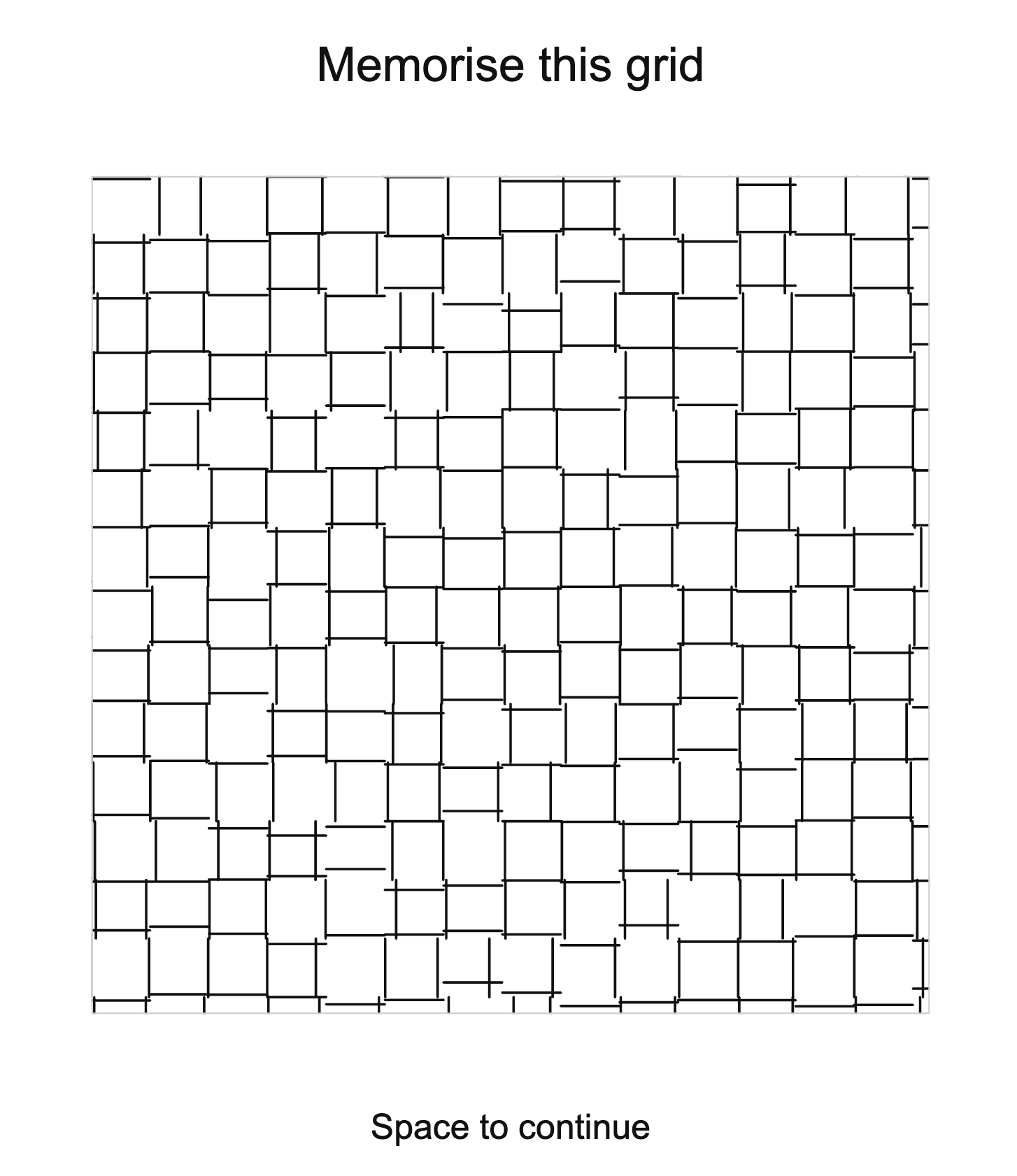
This one was a task: each edge of the lattice is nudged out of line, and you match it against eight options. Try the grid matching task.
Note: At 56:39, Speaker 9 says it looked straighter while high, and that looking at it now, it is clearly not straight.
Speaker 1 (54:25): Let’s power through the last couple of experiments. This is the Hermann grid. I think I simply wasn’t high enough. If I had been as high as I was during the Tracer Institute logo, it would probably have had a significant effect, but it never clicked into a grid for me.Any last comment on this one? Okay, let’s power through the couple experiments. This one, my.. I’ll just mention, with the.. this is the Hermann grid. I think I just was not high enough, and if I had been as high as during the, I guess, like Tracer Institute logo, I think it would have probably had a quite a significant effect, but it’s just like I was just not high enough for it to click into a grid,
Speaker 6 (54:54): As with the first one and a few others, I felt voluntary control here: stop the eye movement, rest the eyes on one spot, widen attention, and it symmetrises. That happens sober too, but the effect was stronger and it was easier to do on 5-MeO.similarly to the first one, and few others I felt voluntary. Control by stopping the eye movement, resting the eyes on one spot, and widening attention, it symmetrizes. That happens also sober, but the effect was stronger, and it was easier to do on 5-MeO. Yeah,
Speaker 8 (55:21): anybody Yeah,
Speaker 3 (55:23): I don’t think I was high enough. I can imagine how this would have worked with a much simpler grid variation. N,N-DMT is the thing that regularises symmetries, and on N,N-DMT I think this would have cleaned itself up significantly. On 5-MeO I genuinely don’t know what it would do. Don’t judge this one unless you were sufficiently high.I just don’t think I was. I can imagine how this would have worked if this was a much simpler grid variation. I think it probably would have done something interesting. Maybe I think of like DMT, like regular N,N-DMT is the thing that like regularizes symmetries. I think, on regular N,N-DMT, this would have cleaned itself up significantly, whereas, like, on 5-MeO, I don’t know, I just don’t know what it would do. I don’t think I was like high enough to, like, you’re really, don’t judge these one unless you
Speaker 1 (56:00): Agreed, because we reported extreme symmetrification effects with this one when he was quite high.were like sufficiently high, because I think, because we reported like extreme symmetrification effects with this one, and when he was like pretty high, I
Speaker 5 (56:06): I might have had some effect at a smaller spatial frequency, but this is the one I laughed most hysterically at. No effect, and I was thinking, what am I even looking at?think maybe I would have had some effect if it was a smaller spatial frequency, but this is the one that I was laughing the most hysterically, no effect, and I was like, what am I looking at?
Speaker 1 (56:20): One addition: it didn’t symmetrify into a perfect lattice, but it did sometimes produce a tiling, something that would spread out without ever becoming a perfect grid.Oh, I’ll add the one, it didn’t symmetrify into perfect lattice, but sometimes it actually did symmetry, kind of like a tiling, like for example, if you were to think of like one of these kind of like the more symmetrical was as a tiling that would kind of like spread out, but it wouldn’t turn into a perfect grid. Okay,
Speaker 9 (56:39): Yesterday, looking at this, it seemed more symmetrical and straighter. Today it looked so broken up that I concluded the picture must actually be perfectly straight. Yesterday I was less high than today. So I remember thinking it was really straight and that I was only seeing it broken up because I was high, whereas now I can see that it is not straight at all. That is more or less how I saw it today.yeah, so yesterday when I was looking at that one, it looked more symmetrical, it looked more straight, but today it looked so broken up that I thought, okay, this picture is actually perfectly straight, and yesterday I was less high than today, so it looked, yeah, a bit more broken up, and now, or something like that, like I remember that I thought that it was actually straight, but because I’m high I’m seeing it completely broken up, but now I’m actually seeing that it is not straight at all. So this is this is more or less how I saw it today. Cool,
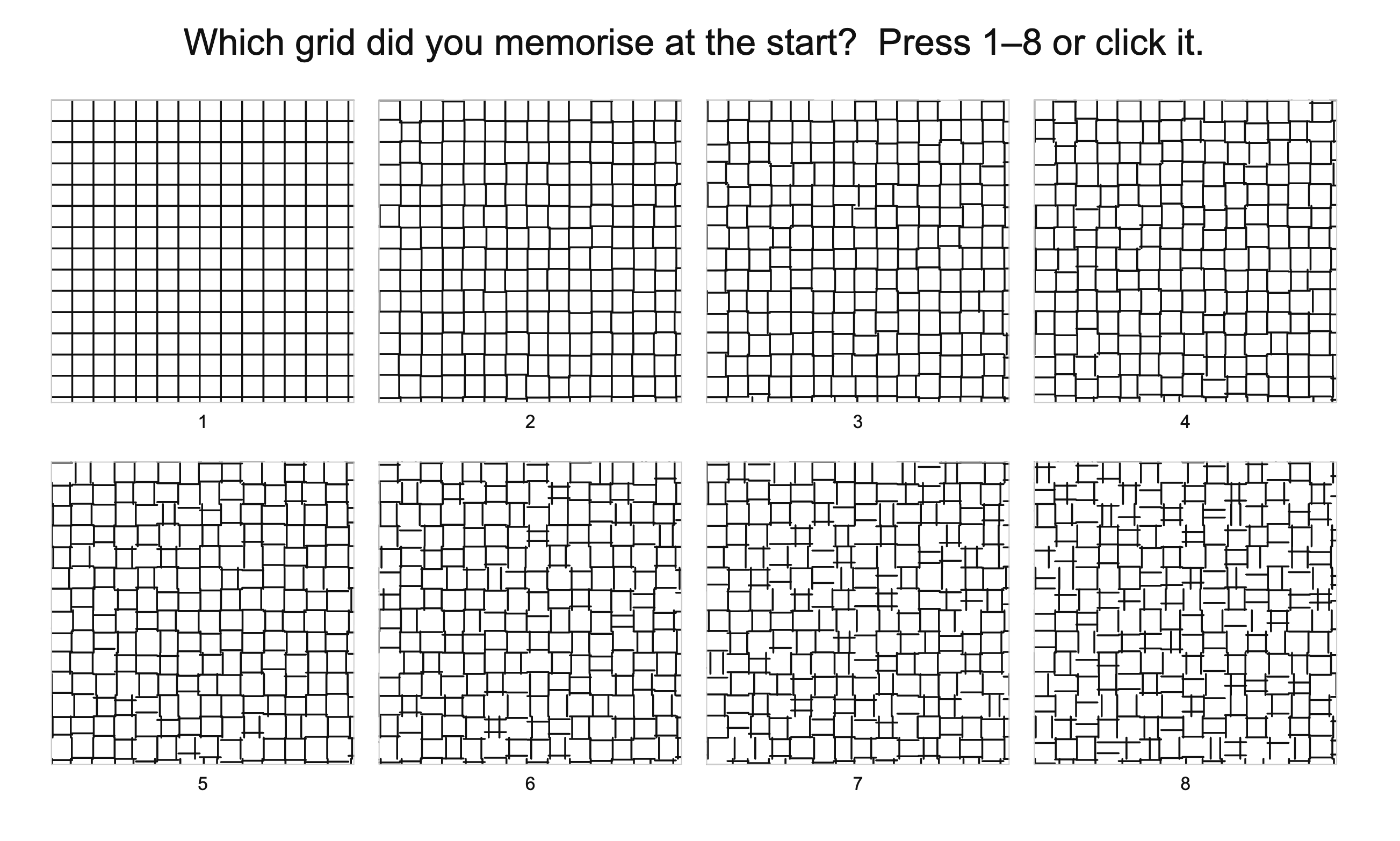
The matching screen. After memorising the grid, you pick it out from eight versions, from perfectly regular (1) to the most uneven (8). Wystan said the grid snapped into perfect symmetry at his 5-MeO-DMT peak that day. I saw it moving in that direction but wasn’t high enough for it to snap; my sense is that one or two more milligrams would have done it.
A draft PDP I made to try to replicate the snap into symmetry. It needs more work. Open it on its own.
Simultaneity task
57:14
A two-alternative task answered with the spacebar.
This one was a task, designed by Ethan Kuntz. Try the simultaneity task.
Note: This was a trial run and no data was recorded. The discussion below turned up three separate problems with the design.
Speaker 1 (57:14): This is a trial run and the data will not be recorded. It was interesting: the main effect was that I felt impaired in my ability to tell whether two things were simultaneous. I don’t know what the data will show, and there probably aren’t enough trials to conclude anything, but my prediction is that this is one of the cases where 5-MeO causes significant impairment.I will shift to unless if there’s anything, anybody else? No. Okay, this is real quick. This one I will mention. I will just power through it. This is a trial run, like this data is not going to be recorded for me. I think actually that was like interesting, and the main effect was I felt that I was impaired in my ability to tell whether two things were simultaneous or not, and I don’t know what the data will show, there’s probably not enough trials to really make any conclusion, but my prediction would be that this is one of the cases where, like, five actually causes like significant impairment. Okay, another person felt impaired. Okay,
Speaker 6 (57:58): I felt impaired in my ability to perform the test rather than necessarily in discerning simultaneity. There’s a quirk where if you press the spacebar to say they were simultaneous, you immediately get the next trial, and that surprised me over and over. If the rhythm were the same whether or not you pressed, it would have been easier. My data probably shouldn’t be taken seriously because of that.I felt empowered in my like ability to perform the test rather than maybe discerning there is this thing where if you press space bar, so okay, these were simultaneous, you press then you immediately get the next thing, I was so surprised by that over and over again, like so some, some, if the rhythm was more similar, like whether or not you press, that would have made it easier. Yeah, I so my data can probably shouldn’t be taken seriously because of that effect.
Speaker 1 (58:35): The reason we used the spacebar rather than left or right was the theoretical consideration that when you are quite high on 5-MeO it becomes hard to tell which is left and which is right. I don’t think we were high enough for that to matter here.Okay, I will add that this is the reason why we did space bar rather than left or right was on the theoretical consideration that when you’re quite high on 5-MeO, actually, like, it’s hard to tell which is left and which is right, but I think we weren’t like high enough for this to matter in this case.
Speaker 5 (58:52): I had the same experience: perceptually impaired, but also impaired at performing the task, sometimes pressing the spacebar when I didn’t mean to. If you compare baseline to the acute state, the outcome will be affected by that. For further phenomenological exploration it would be good to have feedback on each trial, telling you whether you got it right. I had some sense of when I was impaired, and with feedback I would have been able to update in the moment about what was happening to my perception.Yeah, I experienced the same thing, where I think I was perceptually impaired, but also impaired in terms of performing the task, so sometimes I was pressing the space bar when I really didn’t mean to press the space bar, and so you know you could compare baseline to acute state 5-MeO”>5-MeO and the the outcome would be affected by that, so I think for further phenomenological exploration for this one, it would be good to have feedback with each trial, like, did you get it right or did you get it wrong? Yeah, because I had some sense of when I was impaired, and so if it hadn’t been telling me, I would have updated my priors in the moment of, like, oh, I see what’s happening with my perception right now. Yeah,
Speaker 12 (59:38): lovely.
Speaker 5 (59:39): Yeah,
Speaker 1 (59:40): lovely. James, I felt
Speaker 3 (59:43): I felt significantly impaired, and I had a vague intuition it had something to do with the slightly pessimistic mindset the 5-MeO put me into. I was just seeing it flash. I can’t help wondering whether the task is a bit rubbish, but I think I’m simply bad at that sort of timing task anyway. Ethan had me do a similar one before the retreat and I scored badly compared to him and to [name].significantly impaired, and I was sort of like I had a weird intuition that was perhaps something to do, like especially impaired to do with the light pessimistic mindset that the 5-MeO put me into. I was just seeing it flash. Before I almost wonder, I can’t help but wonder whether it’s still like kind of a bit rubbish, but I think I’m just a bit rubbish at that sort of timing task anyway. Ethan got me to do that one before the retreat, and I scored significantly or similar timing tasks, and I scored really badly compared to him in [name].
Speaker 1 (1:00:17): [name] was an outlier.Well, there was an outlier, [name]
Speaker 3 (1:00:18): [name] is very much an outlier.is very much an outlier
Speaker 1 (1:00:20): now. compare anybody else. Yes,
Speaker 9 (1:00:26): For me too, yesterday it felt almost impossible to perform the task. I clicked when I definitely didn’t think they were simultaneous, and failed to click when I did, and I couldn’t make myself make sense of it.yeah, I would just like to add that for me also, yesterday it felt almost impossible to perform the task, like I also clicked when I definitely didn’t think that they were simultaneous and did not click and couldn’t like make myself make sense somehow,
Size comparison task
1:00:44
Judge which of two elements is larger, given their surroundings.
This one was a task, designed by Ethan Kuntz. Try the size comparison task.
Note: The task measures how much context changes judgements of size. There is an experimenter effect at 1:02:56.
Speaker 1 (1:00:44): I’ll speak for [name], who was correcting himself as he went, saying he shouldn’t be showing the spiral because it was jamming the system.
This one assesses the effect that context has. Personally I didn’t feel impaired at all, and if anything I may have had a slight edge on 5-MeO. The difficulty is the performance side of it, which wasn’t too bad, though I suspect it might be enough to offset the advantage.I’ll speak for [name], because also like he was making, you know, he was correcting himself, he’s like, “Oh, fuck, fucking, he’s like, oh, fuck, I shouldn’t be showing this like spiral of like I shouldn’t just kind of jamming the system, which one is bigger? So, I guess, like, in some cases, oh yeah, left or right. Let’s see. I mean, this one is to kind of like assess the effect that context has. Personally, I thought actually I didn’t feel impaired at all in this one, and if anything, I feel like maybe I might have like a slight edge on 5-MeO, but the problem might be just a performance of it, which it wasn’t too bad, but also I suspect maybe that it might be enough to kind of like offset to the advantage.
Speaker 5 (1:01:32): I struggled with this one. I found it too fast and felt I was mashing buttons at a certain point. That’s when I stopped engaging with the laptop and decided it was time for a rest.I just really struggled with this one. I found it too fast, and I just felt like I was mashing buttons at a certain point. So I think I actually stopped engaging with a laptop because of this one, I was like, okay, time, time for a rest.
Speaker 1 (1:01:45): Good to know. And thank you all for being so generous with this.Good to know. Awesome. Yes, anybody else? Also, thank you guys for being, for being so, yeah. Let’s go for it.
Speaker 9 (1:01:56): This one really helped. At first there was a blank screen, because one set of dots had already gone, and I thought, what am I supposed to do here. Then I felt rather stupid, remembering myself from the previous day on the simultaneity task. It helped a great deal that Andrés told me what was going on, and for the next ones he said to just press either, that it didn’t matter if I wasn’t sure. Then I had the attitude of simply pressing whichever I thought was bigger, and I went through them steadily. I had the sense that I got most of them right, to my perception. I don’t know whether they were actually correct, but I felt I could do it well. That small amount of encouragement, understanding that there was no way of getting it wrong, really helped me perform the task.Yes, yeah. So, for me here, it really helps. So, first, there was this blank screen, because one one set of dots had already gone off, and I was like, ah, what am I supposed to do here? And then I felt like really dumb remembering myself from the previous day for the simultaneity task, and then it really helped me, helped me that Andrés just told me what was going on, and then for the next ones he just told me I just, just press any of them, just like it doesn’t matter if you, if you’re not sure, and then, and then I just had this attitude of like, okay, I’m just gonna press what I think is bigger, and then I just went like pom pom pom pom pom pom, and I get, and I got the sense that I got most of them right to my perception, like I don’t know if they were actually correct, but I had a feeling that I could do it really well, so just like this little bit of encouragement, or like making me understand that, okay, there’s no way of getting it wrong or something like that, really helped me perform the
Speaker 7 (1:02:56): That’s why I said it. Having seen someone try the other task the day before, a similar tension seemed to be arising. You had your fingers on the right keys and were clearly present and aware of what was going on, but you were starting to tense up. So I tried to channel James’s answer-intuitively approach into what you were doing.task from why I gave that, so having seen Tea try the other task the day before, and there was a similar kind of tension that seemed to start arising, but I saw you put your fingers on the right piece, like you were like aware of what was going on, you were present, so it just looked like you were starting to like tense up, so that’s why I just tried to channel James’ just answer intuitively sort of sense into into what you were doing,
Speaker 3 (1:03:34): It was genuinely hard to tell whether I felt impaired on this one. Real uncertainty.it was actually really hard to tell whether or not I felt impaired in this
Speaker 1 (1:03:40): one,
Speaker 3 (1:03:40): I had trouble with F and J as well. I was lying on my back trying to sit in a position where they were accessible. Arrow keys would have been easier, or something one-handed.genuine uncertainty. I had trouble with F and J as well, too. I kind of put it on my back, trying to sit in a position where that was accessible. Would have been easier to just use arrow keys, I think.
Speaker 1 (1:03:51): Okay, yeah,
Speaker 3 (1:03:52): just a one-handed. All
Checkerboard shadow
1:03:54
Edward Adelson’s checker shadow: two squares, a cylinder and its shadow.
This one was a task, designed by Ethan Kuntz. Try the checkerboard shadow task.
Note: We included it as a higher-level companion to Ebbinghaus. Seeing the illusion depends on an inferred model of the lighting, so if 5-MeO-DMT weakens high-level context, this one should weaken first.
Speaker 1 (1:03:54): This is the last one. Press space if you believe they are the same. Here too I would have preferred left or right; making it a spacebar yes-or-no is stressful, and I agree with that assessment.
I felt that with a little practice on 5-MeO I might have performed better at this. I had the impression that I could visually segment out the two squares more easily, pop them into a different layer, and then evaluate that layer independently of context. So phenomenologically the spirit of the test agreed with what I was experiencing.right, I think just the last one. We’re almost, almost there. So this is press-space. If, like, if you believe that they’re the same, you press a space. This one, I think, also just like the I would have preferred, like, left or right, I think. And yeah, that’s right. Yeah, I agree. The making it space, pressing yes or no, like it’s stressful. I agree with that assessment, and I actually felt that this one is with a little bit of practice on 5-MeO, I might have performed better. I also got like the slight impression because I could visually segment out more easily, kind of like this square and this square, and have them kind of like pop into a different layer, and then evaluate that layer independent of context, so at least phenomenologically I feel like the spirit of the test agreed with kind of like my phenomenology in the moment.
Speaker 3 (1:04:48): I felt enhanced doing this one. There is a longer conversation to be had, which I’m too tired to unpack, about colour space being non-Riemannian. Who picked this test?Yes, I felt enhanced doing this one, and there’s probably a long conversation we could have that I’m sort of like a little bit too tired to fully unpack right now to do with like color space being non-Riemannian. And like we could get into some details around that. Who picked this test, by the way?
Speaker 1 (1:05:07): Which one,
Speaker 3 (1:05:08): The checkerboard shadow one. You picked it. Good choice.the checkerboard-shadow one? You picked that one. Yeah, good choice. Okay, that’s interesting.
Speaker 1 (1:05:14): The rationale, and this is for the team to think about: the Ebbinghaus illusion with its contextual circles is low-level processing, just circles and their context. This one is high-level processing, where you recognise that there is a cylinder and lighting, and you correct for all of it. I thought that on 5-MeO the high-level part might go away first, leaving the more low-level perception, in which case decontextualising should be easier.I mean, it was just okay. So the rationale, and also for the team to like think about this, is that the Ebbinghaus illusion, the contextual circles. I thought, like, okay, that’s like kind of like low-level processing. It’s just like, okay, circles and their context, whereas this one is like high-level processing, where it’s like, okay, you realize that there’s a cylinder and there’s like lighting and you’re controlling for all of that, and I thought maybe on 5-MeO that might go away first, then like they’re just like more low-level perceptions, so I would imagine maybe decontextualizing would be even easier in that case.
Speaker 5 (1:05:50): I stopped at this one. I found it too annoying, because looking at it normally requires a fixed point of attention and moving between spots, and I found that very hard. My attention was chaotic. I noticed the same thing looking up at the ceiling: there were knots in the wood, and trying to focus attention on a single knot, which would be effortless in normal consciousness, was very effortful. This task was effortful in the same way, having to assess separate points, really feeling that you are constructing something. That is when I shut the laptop.I actually stopped at that one, and I found it too annoying, and I think it’s because when I look at that one normally, it does kind of require a fixed point of attention, and you kind of go between spots, and I just found it really hard. It was just my attention was kind of chaotic, and I noticed it as well, like I was looking up at the ceiling, and there were these nuts in the wood, and so I was trying to focus attention on just the nut in the way that would be super easy in normal consciousness, and it was very effortful, and so I found this task very effortful in the same way, like having to like assess separate points, and really kind of you really feels like you’re constructing something there, and I found that really hard, and that’s when I shut the laptop, and thought, “No, I’m not doing this.
Speaker 1 (1:06:44): Any last words?Any last words? Okay,
Speaker 9 (1:06:46): This was really hard for me too. I understood conceptually what was supposed to happen, but in each example I had no idea what I was assessing. I think that part of my test should be deleted, if it was saved at all. I went through a few images and then decided to get the laptop away from me.yeah. For me, this was also really hard. Like, I got the sense, “Oh, I understand conceptually what is supposed to happen here, but, like, in each example, I have no idea what I’m assessing, and so I think that part of my test should be deleted if it was saved at all, but yeah, so I just went through the through a few images, and I was like, okay, get the laptop away from me. Yeah, cool.
Tesseract
1:07:12
Left for a session of its own.
A recording of QRI’s 4D wave control demo, the four-dimensional lattice rotating in two ways at once that was offered as a stimulus during the sessions. The demo carries a seizure warning.
Note: We did not get to it in this meeting. Speaker 7 offered to record a separate session about it.
Speaker 1 (1:07:12): Thank you, everybody. These have been extremely fascinating and I’m very happy with the session. Apologies that it was rushed; we need some time to sleep and rest tonight. Thank you for putting up with my hurrying.Thank you, everybody. These have been actually extremely fascinating. I’m super happy for the session. Sorry, it was like rushed, but it’s just like, okay, we’ve got to have some time to sleep and rest tonight. So, thank you so much for also putting up with my rushing, you guys. So, thank you, thank you, thank you, thank you.
Speaker 7 (1:07:26): I’ll make a separate recording about the tesseract.Awesome! Yay! And I’ll make a separate recording about the Tesseract.
Speaker 1 (1:07:33): We haven’t discussed that at all. Could we do it tomorrow afternoon?Yes, we haven’t discussed that. Could we maybe discuss that tomorrow afternoon, because it’s
Speaker 7 (1:07:39): you can do that
Speaker 1 (1:07:43): Sunday afternoon, or Monday.Sunday afternoon. Yes, or Monday.
Speaker 7 (1:07:45): Very happy to.Yeah, very happy.
Speaker 1 (1:07:45): The tesseract is one that is personally very meaningful to me.The Tesseract is one that is also like personally very meaningful to me, and very
Speaker 7 (1:07:50): I’m going to talk with [a friend] about it as well, because he’s very interested in how rigid shapes coalesce.gonna talk with [a friend] about that quite a bit as well, because he’s super interested in how shapes rigid shapes coalesce.
Speaker 1 (1:07:59): So, noting before we adjourn: there will be a future meeting about what the tesseract looks like in different states of consciousness. Thank you everybody. Meeting adjourned, at one hour and eight minutes.I’ll bring back some, okay. So I guess, like before we adjourn, which is like making a note, there’s gonna be a meeting in the future about what the Tesseract looks like on different states of consciousness. All right. Thank you everybody. Meeting adjourned. Yay, one hour and eight minutes,
Speaker 8 (1:08:19): perfect, very, very good. One.
Citation
For attribution, please cite this work as:
APA
Gómez-Emilsson (2026, September 11). Visual Illusions and Psychophysics on 5-MeO-DMT. https://heart.qri.org/retreats/2026-tepoz/andres-gomez-emilsson/visual-illusions-5meo.html
BibTeX
@misc{gomezemilsson2026illusions,
  author = {Gómez-Emilsson, Andrés},
  title = {Visual Illusions and Psychophysics on 5-MeO-DMT},
  url = {https://heart.qri.org/retreats/2026-tepoz/andres-gomez-emilsson/visual-illusions-5meo.html},
  year = {2026}
}