Written by Anna Eiserbeck on 11 September 2026.
This post is a contribution to the third Qualia Research Institute psychophysics retreat, which took place from May to June 2026 in Tepoztlán, Mexico.
Table of contents
Rotating Snakes on 5-MeO-DMT
This is a report from Day 4 of the 5-MeO-DMT retreat. What follows covers roughly the first 20 minutes of the session. On this day, we used a 1:4 vape pen, taking 10-second pulls (~3.4 mg per pull). In this session, I focused on visual illusions and psychophysical stimuli. This report describes my experience with the first stimulus, “Rotating Snakes”, as well as some broader effects that occurred during this session.
Taking the first pull
I was sitting with my attention on the room, with a laptop already open in front of me, prepared to look at the visual stimuli. After the first pull, I held my breath for as long as I could—around 20 seconds, I think—and then exhaled slowly.
Almost immediately, my visual field began to change. Contrast intensified, and my spatial perception started to wobble. Distances appeared slightly distorted: objects that were close seemed even closer, and things that were further away appeared even further away. At the same time, anything or anyone I focused on felt energetically nearer, as if I could perceive the essence more clearly, with fewer layers in the way (e.g., social rules, expectations, or fears).
My sense of time also shifted. Moments alternated between stretching out and snapping by quickly. Some brief scenes felt elongated and almost frozen, while others seemed to unfold at two- or three-times their usual speed, giving me fewer details than usual even though my attention was very focused. I experienced time as a series of snapshots: as I looked around the room, my attention would settle on discrete scenes that felt complete and self-contained, each lasting around three to five seconds. Although my time perception was altered, I could still estimate how much time was passing by what was happening in each small segment.
At first, the room felt busy and somewhat asymmetrical, with different lines of intention running through the space. Some people were still moving around and preparing things, for example on the laptops for the psychophysics tasks. The atmosphere in the room had a heady, mentally active quality. Over the next few minutes, it gradually settled, as if the energy were turning inward. This change felt like a stormy sea calming down: at first, waves seemed to arrive from different directions, slightly chaotic and with high amplitudes; as the room settled, they became smaller and more harmonious.
Once the atmosphere felt more settled, I turned my attention to the laptop and the first visual stimulus.
Rotating Snakes: Phase 1
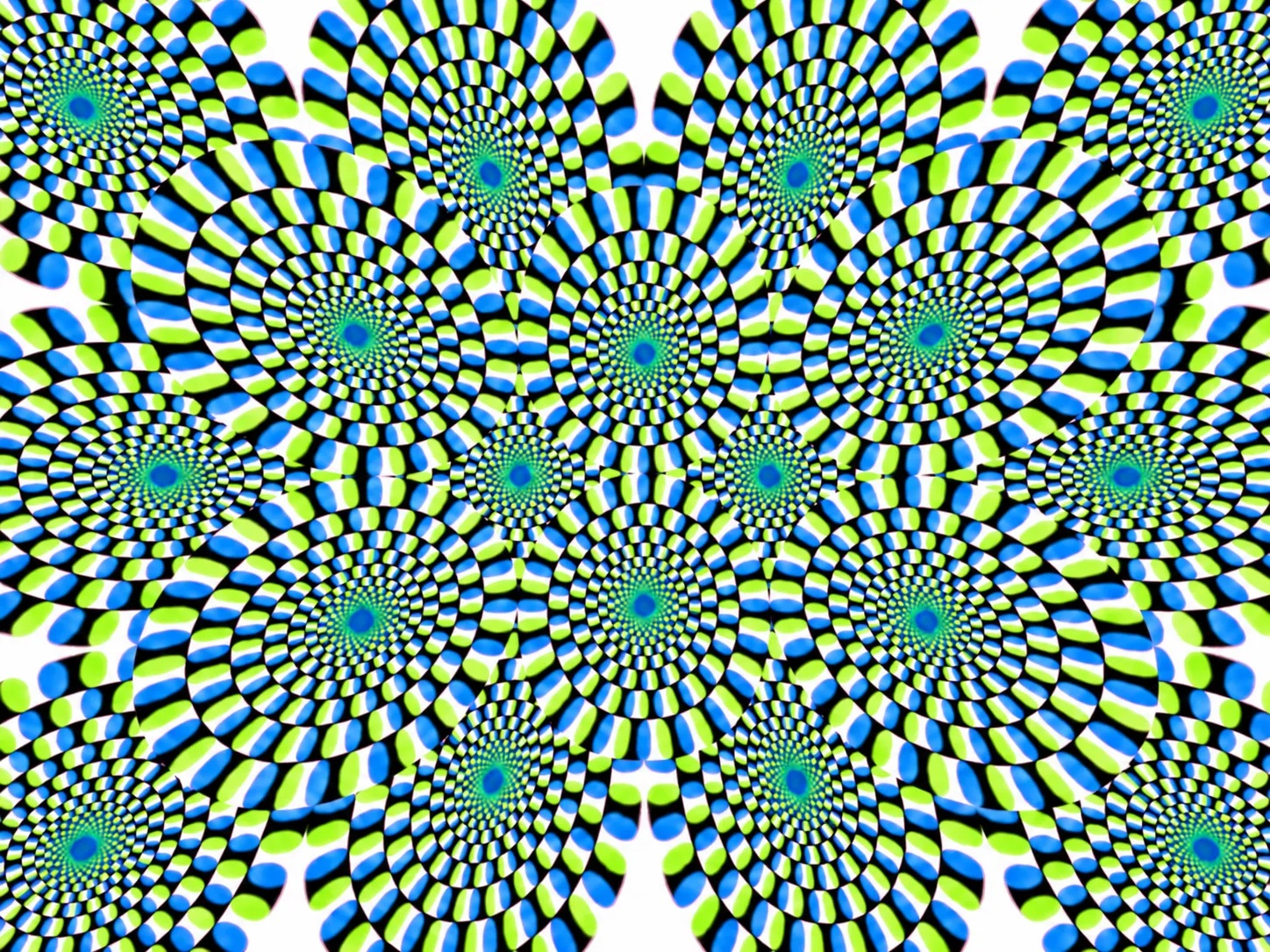
The first stimulus was the Rotating Snakes illusion1, shown below.
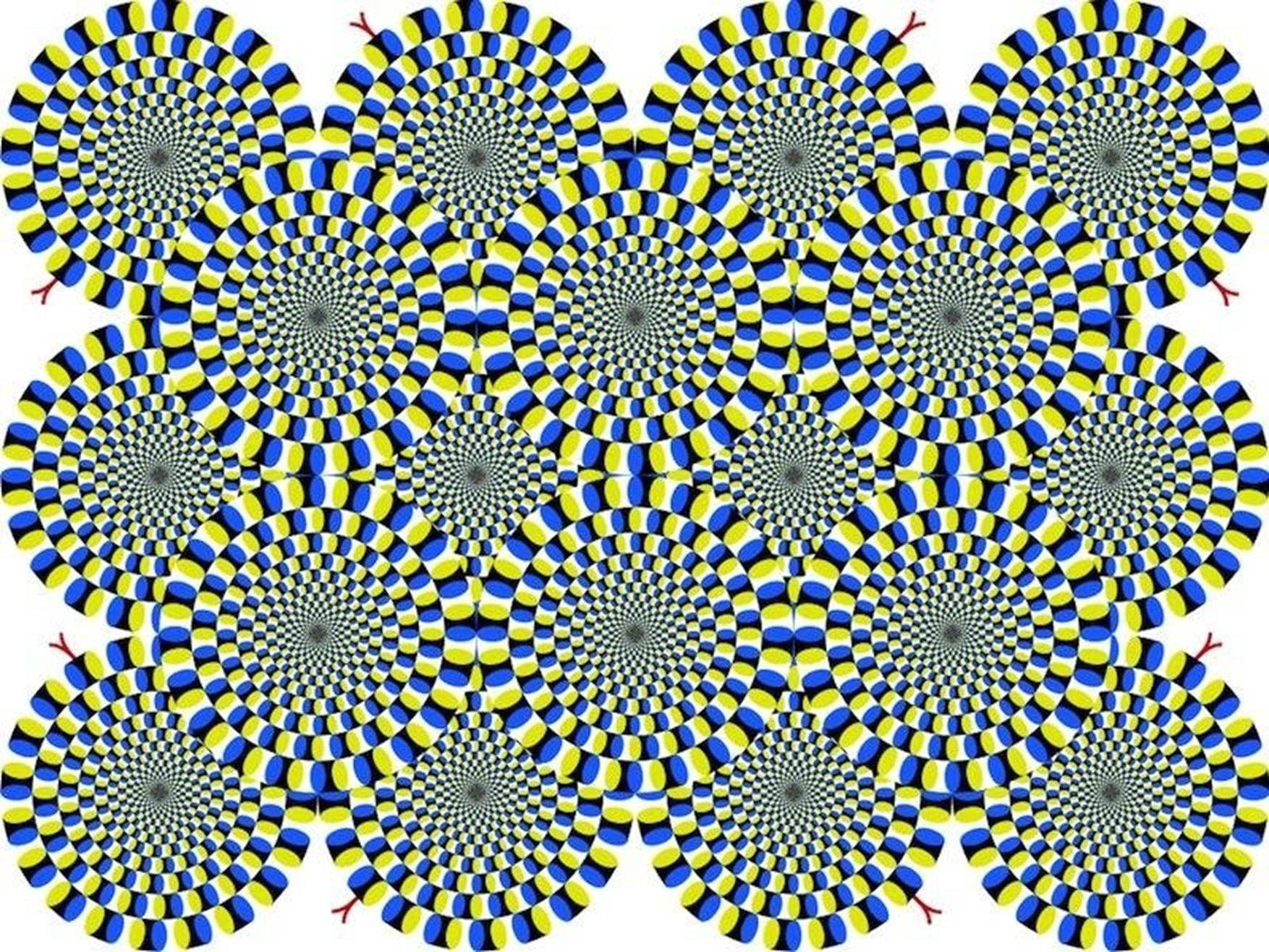
Original stimulus: Rotating Snakes illusion by Akiyoshi Kitaoka (2003)
I had encountered this type of stimulus before the retreat, so I expected to perceive rotational movement. At first, I did see rotation, which briefly made me worry that I might get nauseous because the motion felt much more intense and somatic than usual. However, this did not happen, because my attention very quickly and instinctively oriented toward stopping the movement.
Rotating Snakes: Phase 2
Soon, my focus shifted strongly toward the darker spots in the image. At the same time, my mode of looking changed to a softer, more diffuse focus, which felt more pleasant and less overstimulating. With this soft focus, I could attend to all the darker areas at once. I perceived them as black points surrounded by a kind of halo, and they moved into the foreground of my perception. They conveyed depth and exerted a subtle pull, drawing my awareness toward them. The more evenly I distributed my attention across all the points, the more the apparent rotation in the stimulus slowed. Eventually, when my attention felt uniformly distributed across the entire image, the movement came to a complete stop. I had the sense of seeing all the points at once in a very even, balanced way.
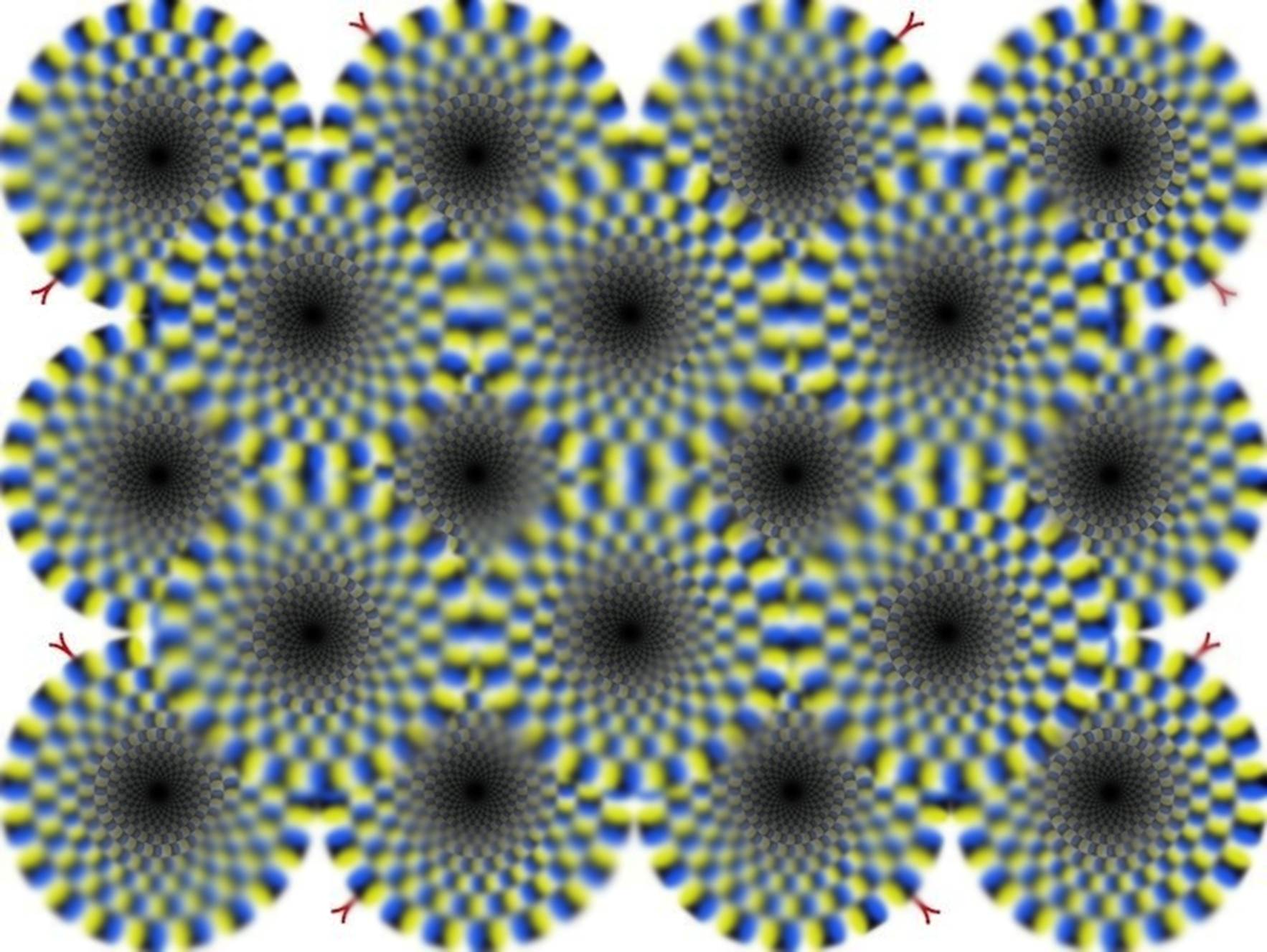
Perceptual reconstruction (Phase 2)
The moment the motion stopped felt pleasant and was accompanied by a sense of harmony and quiet. I noticed how deliberately I could shift my focus and thereby change what I was seeing, with much more precision than usual. This came with the feeling that I could mentally create or stop movement in the image, which felt surprisingly powerful. It gave me a direct sense of how strongly my attention shaped what appeared in front of me.
Rotating Snakes: Phase 3
After some time with this evenly distributed focus on the dark points, another shift occurred. The darker spots receded slightly, while the broader colored regions of the image moved into the foreground, forming something like a grid. The entire grid was visible at once, but my focus centered on the part where the foreground-background contrast felt strongest, roughly in the middle of the image. The earlier rotation had disappeared. Instead, I now perceived a subtle psychedelic wobble: parts of the grid seemed to alternately contract and expand slightly.
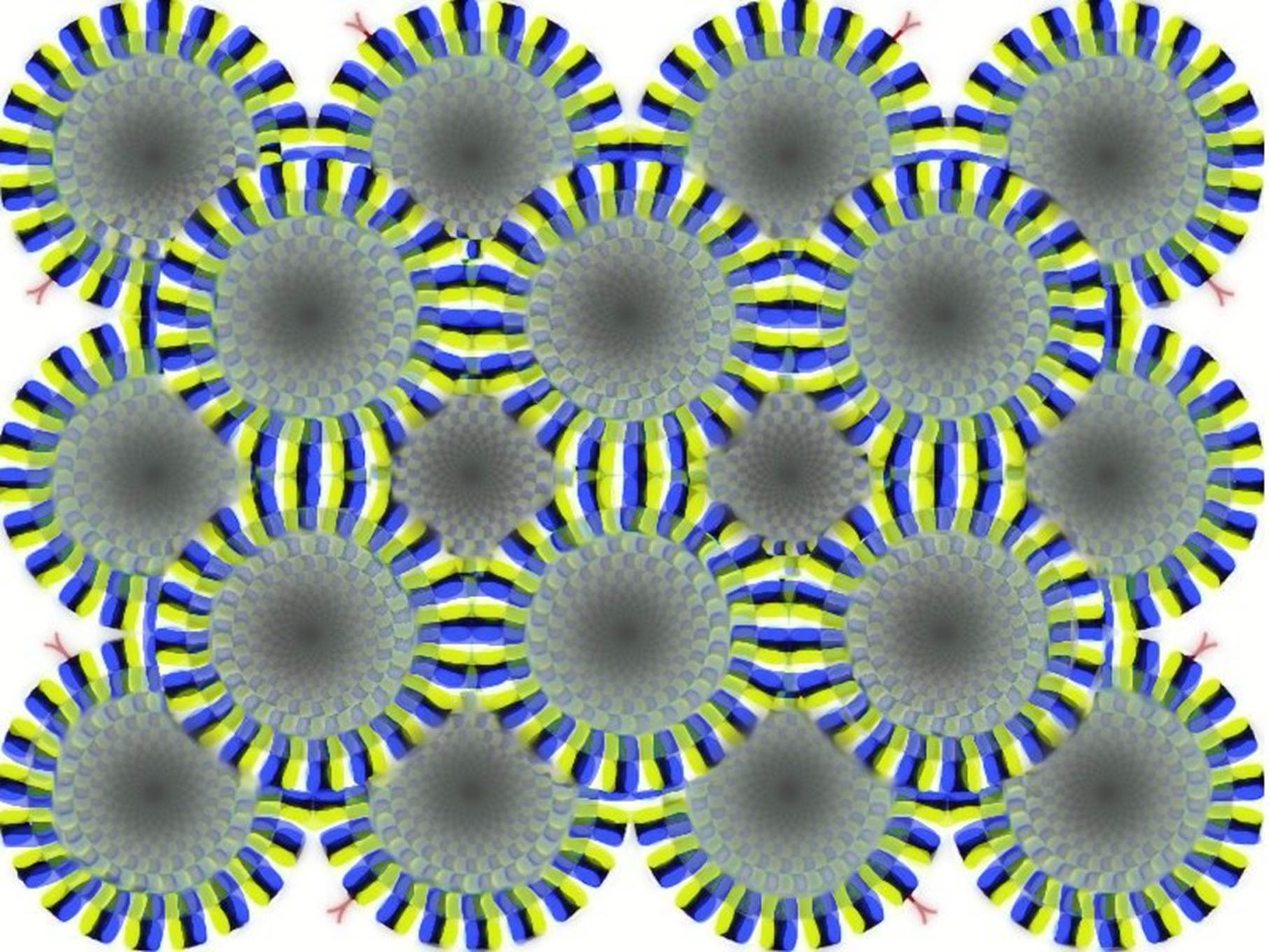
Perceptual reconstruction (Phase 3)
Second pull and getting distracted
After a few minutes, the effects seemed to diminish somewhat, so I decided to take a second pull from the pen. Initially, I was sitting facing the group and the center of the room. Shortly after the second pull, however, I turned to my right, so that I could see less of the group and the room and more of the calmer area outside.
This change in orientation felt necessary. When I sensed others’ attention on me, I felt strongly overtaken by it. At one point, two participants were watching me as I looked at the stimulus. I could feel their attention very clearly, each with its own specific quality, and my own attention was automatically drawn to the fact of being observed. I also had a sense of how they perceived me in that moment—positively, curiously, and observantly overall—but the intensity of their combined attention felt too strong. It pulled me away from the task and the more settled state I was trying to maintain.
This was accompanied by a shift in my bodily awareness. I felt increased activation in the parts of my body that seemed to lie within their field of view, especially on my left side: my shoulder, face, and eyes. The laptop and the area around it also felt included in this zone of attention. The sensation reminded me of those regions being illuminated by a flashlight. It was as if I could feel both zones of attention simultaneously, with their overlap becoming particularly intense. This left me with an uncomfortable sense of bodily asymmetry. I had the impression that some of my available attentional resources were being diverted from the stimulus toward managing the experience of being observed. I therefore turned further to the right, away from the group, to reclaim my focus on the stimulus.
Return to the Rotating Snakes
Once I had turned away and felt more contained again, I brought my attention back to the first visual stimulus on the screen. My perception moved through the same sequence as before, almost as if following a familiar path. First came a brief sense of rotation. Then the dark, halo-like points moved into the foreground, followed by the grid-like structure. As soon as the grid appeared, the gentle wobbling effect returned in much the same way as before.
Rotating Snakes: Phase 4
After that, there was another gradual shift. The image began to feel increasingly three-dimensional. At this stage, I saw something that could be described as an Escher-like structure: the darker regions appeared to form entrances or portals leading in different directions, some more like openings and some more like exits. The structure felt impossible, as though it could not exist in ordinary physical space.
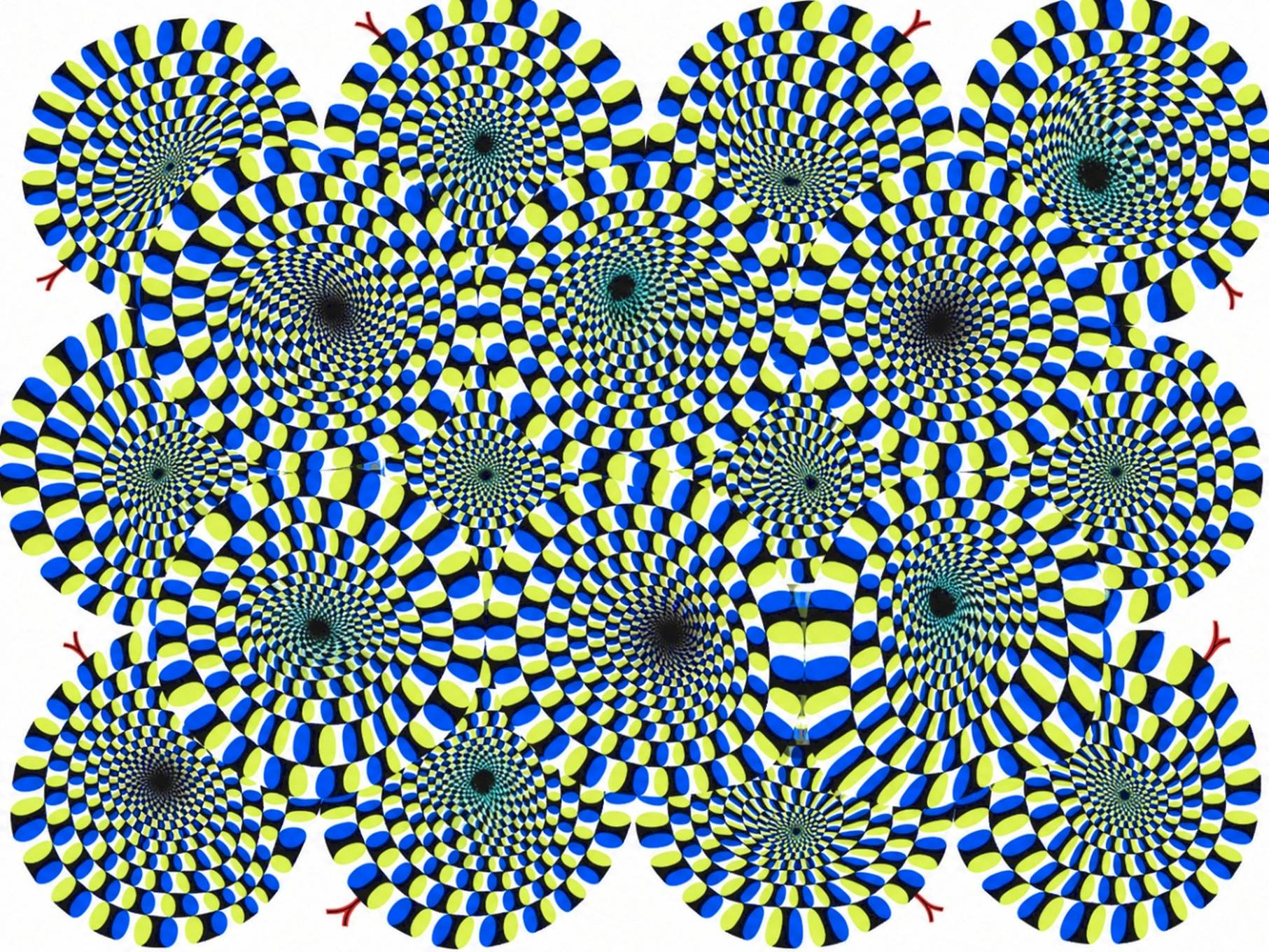
Perceptual reconstruction (Phase 4)
The tunnels seemed to lead inward, into a depth extending beyond what was visibly present. I had the impression that I could feel, and almost mentally see, them continuing behind the image. At the same time, their apparent continuation from entrance to exit did not quite connect. What had looked like a unified structure at a coarser glance separated into pathways that did not actually meet when I examined them more closely. This contributed to this sense of an Escher-like illusion.
The portals, exits, and connections within the structure were not fixed. As I moved my eyes or examined one area more closely, the configuration seemed to change: new pathways emerged while others receded. This prompted a spontaneous association with the moving staircases in Hogwarts, where routes shift and may or may not connect depending on their arrangement. Here, it felt as though the placement of my attention determined which elements of the image connected with one another.
Attention also seemed to warp the visual field. Areas could feel compressed, stretched, or magnified. When I looked at a particular region, new information about the image and its internal connections seemed to emerge almost “magically”. This quality seemed to arise from how unusually pronounced and immediate the coupling felt between my attention—mediated through eye movements and focus—and my visual perception.
I was also aware of how the experience built in depth. Each time I moved my eyes, something appeared immediately; but the longer and more steadily I attended to it, the deeper the impression became. This deepening was visual—for example, in the increasing sense of spatial depth—but also somatic: a feeling of being drawn further inward, toward a kind of nothingness inside the tunnels. (This inside of the tunnels reminded me, in its essence, of the seventh jhāna.)
At the same time, sensing the tunnels’ outer layer as continuing behind the image gave me a sense of an empty space beyond it. This space felt transparent, neutral, very calm, and seemingly infinite. (In this respect, it reminded me of the fifth jhāna.) I did not feel that I was sensing the physical space behind the laptop; rather, the experience felt specific to the Rotating Snakes stimulus itself, as if I were looking behind that particular image or structure.
Rotating Snakes: Phase 5
After I had spent some time with this Escher-like perception, another layer unfolded. I do not have prior experience with hyperbolic geometry, but the concept came to mind at this point. What I was perceiving no longer felt merely three-dimensional, but as if the whole image had opened into a space governed by a different dimensional logic and different rules of connection. Whereas the preceding Escher-like structure had felt impossible in ordinary physical terms, this later structure seemed even further removed from anything I could imagine translating into everyday three-dimensional space.
I felt deeply immersed in the stimulus, almost as if I were inside a room belonging to another realm, looking at a wall within it. The space did not feel rectangular or conventionally architectural. It felt more spherical, enclosing, and continuous, while also containing far more intricate structure than an ordinary room could. I could almost sense the wall extending beyond my field of view and continuing behind me.
The “wall” itself appeared to consist of highly intricate, interconnected forms. They resembled hyperbolic shapes or surfaces joined by well-defined yet gentle edges. The structure felt soft rather than rigid: extremely stable and precise, yet not fixed or cold. It felt mathematical and geometrical in an unusually direct, intuitive sense.
The image below is my best attempt so far to visualize the experience, although it captures little of the hyperbolic quality I perceived:
Perceptual reconstruction (Phase 5)
This phase felt exceptionally fascinating, beautiful, and coherent. It was more harmonious than the preceding phases, as though every element were exactly where it belonged. I experienced it as a kind of perfection in the most positive sense. In contrast to Phases 3 and 4, there was no longer any movement; the impression simply continued to deepen. Phase 2 had also been motionless, but comparatively simple. Now the visual impression felt stable yet highly detailed and “alive”. It was almost as if the essence of beauty, harmony, and intelligence were looking back at me through the image. Looking at it felt deeply nourishing.
I remained with this experience for a while, simply absorbing it. Eventually, I sensed that my experience with the stimulus had reached its peak, at least for the moment. It felt complete, and I became curious to move on to other stimuli.
The Rotating Snakes illusion was created by Akiyoshi Kitaoka (2003); see his page on the illusion. For the scientific description, see Kitaoka, A., & Ashida, H. (2003). Phenomenal characteristics of the peripheral drift illusion. Vision, 15, 261–262.↩︎
Citation
For attribution, please cite this work as:
APA
Eiserbeck (2026, September 11). Rotating Snakes on 5-MeO-DMT. https://heart.qri.org/retreats/2026-tepoz/anna-eiserbeck/rotating-snakes-5meo.html
BibTeX
@misc{eiserbeck2026snakes,
  author = {Eiserbeck, Anna},
  title = {Rotating Snakes on 5-MeO-DMT},
  url = {https://heart.qri.org/retreats/2026-tepoz/anna-eiserbeck/rotating-snakes-5meo.html},
  year = {2026}
}