Written by Sasha Putilin on 11 September 2026.
This post is a contribution to the third Qualia Research Institute psychophysics retreat, which took place from May to June 2026 in Tepoztlán, Mexico.
Table of contents
- The Ebbinghaus Illusion
- Qualia Research Institute’s research retreat
- 5-MeO-DMT: more transcendelic than psychedelic
- The cancellation of the Ebbinghaus illusion
- Classical psychedelics may strengthen the illusion rather than weaken it
- Other participants reported the same effect
- A later 5-MeO-DMT trip did not weaken the illusion for me
- Hints for consciousness as computational medium
Psychedelics produce all sorts of visual distortions: from breathing walls and geometric patterns to complex visual landscapes populated by full-blown entities. Sometimes people claim to see the Truth on them — but it’s typically spiritual, emotional or personal truth.
But can psychedelics make you see the world more clearly in the most literal sense? Amid the sea of visual distortions they produce, might some patterns be perceived more clearly than they are in our normal, sober waking state?
At least sometimes, the answer appears to be yes. On 5-MeO-DMT, a powerful psychedelic, I experienced a near-complete cancellation of the Ebbinghaus illusion.
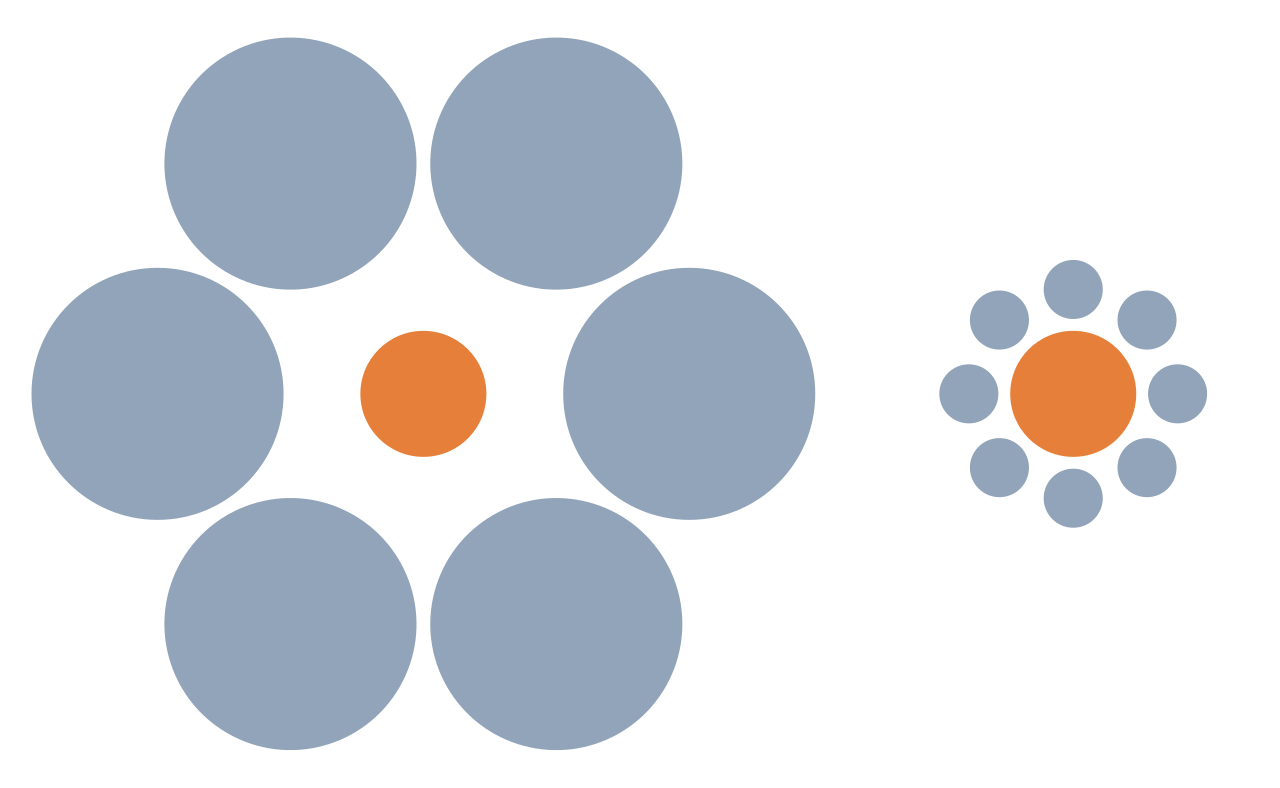
The Ebbinghaus Illusion
The two orange circles above are physically the same size, but the surrounding grey circles make the one on the right appear larger.
This illusion was discovered by German psychologist Hermann Ebbinghaus (1850–1909) and popularised by Edward B. Titchener in a 1901 textbook on experimental psychology.
Different people perceive the illusion to different degrees. To me, the circle on the right looks about 10–20% larger, depending on my distance from the screen and the size at which the illusion is displayed. I measured my own susceptibility using an app I asked GPT-5.6 Sol to create: I dragged a slider until the two circles appeared equal in size.
Qualia Research Institute’s research retreat
In May and June 2026, I attended the Qualia Research Institute’s research retreat in Tepoztlan, Mexico. Over eight weeks, a team of physicists, mathematicians, visual artists, advanced meditators, philosophers, and rational psychonauts studied jhanas (deep meditative absorption states) and 5-MeO-DMT (a powerful psychedelic that’s legal in Mexico).
QRI is a non-profit building a new science of consciousness. Its central bet is that:
- Consciousness is a relatively simple property of our universe — simple enough for evolution to discover it.
- Consciousness has useful computational properties — otherwise evolution would not have come to rely on it.
Physicists do not study only ordinary matter at room temperature. They also build particle accelerators to create exotic forms of matter, which can reveal more about the mathematical laws governing our universe. Similarly, QRI studies exotic consciousness states, such as those arising from psychedelics, to uncover mathematical principles behind subjective experience.
Visual illusions are interesting for a related reason: they are small tears in the fabric of normal perception — glitches that make it apparent that there is active construction going on underneath. Studying how these irregularities change under psychedelics may offer further clues about consciousness as a computational medium.
5-MeO-DMT: more transcendelic than psychedelic
We were in Tepoztlán for eight weeks, one of which was dedicated to exploring 5-MeO-DMT. It is a short-acting psychedelic whose effects last around 10–20 minutes when vaporised. Vaporisation was our typical route of administration because 5-MeO-DMT is inactive when taken orally: enzymes in the gut and liver rapidly break it down.
On my third day of exploring it, we vaporised 5-MeO-DMT in increments of approximately 3.4 mg, taking up to three doses within a one-hour window. The 3.4 mg figure was estimated from the concentration of 5-MeO-DMT in the liquid.
5-MeO-DMT is a highly abstract psychedelic and, at those doses, not a very visual one. Your ego may be blown to smithereens, your understanding of reality may be turned upside down while your ordinary concepts blend into fun uniform mush. But all this while you visually experience little more than intensified colours in a hyper-HD fashion, some flattening of the visual field into two dimensions, and perhaps a few minimal geometric patterns.
This ratio of mental to visual effects sets 5-MeO-DMT apart from classical psychedelics such as LSD, psilocybin, and DMT. The difference may stem from its neuropharmacology: classical psychedelics act primarily as agonists at serotonin 5-HT2a receptors, whereas 5-MeO-DMT acts primarily as a 5-HT1a receptor agonist — though it has activity at 5-HT2a receptor too. It is a weird drug, and I have heard people call it transcendelic for this. I think this label is apt.
And so I take a 3.4 mg hit out of a 5-MeO-DMT vape pen. Within 15 seconds, my ego is indeed blown to smithereens, and my consciousness becomes perhaps 50 times more intense per “unit of perceptual field.” This is not an exaggeration: somehow, everything in my experience is more intense. “Fuck that. I am not taking this drug again” I think to myself. But 5-MeO-DMT is short-acting, and ten minutes later, my sense of self returns — and I change my mind. I take another 1.7 mg, but it does not intensify the experience further. A few minutes later, I take another 3.4 mg. This deepens the experience somewhat, but not nearly as much as the first dose.
And that’s when I decide to stare at the Ebbinghaus illusion — the peak has clearly passed, my sense of self regained enough to open my laptop, but all in all the effects of the drug are still quite pronounced.
The cancellation of the Ebbinghaus illusion
As I mentioned, 5-MeO-DMT is not a very visual drug. When I first look at the illusion on my laptop screen, it looks exactly as it does when I am sober: the orange circle on the right still appears larger.
But then I notice that when I move my attention to the centre of the picture — to the space between the two groups of circles — their apparent sizes begin to rebalance as if they were physical objects exerting field-like pushes and pulls on one another — or balloons being inflated and deflated.
The illusion is effectively under volitional control. Move attention to either group of circles, and it looks as it does when I am sober. Move attention to the centre, the size difference almost disappears. The transition between those two states is smooth. The video below replicates the effect, with the cross representing the focus of attention:
The replication is designed to be viewed while sober, which creates a problem: the viewer experiences the very illusion whose cancellation I am trying to depict. I calibrated the video to my own perception, deliberately adjusting the circles’ sizes until they appeared nearly equal to me at the point of maximum cancellation. But because your baseline Ebbinghaus effect may be stronger or weaker than mine, the video may look different to you.
If that’s the case, simply assume that the circles are meant to appear nearly equal when the cross moves to the centre. Alternatively, you can play with the app here to tune it for your experience.
Classical psychedelics may strengthen the illusion rather than weaken it
The 2025 study “Psilocybin alters visual contextual computations” reports that psilocybin increases the Ebbinghaus illusion by 38% (5 mg dose) and 59% (10 mg dose) relative to placebo. As I mentioned above, classical psychedelics are 5-HT2a agonists, so I would tentatively — very tentatively — expect this effect to generalise to other classical psychedelics, such as LSD and DMT. 5-MeO-DMT’s preference for 5-HT1a may be key for the cancellation.
I haven’t had a psychedelic trip ever since coming from the retreat, so I can’t say if other psychedelics increase or decrease the illusion for me.
Other participants reported the same effect
Among the other retreat participants who noticed any effect of 5-MeO-DMT on the illusion, all reported that it became weaker.
One participant I spoke to also reported that the illusion was under volitional control, but apparently in a different way from mine. They compared it to a Necker cube that they could deliberately flip between two interpretations.
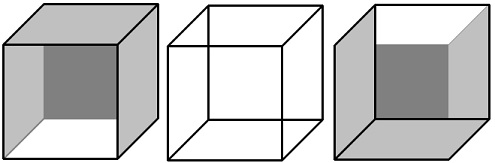
The Necker cube is shown in the centre. Many viewers can deliberately flip between the two orientations represented on its left and right.
A later 5-MeO-DMT trip did not weaken the illusion for me
After the trip described above, I had another 5-MeO-DMT trip — at a higher dose. During the comedown, I looked at the Ebbinghaus illusion again and saw no change in the circles’ relative apparent sizes. The perceptual effects were minimal: the contextual circles seemed to form vertical groups of three on either side — but had no effect on the size.
I don’t have a good theory for why the cancellation happened one time but not the other.
Hints for consciousness as computational medium
My experience of the cancellation felt strikingly physical: the circles seemed like objects exerting field-like pushes and pulls on one another until they reached an equilibrium. This may be more than a coincidence.
There are electromagnetic theories of consciousness postulating that consciousness is an electromagnetic phenomenon. Some of these theories go so far as to claim that consciousness is the electromagnetic field as experienced from the inside. In this view, what we call “the electromagnetic field” is a third-person description of the underlying phenomenon, while consciousness is its first-person aspect.
Not every pattern in the electromagnetic field would be experienced as human-like consciousness. Perhaps most such patterns would amount to simple “qualia white noise”. Only under the right conditions, with the right kinds of self-interaction, would activity in the field form complex patterns corresponding to moments of human experience with complex self-reflection. For an impressionistic interpretation of how this might work, check out this video.
I am not claiming this with certainty — quite the opposite. My probability for the EMF theories is ≈65%. But after experiencing field-like interactions among circles in my visual field on 5-MeO-DMT, I updated upwards by like 5%.
As they write in scientific papers — further research is needed. It took 300 trillion proton-proton collisions on the LHC to confirm the existence of the Higgs boson, which is only one small building block of the physical reality. Do we need 300 trillion 5-MeO-DMT trips to figure out consciousness? Probably not — or at least not yet. We are not at the stage of testing a definitive theory of consciousness against a vast number of precise observations. Consciousness research is currently very much preparadigmatic.
But a study with a few dozen 5-MeO-DMT trips would be great to see. How much 5-MeO-DMT do we need for the illusion reduction to appear at all? What’s the relationship between the dose and the strength of the illusion reduction? What’s the mathematical model that best describes the field-like push/pull effects — and how does it correspond to existing theories in physics?
These are the questions a larger study could try to answer. But in the meantime, you can give me money to take drugs (in a legal way), look at shapes and publish the results as a follow up.
Citation
For attribution, please cite this work as:
APA
Putilin (2026, September 11). 5-MeO-DMT sometimes cancels the Ebbinghaus illusion. https://heart.qri.org/retreats/2026-tepoz/sasha-putilin/ebbinghaus-illusion-5meo.html
BibTeX
@misc{putilin2026ebbinghaus,
  author = {Putilin, Sasha},
  title = {5-MeO-DMT sometimes cancels the Ebbinghaus illusion},
  url = {https://heart.qri.org/retreats/2026-tepoz/sasha-putilin/ebbinghaus-illusion-5meo.html},
  year = {2026}
}