Written by Sasha Putilin on 11 September 2026.
This post is a contribution to the third Qualia Research Institute psychophysics retreat, which took place from May to June 2026 in Tepoztlán, Mexico.
Table of contents
The most based cringe meditation technique
Vase Breath is an OP technique for resolving mental knots. The instructions:
Take in a diaphragmatic breath through your nostrils. A diaphragmatic breath is one with your belly.
Once you have finished inhaling, lightly clench your anus, pull up your perineum, and swallow — all at the same time.
Hold your breath for as long as is comfortable.
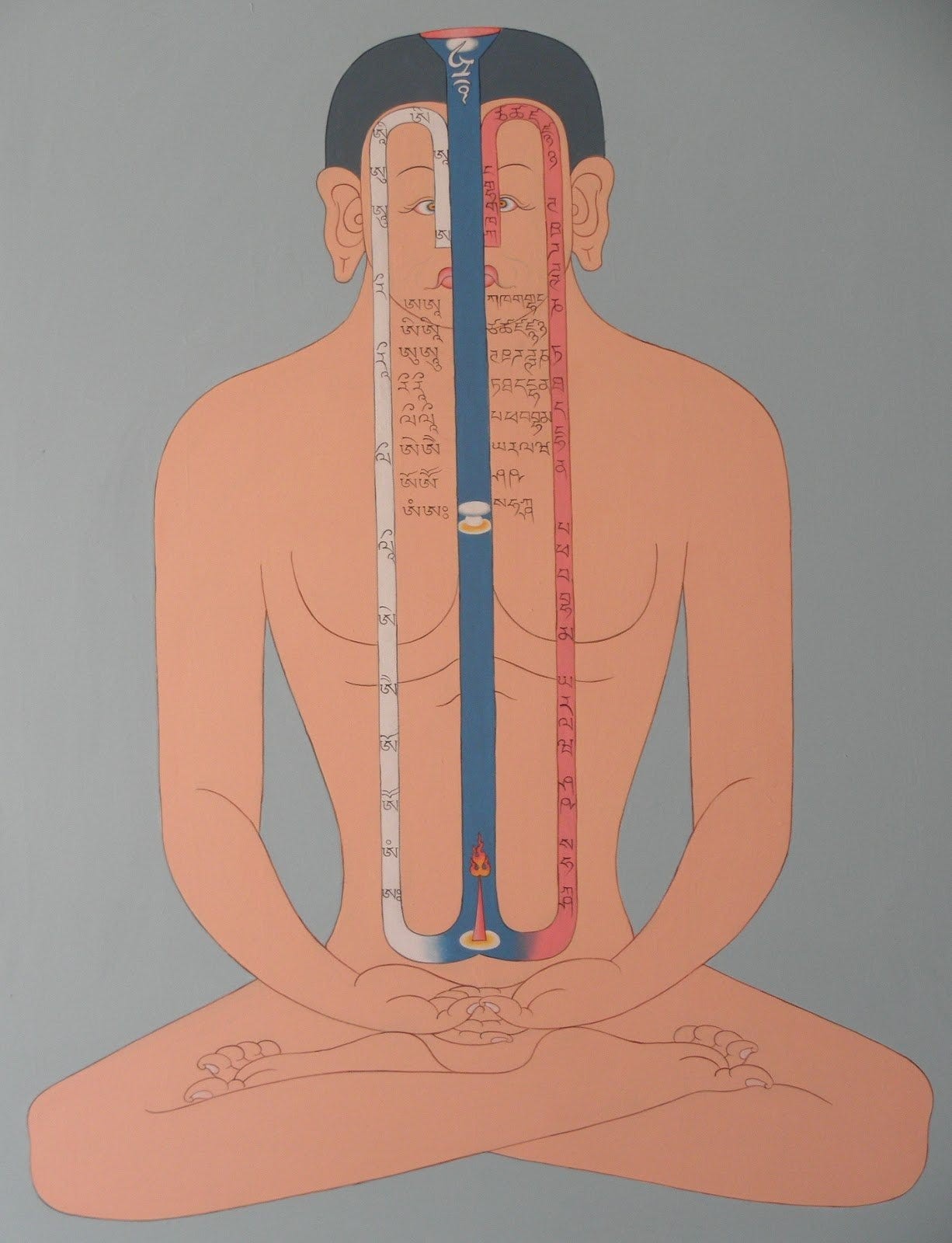
- While doing this, visualise the energy flowing through your body like in this picture. The two tubes start at your nostrils and descend to a point that’s four digits below your navel. There, they merge into a larger tube that rises to the top of your head.
Some people might be thinking: “clenching your anus? this meditation technique is fake and gay”. And they couldn’t be further away from the truth. This technique is real — it’s been in existence in Tibetan Buddhism for more than a millennium.
And it transcends the entire gay-straight continuum. I was a bit weirded out by the whole swallowing-while-clenching-your-anus idea initially. But then Wystan Bryant-Scott got eight of us at the QRI retreat in Mexico meditating this way, clenching our anuses (not in sync), and I am now a huge fan of it.
It can feel quite intense, below is a replication by Andrés Gómez-Emilsson, QRI’s Director of Research, who was the leader of the retreat. The vector field represents the field of somatic sensations.
Clarifying the instructions
- It is usually recommended to visualize energy flowing in as you inhale. After that, there are two options: you can imagine the energy collecting at the bottom while you hold your breath, then rising during the out-breath; or you can visualize it rising while you are still holding your breath.

Don’t hold your breath for longer than it’s comfortable — don’t be the guy in the meme above. As you get accustomed to the technique, your hold time will naturally increase. Some very experienced practitioners can hold for 4+ minutes, but beginners are better off starting slowly. It’s also fine to take a couple of normal breaths between the rounds of the vase — you don’t have to go full dedicated monk mode from the very beginning.
When getting used to this meditation method, spend periods focusing only on visualisation or only the breathing-clenching aspect of it. Spend some time visualising the energy flowing throughout the tubes, how they merge in an inverted Y-fashion, how the central tube is twice as thick, and so on. Then separately focus on coordinating clenching, swallowing, and taking a diaphragmatic breath. This meditation method is a bit like juggling while riding a bicycle: it helps to practice each part individually.
The quality of visualisation might be poor at first. That’s ok. Do the best you can, and don’t get overly attached to the end result — it will get better as you practice.
Keep in mind that you are supposed to be using both visual and somatic fields when imagining the tubes. Try to both feel the energy moving in your body and also see it.
While meditating this way, your core temperature might rise and you might feel waves of heat. That’s normal. There are also versions of this meditation technique that focus specifically on imagining yourself being on fire, but they are outside of the scope of this article.
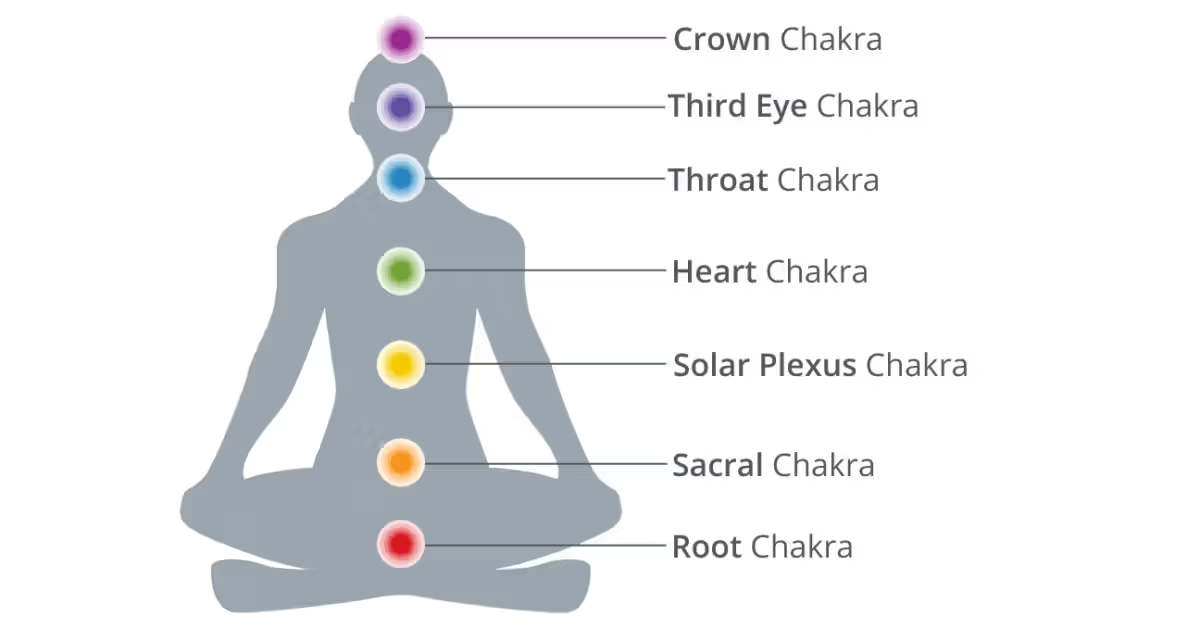
Trigger warning: further discussion contains woo and chakras
If you google the instructions for this meditation technique, you might find that traditional instructions mention chakras. In this meditation you visualise energy going from your nostrils to your sacral chakra, and then up to your crown chakra. So far in the post I avoided using the term so as to not scare off more skeptical readers. But now you have the true instructions.
So what are chakras? You can go full skeptic mode and say that chakras are bullshit and don’t correspond to anything. And you’d be at least somewhat wrong: most people would agree that there are places in the body that are especially emotionally salient.
For example:
Genitals. An area that is undeniably very sensitive. The root chakra is there.
Throat. Your throat gets tense when you are nervous. People often describe having a lump in their throat when they hear especially bad news. So sensations in the throat are one way emotions can get passively expressed somatically. And you also actively express emotions there via modulating your vocal cords, e.g. yelling when in danger.
Chest. When people feel anxious, their heart physically starts beating faster — this is noticeable on the physical level. But also, language-wise, in English, emotional pain is often described as heartache. It’s not like the heart itself physically aches, but some cluster of somatic sensations there definitely gets activated.
Belly. Anxiety causes abdominal muscle tension, people talk about having a ‘knot in the stomach’. Positive excitement is often described as butterflies in their stomach. And guess what — the sacral chakra is there, it’s just below the navel.
If you are still skeptical about chakras, would you become less skeptical if we called them “psychoemotional centers”?
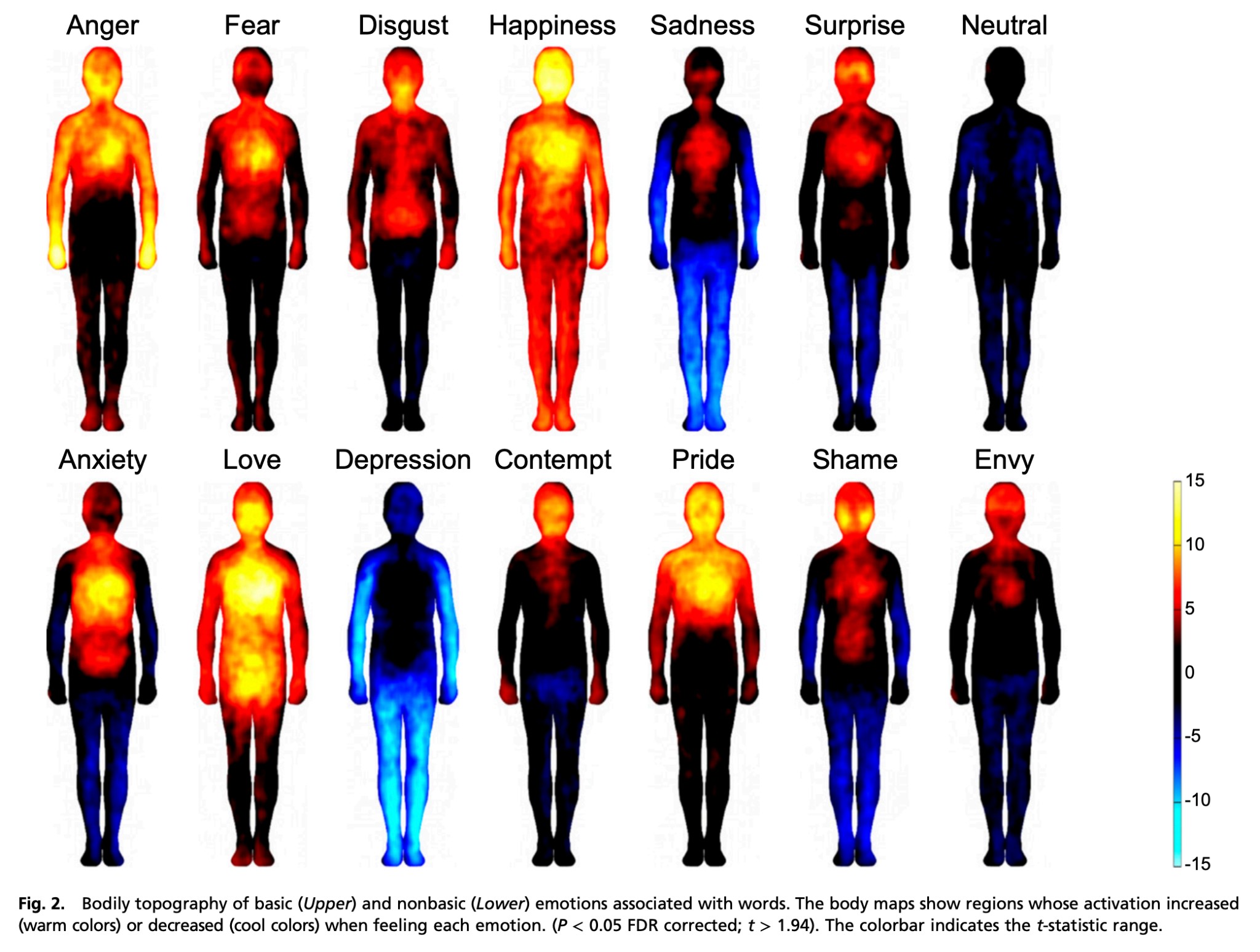
The above is a picture from Nummenmaa et al. “Bodily maps of emotions” that I first saw in Kaj Sotala’s “Taking woo seriously but not literally”. Emotions happen not just in the body, but in areas in the body that are different for different emotions.
Michael Edward Johnson in “Qualia Formalism and a Symmetry Theory of Valence” gives another angle to think about the nervous system:
Just as an organism is a confederation of cells, a nervous system is a confederation of ganglia. And as cells have their own economy of sticks and carrots meant to identify and prevent cancerous defection, so too each ganglia has its own toolset of harmonic sticks and carrots meant to align disparate organs. Put simply, if an organ isn’t getting its needs met and wishes to raise an objection, it can strategically broadcast dissonance into other organs. If it is getting its needs met and wishes to train other organs with positive reinforcement, it can broadcast loud harmony – the stomach is notorious for both. Each organ has different channels available for this, depending on its position in the nervous system’s topology.
Chakras may in part correspond to places where the body has unusually rich visceral traffic: from organs reporting internal state, to breathing signals and blood pressure signals.
Annealing your body schema
The above may be a rational explanation for chakras — they are emotional/somatic centers in the body. But it doesn’t explain anything about the three tubes you are supposed to imagine (called the central channel and the side channels). It’s not like we have any tubes going from the nostrils to below the navel. The trachea isn’t long enough and the spinal cord branches out in tons of ways instead of wrapping back.
Moreover, the traditional instructions are not descriptive but prescriptive: you are not supposed to locate chakras and channels in your body. You take the instructions and do as you are told. Eventually something happens.
But happens what exactly? What’s up with these channels? Here is my best tentative model.
You are not experiencing the world directly. Nor are you experiencing the body directly. Your mind takes noisy sensory data and builds a virtual world simulation for you. That simulation has a representation of your body inside it. People can be tricked to believe that a fake rubber hand is their own. Conversely, phantom limb pain happens in part because the mind doesn’t update its representation after the physical body loses a limb. You inhabit a virtual world that’s only partially coupled to reality.
Controlling the body involves a lot of fine-grained microroutines, not all under conscious control. Someone bumps into you while you are carrying a glass of water, and you automatically adjust your position so as to not drop it. You see a cute girl (the girl reading this), your heart flutters a little bit and after a pause you strike up a conversation, tensing your vocal cords — a whole-ass chain reaction between several different body parts. An urgent meeting invite from HR gets dropped into your inbox at 3 AM and your heart rate rises and you start wondering if you were laid off — tensing your body in the meeting-shape in the meantime.
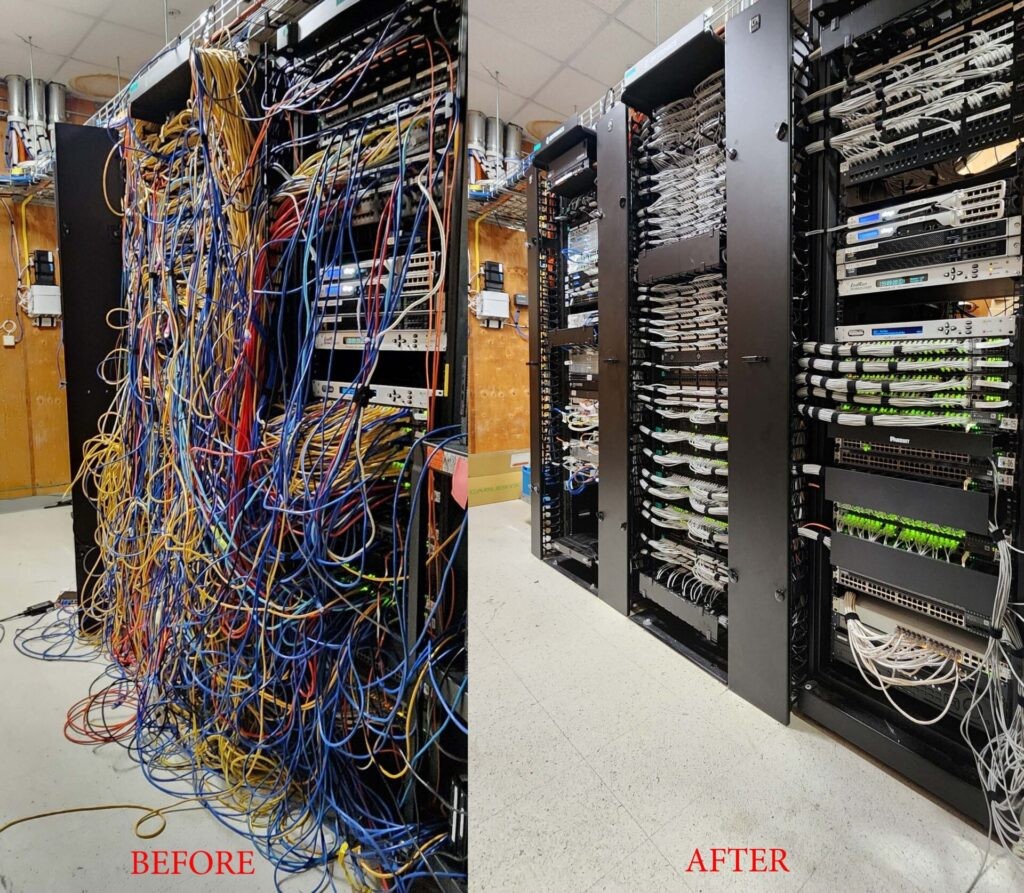
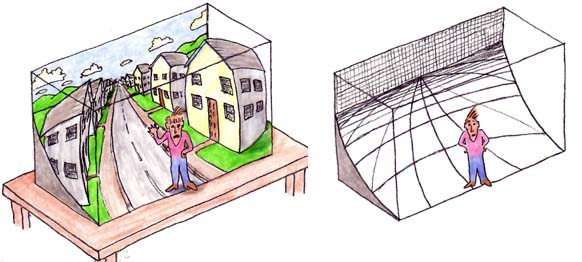
So you tangle representation of your body with subroutines for exercising control over it in response to emotions. For many people the mind generates wiring “the spaghetti code” — like on the left of the picture above. And Vase Breath helps the mind to become more neatly organised — think the picture on the right.
There are many ways to wire the same nervous system — some more effective than others. And so perhaps the central channel and the side channels are “software” (rather than “hardware”) highways for signals, around which the subroutines can be organised more efficiently.
Dangers
The cable analogy is also a warning: you are rewiring the nervous system touching on everything: from the bodily perceptions to your most basic social instincts. This can be inherently activating and destabilising. Three times during the first months of the QRI retreat after particularly productive vase breath sessions I found myself having to skip an evening of youtube shorts and mindlessly scrolling twitter — in order to do more rounds of vase breath. In my case the solution to problems with this meditation method ended up doing more of this method, but you may not be so lucky.
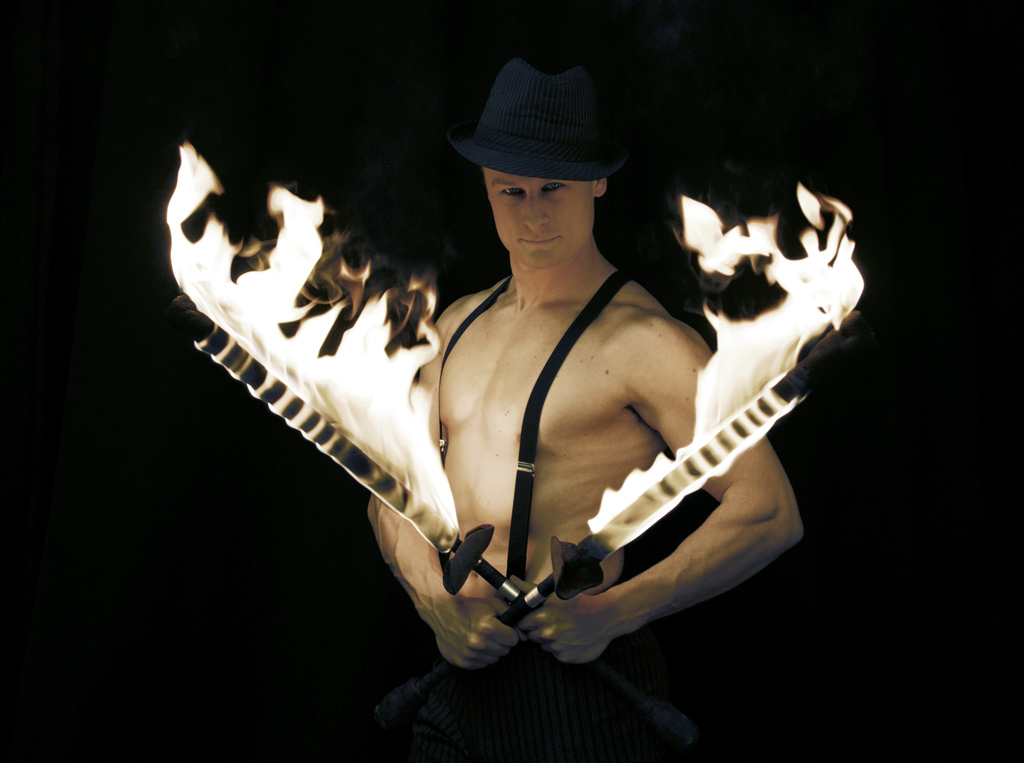

I don’t have advice on how to know if this meditation is the right fit for you. Vase Breath is very much a double-edged sword. Still, wielding double-edged swords is fun. If you are like me, and like to live a bit dangerously while playing with fire swords, I recommend giving this meditation method a shot.
Citation
For attribution, please cite this work as:
APA
Putilin (2026, September 11). Vase Breath: the clench-your-anus meditation. https://heart.qri.org/retreats/2026-tepoz/sasha-putilin/vase-breath.html
BibTeX
@misc{putilin2026vase,
  author = {Putilin, Sasha},
  title = {Vase Breath: the clench-your-anus meditation},
  url = {https://heart.qri.org/retreats/2026-tepoz/sasha-putilin/vase-breath.html},
  year = {2026}
}