Written by Sasha Putilin on 11 September 2026.
This post is a contribution to the third Qualia Research Institute psychophysics retreat, which took place from May to June 2026 in Tepoztlán, Mexico.
Table of contents
- Qualia Research Institute’s HEART retreat
- The jhanas
- Formless jhanas as one of the goals of the retreat
- How to get into formless jhanas
- My preliminary experiments
- If something in your meditation practice works, do more of it
- The success is partial
- The 9-day retreat setup
- The nine-day “trip report”
- Re-entering normal life
- Three months later
- In conclusion: subtractive and additive happiness
- Resources
Day 1/9 of a meditation research retreat. I close my eyes and my body immediately starts to dissolve into the void. Void juice slowly flows into emotional wounds and they begin to heal and fade. Over the next few minutes the state gets extremely pleasurable — more pleasurable than any drug I tried, including MDMA, opioids, various dissociatives, stimulants and sedatives — but it’s caused by meditation and not drugs. Only some rare psychedelic trips rivalled or surpassed it in pleasure — and I had 100+ trips on two dozen different psychedelics.
Despite being so pleasurable, the state is not addictive. If anything, it’s mildly anti-addictive: it acts like a tuning fork for the mind, dissipating internal stress left by past addictive behaviours and traumatic memories.
Popular culture has a particular image of meditation: you sit in a lotus position, you observe your thoughts, and you try to make your mind as still as a pond on a windless day, acquiring the seemingly superhuman mental stability of a Zen monk. Some meditation techniques do work like this. But the kind of meditation I’m doing is very different. It’s geared towards achieving jhanas — super-pleasurable concentration states. There are eight jhanas, and I am trying to enter the fifth one — hence the title of this post.
Qualia Research Institute’s HEART retreat
The nine-day meditation retreat was a part of the 8-week HEART research retreat in Tepoztlan, Mexico organised by Qualia Research Institute (QRI) in May–June 2026. HEART stands for “High Energy Awareness Research Team”.
QRI is a non-profit focused on building a new science of consciousness. QRI’s approach combines first-person phenomenology of exotic states of consciousness — such as those arising from meditation and psychedelics — with rigorous mathematical modelling and leading-edge neuroscience.
Physicists study matter not just under ordinary room-temperature conditions but also in particle accelerators, where they create exotic forms of matter — these allow us to better understand the underlying rules of the universe. Similarly, studying exotic states of consciousness helps us better understand consciousness and the computational medium of the brain.
QRI’s goal is to reverse-engineer consciousness, figure out the mathematics of pleasure/pain, and apply these insights to reducing suffering at scale and developing sustainable and wholesome bliss.
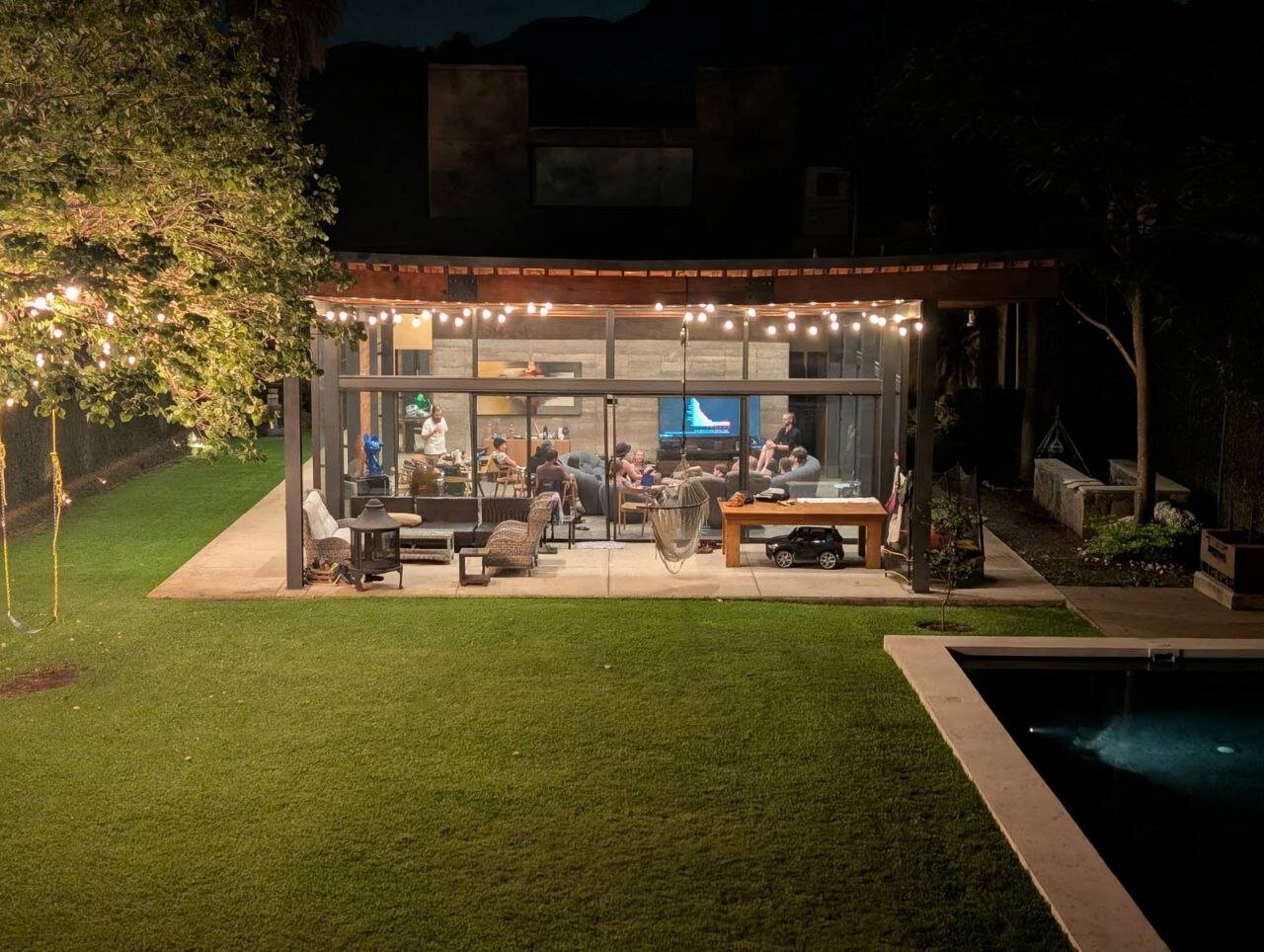
In Tepoztlán, a team of physicists, mathematicians, visual artists, advanced meditators, philosophers, and rational psychonauts gathered for eight weeks to study the jhanas (pleasurable meditative absorption states) and 5-MeO-DMT — a powerful psychedelic that’s unscheduled in Mexico. The retreat was led by Andrés Gómez-Emilsson, QRI’s President & Director of Research, and supported by Hunter Meyer, its Director of Operations.
I was invited there as an experienced meditator and a software engineer with a background in Applied Mathematics due to my familiarity with philosophy of mind and broad alignment with the organization’s mission. I had followed QRI’s work for years and had been running regular meetups for the community around QRI in London.
In Tepoztlan we studied meditation and 5-MeO-DMT by:
experimenting on ourselves;
writing qualitative reports about experiences
collecting quantitative survey data;
conducting microphenomenology interviews;
drawing sketches;
creating software-based visual replications of our psychedelic and meditative experiences.
We also used tools created by QRI, such as oscilleditor and tactile visualiser to map out the dynamics of the states and pinpoint mathematical properties of their generators. And we collected 15 hours of EEG brain data along with associated pleasure/pain reports for later study.
The overall event lasted 8 weeks, and only 2.5 weeks focused on directly experiencing meditation and psychedelics — the rest was focused on the work described above. Some people attended only part of the retreat, while others stayed for its entire duration.
I stayed for all eight weeks, but this post is about my experience during the nine-day meditation retreat within it.
The jhanas
There are 8 Jhanas. They are all highly pleasurable, but the pleasure differs in texture and structure. The first jhana is an explosion of bodily pleasure. In the second jhana, the fireworks settle into a smooth current of joy. In the third, the joy softens and becomes deep contentment. In the fourth, even contentment gives way to perfect equanimity — vast, still, and almost affectless.
These four jhanas are called the formed jhanas. Their meditation objects are in the material world: sensations of the breath, pleasure in the body, and so on. The next four are called formless jhanas, or formless realms. Their meditation object no longer corresponds to anything in the “material world”.
In the fifth jhana, your entire experience becomes a smooth, uniform, boundless space that feels infinite. And by your entire experience I mean exactly that — you lose all perception of your body — you become that boundless space.
The sixth jhana is called “Infinite Consciousness”: you notice your awareness of boundless space and tune into the awareness itself. In the seventh, “Infinite Nothingness,” space falls away completely, leaving only — well, this will sound abstract and self-referential — a kind of thin nothingness. It is no longer empty space, it’s even less than that. The eighth one is “Neither perception nor non-perception” — Daniel Ingram, the author of “Mastering the Core Teachings of the Buddha: an unusually hard-core dharma book”, describes the state as “largely incomprehensible. There is no reasonable way to attempt to describe it, save that it is a mind state”.
Each of the eight jhanas progressively deconstructs and strips away aspects of experience. The eighth is so attenuated that people can barely say anything about it. Can you strip down the experience further? It turns out you can, but you get to an unconscious non-state Nirodha samāpatti in which there is no experience whatsoever. It typically lasts for minutes, but can sometimes last for hours and, in rare cases, even days. To the meditator, that time passes in an instant.
Formless jhanas as one of the goals of the retreat
The goal of the eight-week research retreat was to compare and characterise different jhanas and different levels of 5-MeO-DMT experience. There are anecdotal reports of people accessing jhana-like states on 5-MeO-DMT, and we wanted to find out whether empirical evidence could support those reports.
Experiencing formless jhanas was considered especially valuable for research. Their high pleasure and simplicity (low informational content) are especially useful for studying mathematics of pleasure/pain. We were also interested in phenomena suggestive of non-linear optics, hoping to find further evidence for QRI’s theory of “Brain as a Non-linear Optical Computer”.
Needless to say, I wanted to maximise my impact, so I was especially motivated to reach the formless jhanas.
How to get into formless jhanas
Traditional methods instruct practitioners to attain the jhanas in order. Each state is a progressively more “deconstructed” version of the previous one, so it helps to proceed sequentially — allegedly.
A few months before the retreat, I read Sasha Chapin’s claim that some meditators find it easier to start at jhana 5 rather than 1. And indeed, suttas — canonical scriptures in Buddhism — do describe people reaching formless jhanas first:
The Buddha himself reached formless jhanas (jhana 7 & 8) first, before embarking on a systematic exploration of other jhanas. And while the same sutra mentions him spontaneously reaching the first jhana as a child, at minimum it makes clear that it’s not necessary to experience every lower jhana before experiencing the formless ones.
Another sutra, MN 121, Cūḷa Suññata Sutta, The Shorter Discourse on Emptiness describes a monk reaching jhana 5 — and then 6, 7, and 8 — after first focusing on the perception of earth.
But how often does this happen? Nobody truly knows. Wystan Bryant-Scott, another retreat participant and the retreat’s meditation coach, was skeptical that it happens often — his guess was that it happens in <1% of cases.
As for me, I was skeptical that it was that rare, simply because we lack reliable numbers. Buddhists do not run randomised controlled trials to identify the most efficient routes into various states, so any statistics will be dominated by people practising as they were taught. Students typically follow the instructions as given, without asking, “Is there a more efficient way to meditate?”
Not me, though. I am interested in speedrunning enlightenment — figuring out the most effective ways to transform your mind towards it. The term comes from video-game speedrunning. Speedrunners explore a game to find the fastest way to complete it, sometimes by doing seemingly crazy ridiculous things. For example, rather than assuming that walls are solid, they treat them as thin textures that the game engine prevents you from walking through. By studying what the engine actually does under the hood and experimenting with it, they can sometimes literally pass through walls, as in this Super Mario 64 video:
In meditation, we are handed imprecise maps: nebulous instructions and knowledge passed down by experienced practitioners. Maps are valuable — they encode the results of past successful experiments. If you have a treasure map with a path on it, following it may be useful — but you can also study the map, study the territory and chart your own route to the treasure.
Still, embarking on a quest through largely uncharted territory with an estimated low probability of success could mean wasting my time and losing valuable research data for QRI — the organisation I was invited to help.
Why did I decide to do it anyway? I ran some preliminary experiments.
My preliminary experiments
Before coming to Mexico, I began experimenting with modern instructions for entering jhana 1. First, you focus on the breath in the area beneath the nostrils and stabilise your attention — reaching a state called access concentration. Then you focus on a mildly pleasant sensation in the body. Attending to that pleasure without grasping or clinging creates a feedback loop that eventually leads you into jhana 1.
I also experimented with entering jhana 5 directly by focusing on the boundlessness of the space we all inhabit. I would attend to the sense of space around me and find myself in mildly mystical territory within minutes.
Here are the instructions I developed through trial and error, based on Sasha Chapin’s note I mentioned. Close your eyes. You retain some awareness of your surroundings, right? Try attending to them in order of increasing distance. Let’s say you are in a room, and the room is in a city. Begin with the nearest objects. Try to locate the surrounding streets in your experience. Then locate various landmarks and place them on a mental map. Next, notice that other cities and continents exist somewhere beyond them — these, too, can become part of your experience. Finally, remember that distant stars are out there (which don’t go out even if it’s daytime where you are). And as you do these instructions, you may notice your perception of space expanding and becoming a single whole. This sense of expansion and unification is the point — placing objects is a hack and you don’t have to be super precise with it.
The instructions to focus on the breath around my nostrils, however, did not feel right, and my mind would be distracted. There were two main reasons:
When I practised Vipassana extensively in 2019 and 2020, I focused on the breath at the roof of my mouth. At the time, my nose was permanently blocked because the cartilage separating my nasal cavities was deformed — a condition called deviated septum. In 2021, I had surgery to correct it (briefly described in this post), but even now, breathing through my nose does not feel entirely natural. And when I tried breathing through my mouth as I used to, the sensations felt too faint.
I now simply prefer more spacious practices such as Do Nothing meditation, which I had practised for 50–100 hours per month during the few months preceding the retreat.
The retreat instructions also offered two other main choices for the initial practice to build access concentration:
Metta (loving kindness) — sustaining the feeling of goodwill towards yourself and others until it becomes continuous and unified.
Whole-body awareness — focusing your attention on your entire body without collapsing it whenever a pleasant or an unpleasant sensation awareness arises.
Neither of these felt like a good fit. Metta was a non-starter: throughout the years whenever I tried it, I could generate loving-kindness, but it felt forced. Whole-body practices — including Vipassana-style noting and body scanning — had also felt forced, although this was a more recent development.
If something in your meditation practice works, do more of it
I faced a choice: should I pursue the unlikely approach that others doubted but that seemed to be working well for me, or follow the practices held up as the Right Way even though they did not work? I firmly believe in following gradients in meditation: if something in your practice feels as though it is working, do more of it. So I chose the uncharted path.
The success is partial
I succeeded only partially. The goal was for my entire experience to become a centreless, boundless space, with my body gone as well. I could instantiate boundless space and dissolve most of my body into it; my body schema would dissolve to varying degrees. A few times during the retreat, I dipped into full formlessness for a second or two: my body disappeared completely, leaving nothing in experience but empty space.
Under some definitions1 this is enough to say that I experienced a lighter jhana 5.
But stricter — and more popular — definitions require all perception of the body to be gone for a state to qualify as full jhana 5. During the retreat, our cutoff for full jhana 5 required sustaining complete boundlessness for 10–15 minutes, although we also recognised that these states exist on a spectrum.
After the meditation retreat, two experienced practitioners — Wystan Bryant-Scott (who I already mentioned) and a second experienced practitioner — interviewed us and rated both the depth of our jhana-5-adjacent states and the extent to which we had explored them. Among participants who had not previously experienced the formless jhanas, I received the highest ratings. Specifically:
2/10 for depth and 5/10 for extent from Wystan;
5/10 for depth and 7.5/10 for extent from the second interviewer.
People who followed the traditional route did not reach any level of the formless realms within the same timeframe (unless, like I said, they had experience with formless realms from before the retreat).
I do think it is valuable to experience the state at its full depth, and I am continuing to practise. If I attain a full, stable jhana 5, I’ll post an update. For now, here is the story of the retreat.
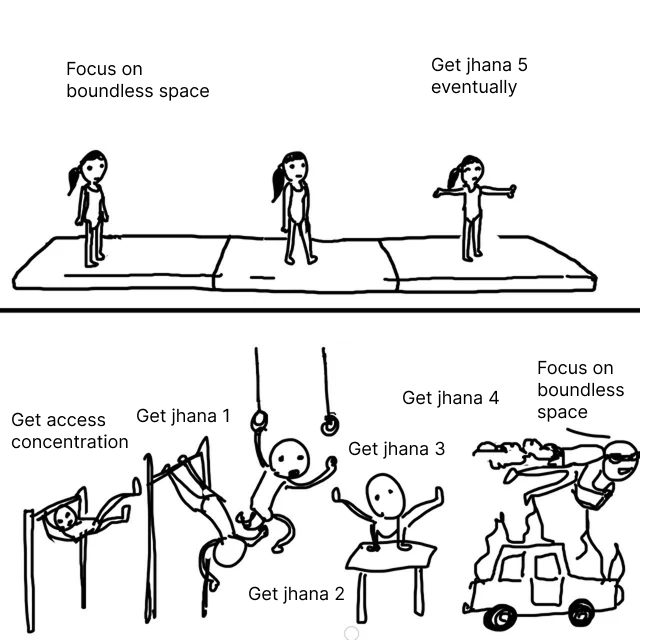
This is how the traditional instructions sounded to me
The 9-day retreat setup
In many ways our meditation retreat was modeled after Buddhist retreats. But in many other ways it was different.
We weren’t in a monastery — our team was spread across three houses. Two of them had the following rules:
10 hours meditation time per day;
Noble Silence (only required speech is allowed, which should ideally be rare)
plain diet with no sugar or sugary foods;
electronic devices being switched off — as limited contact with the outside world as possible.
The third house operated more like a normal group house with a recommended six hours of meditation per day.
Even in a hardcore house, however, you did not have to follow the rules at all costs. You could abandon the practice if you experienced adverse effects — meditation is known, in some cases, to trigger latent mental health problems. Because of this, QRI offered to book anyone a flight home at any time, no questions asked. That said, nobody took up the offer.
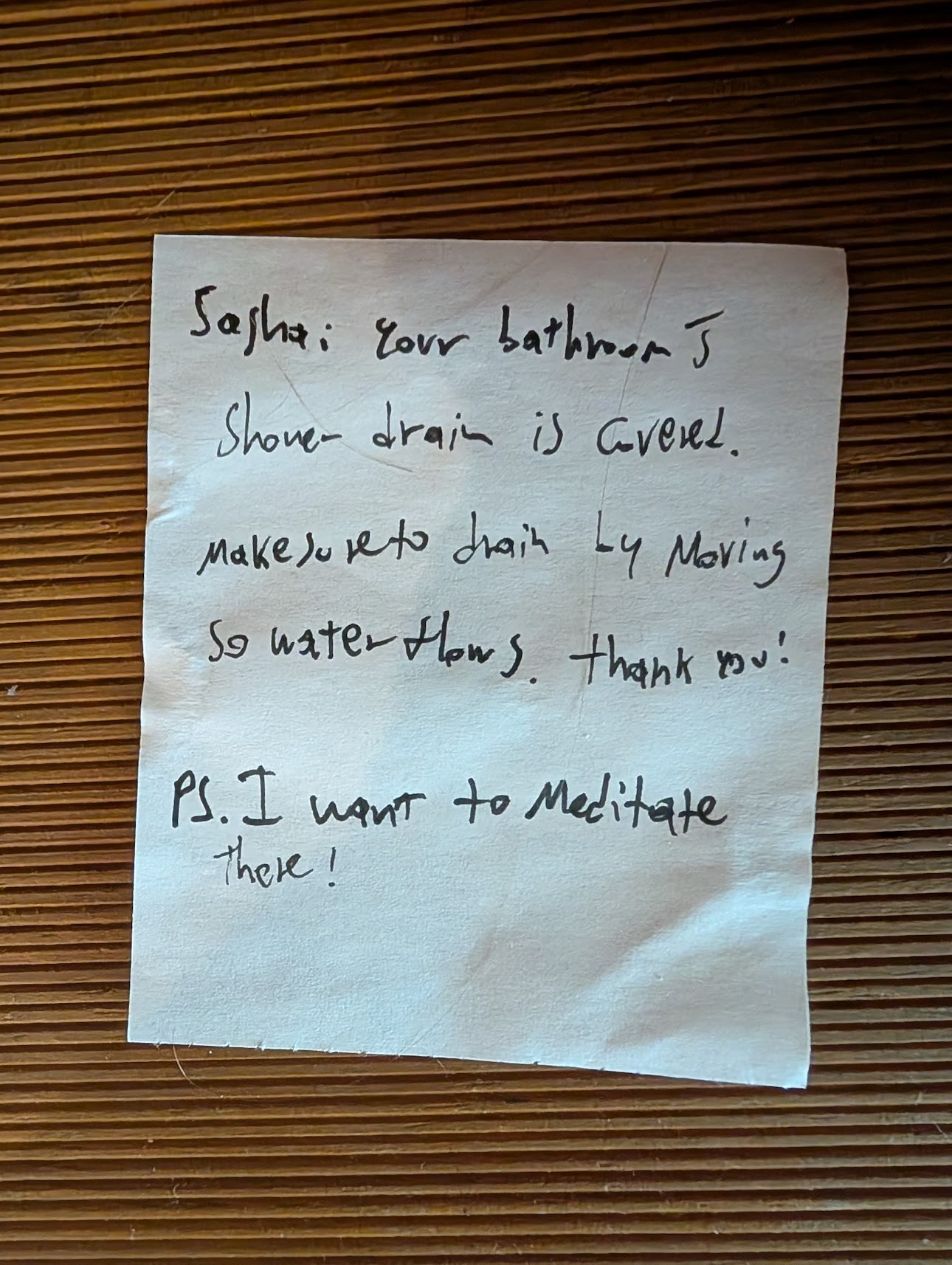
During Noble Silence people would actually avoid talking as much as possible. Even some required speech would be written notes. This one is from Andrés Gómez-Emilsson to me: “Sasha: your bathroom shower drain is covered. Make sure to drain it so water flows. Thank you. PS: I want to meditate there”. It turns out Andrés was sensitive to the environmental noise when visiting our house (he stayed in the other “hardcore” one).
Buddhist retreats generally have everyone meditate in the same space. As for us, we had only three optional 45-minute group sits. The rest of the time, we could meditate however and wherever we wanted: in private rooms or shared spaces, walking or sitting. Some people preferred the traditional lotus position, others sat in ordinary chairs. I spent most of my time in a reclining garden chair outside, occasionally getting sunburnt by intense Mexican sun.
Every other day, we had a 20-minute session with our coach, Wystan. Although he was initially sceptical of my approach, during the retreat itself he was nothing but supportive and provided a lot of helpful tips. I highly recommend him as a teacher. He is, by the way, running a jhana retreat in November that you can apply to attend.
The nine-day “trip report”
I generally practised for 10–11 hours per day, spending 70–90% of that time focusing on boundlessness as described. In the evenings, when my concentration waned, I would practise Vase Breathing for a couple of hours.
A note on psychoactive substances: throughout the retreat, I took my prescribed ADHD stimulant, lisdexamfetamine, at the prescribed dose of 10–15 mg per day, and drank two to four cans of Monster daily, containing 320–640 mg of caffeine in total. These doses were in line with my pre-retreat consumption.
Day 1: already reaching some degree of boundlessness
Before the retreat, I had practised the instructions outlined above for a total of a few hours spread across several days. Initially, I placed landmarks, cities, continents, and stars until I experienced a sense of a large space as a whole. Focusing on that sense of expansion is the mental motion to do. And soon I would start my meditation sits by performing it directly, without the placing hack.
As I perform this mental motion — with my eyes closed — my perception of my surroundings would soften, gradually giving way to a growing sense of space. My body would become more “transparent,” as though someone had dragged its opacity slider in an image editor down to 75%. After 10–15 minutes, the state would become intensely pleasurable. As I mentioned, it felt better than any drug experience I had ever had. This was not the richly textured pleasure of watching a good film or meeting an old friend — it was simple and abstract. Metaphorically speaking, if meeting a beloved friend is like hearing a beautiful orchestra, then this state is like a single pleasant reverberating piano chord. The “louder it sounds”, the more pleasurable the experience.
Meditators often speak of equanimity: a steady and balanced state of mind characterised by experiencing painful feelings without fighting them and pleasant feelings without clinging to them — basically, the opposite of reactivity. The sensation of boundlessness is equanimous — the pleasure of the state allows you to experience past painful or cringeworthy memories in full detail without flinching.
Traditionally, regret is considered a hindrance to jhana. I had many regrets in my life: cool job offers not taken, Bitcoin not mined in 2010, friendships that had fallen apart, cringeworthy things accidentally said — all sorts of bad decisions. I can see how these regrets might obstruct a full jhana, but during this initial period they become my primary motivation to practise. Even when you are not consciously thinking about your failures, representations of them may remain encoded somewhere in your mind, weighing you down every now and then. But now I could close my eyes, experience the pleasure, and throw my memories into it, allowing their stored stress to dissipate. Sounds fun, right?

And it was fun. Regrets burned away in the structural pleasure of the partial jhanic state. Buddhists call this “purification of mind.” QRI would call it “annealing” — a term that’s borrowed from metallurgy.
Physics textbooks depict metals as neat, regular crystal lattices. But real metals contain many structural imperfections. Annealing is the process of heating a metal above its recrystallisation temperature, allowing its atoms to move more freely, and then cooling it so that the atoms settle into a more regular lattice.
The analogy: mind is like a belief lattice riddled with irregularities. Meditation “heats it up” by adding “energy” — neuronal activity — allowing it to settle into a more regular structure. The full discussion of this is beyond the scope of this post, but if you are interested in this model, I recommend reading my guide on annealing, QRI’s “Healing Trauma With Neural Annealing” or Mike Johnson’s original article “Neural Annealing”.
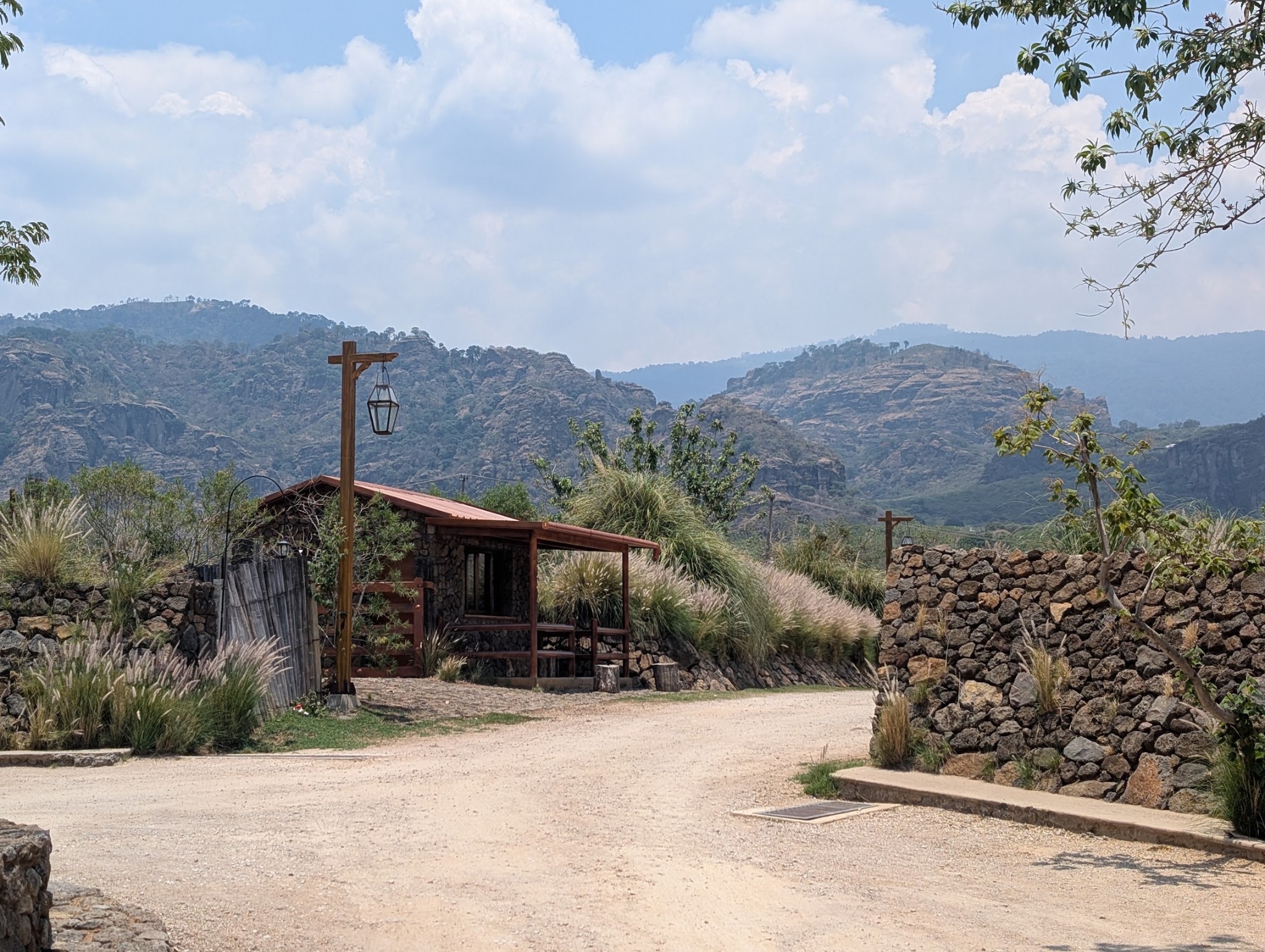
Mountains in Tepoztlan
Days 2–3: fuck these mountains
I continue practising for ten hours a day. Space becomes more tangible — more like an encompassing void. It is not yet boundless, but it envelops everything, and most of my surroundings disappear while I practise. Not all of them, though: a mountain a few kilometres in front of me is very annoying. I practise outside with my eyes closed and find that the rest of my surroundings dissolve much more readily. The mountain softens considerably but refuses to disappear. Fuck you, mountain.
I continue throwing regrets into the void. Psychologists speak of an internal locus of control: focusing on what you can control without worrying too much about the rest. I am in my thirties now and over the last few years I’ve gotten much better at this. But my twenties were a considerable mess, full of worry, broken dreams, and stress over things I could not control. Everything from securing immigration visas — to Russia, where I am from, banning psychedelics and seizing foreign territories.
Parts of the mind that developed over a lifetime may persist for years. Unless, let’s say, you throw them into the void. And it turns out that developing more robust psychology later in life helps with dissolving past stressed parts. To use a metaphor from software engineering, my mind ended up accumulating a lot of “technical debt,” but it now has the right high-level abstractions, and the meditative state allows me to begin paying that “technical debt” down.
Days 4–5: it gets very psychedelic
The mountain is fully dissolved — take that, mountain. The pleasure goes up. The equanimity aspect goes up too. I learn to hold the entire space as a single meditative object in my attention, kind of gripping it confidently and consistently, infusing it with attentional strength.
And the state becomes significantly more mystical and psychedelic.
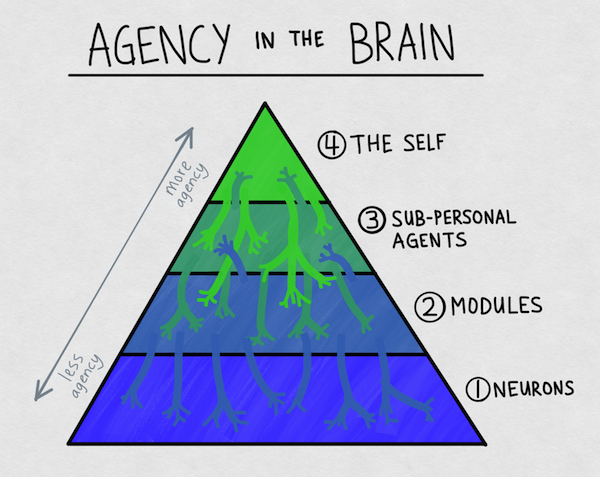
The picture from Neurons Gone Wild by Kevin Simler. It presents the idea that neurons are selfish agents partially reverted to their feral single-celled eukaryotic past. It mentions this quote from Dennett:
Maybe the neurons in our brains are not just capable, but motivated, to be more adventurous, exploratory, or risky in the way they live their lives. They’re struggling amongst themselves for influence and for staying alive. As soon as that happens, you have room for cooperation, to create alliances, coalitions, cabals, etc.
Around this time in the retreat my meditative experience becomes almost a description of my actual experience. The mind disintegrates into a soup of cognitions. Individual thoughts and memories bubble up, while various high-level personality structures try to consume them and recruit them into alliances. There is no high-level “me” directing the process: different parts of my mind are negotiating an equilibrium — a more effective overall mindset built from years of accumulated data.
The mind is a Darwinian meaning-making machine, made in the image of its creator: evolution. You can notice this even in a sober state, but in this state it is overwhelmingly obvious. The negotiation between different parts of my mind has a quality of gentle violence to it — tender, caring, equanimous, but still violence. Think of it as self-gardening. We imagine gardening as this peaceful practice — but actually it is anything but: you pull up weeds and sow desired plants in place of the previous ecosystem.
I also begin experiencing the space I am instantiating as a kind of mystical cosmic entity: a “void tulpa” within my mind. Whenever a difficult emotional pattern arises, I think, “The void forgives all your sins,” because dissolving the pattern involves interaction with the void. There is a unitive cosmic gravity to the state I’m experiencing that makes it hard to not reach for religious metaphors. I hold these metaphors lightly — without believing I have discovered absolute religious truths. I also do wonder if people who describe unitive experiences with god and talk about god being the ground of all existence experience a shadow of a jhana-like state.
***
The passages above describe the deeper meditative experiences. If I open my eyes, I can switch back instantly to doing ordinary activity. For example, during day 5 I went to a different house 40 minutes away to collect meditation EEG data (using the headset from my ACX grant project).
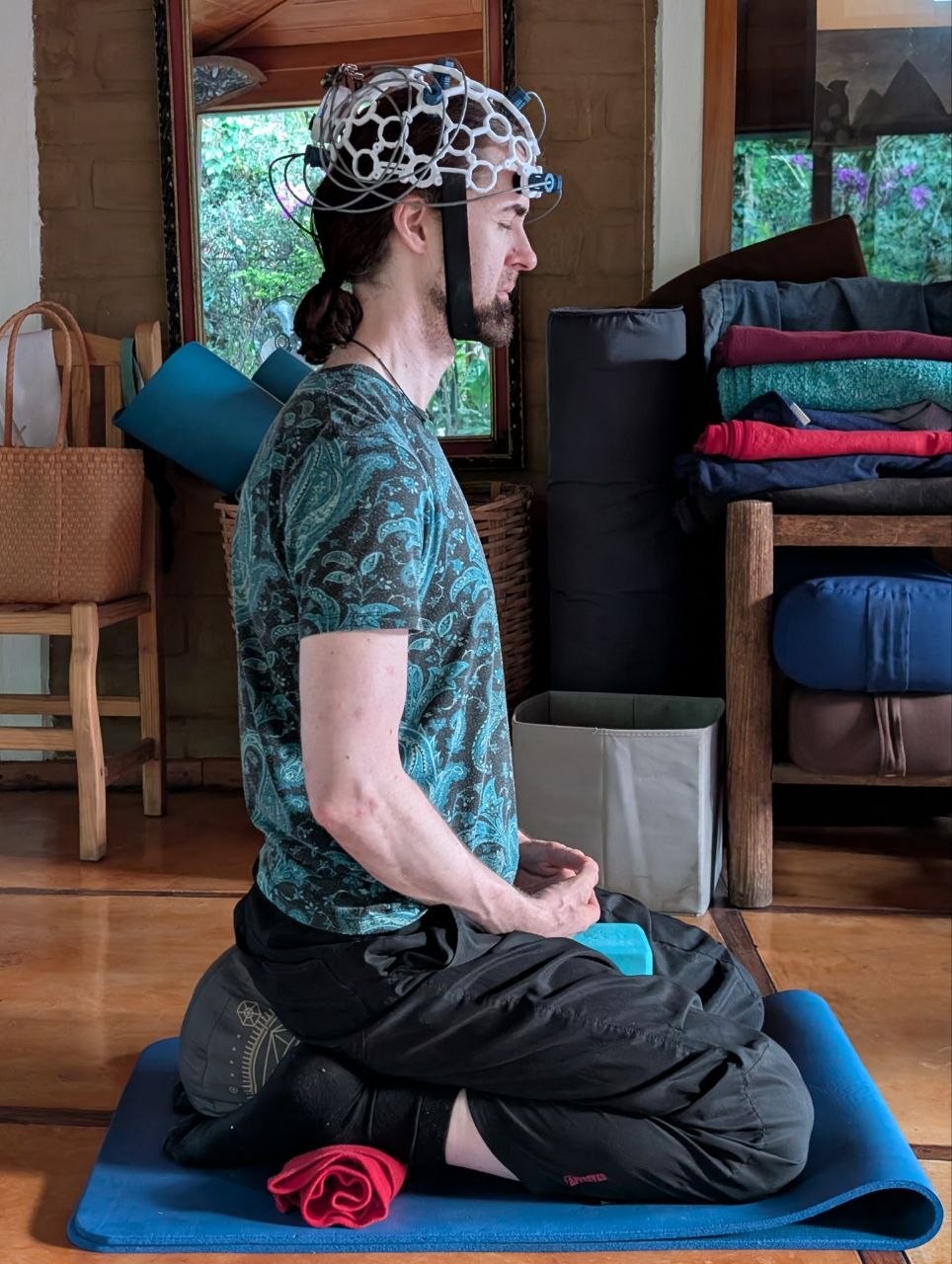
Recording EEG of Emil Hall, a colleague
Collecting EEG data is a relatively complex procedure. It requires several minutes of fitting and adjusting the headset, checking that the readings are sensible, explaining the protocol to the person whose brainwaves you are recording, keeping track of time, and so on. Despite spending a few hours a day in a distinctly altered state, I have no trouble carrying out my EEG-collection duties.
Breaking the “no sugar” rule of the retreat
Day 5 is also when I began breaking one of the retreat’s rules: the prohibition on sugar. We were allowed plain food — including Soylent, a meal replacement powder. But Soylent didn’t arrive in time for the retreat. Nor was it available there on Day 5.
We’d only have one communal cooked meal during the day, prepared by a rota of participants — it’d be both tasty and healthy. In the mornings, I’d cook myself eggs and eat them with a can of Monster. In the evenings, I’d be starving, because I am terrible at cooking.
On day 5, I went to the other hardcore house to collect EEG data. There were a couple of shops along the way… so I ended up buying calorie-dense food: biscuits, chocolate bars, and the like. I’d munch on them throughout the day for the second half of the retreat without telling anyone.
Wystan had inspired this decision before the retreat began. He told us that we were banning sugar, as Buddhist retreats do — but he also told stories about monks sneaking into the kitchen to steal it. Every time I’d eat one of my forbidden snacks, I’d feel part of something larger than myself: a great spiritual trickster tradition. We are all one, and we are all stealing negentropy from the rest of the universe in one way or another.
Wystan is a great teacher who can tell a moving story.
Days 6–7: the experience getting pretty terrifying
For the first time, the experience becomes genuinely terrifying. I have learned to summon boundless space around me while dissolving perhaps 60% of my body, with the remainder becoming increasingly ghostlike. My body schema has become a patchwork of qualia, many of them half-dissolved. This is difficult to describe, but imagine the body as a hierarchical, low-polygon mesh in which the polygons corresponding to the faintest sensations simply disappear. The void is kind of overflowing in the body and the polygons have softer edges where it stops.
As I inch closer to full dissolution, some built-in mammalian instinct activates, “no body = death.” Rationally, I know that many meditators before me have experienced this. I also know that I have lost contact with my body dozens of times on ketamine, a dissociative drug. But when space begins overflowing deeper and deeper into my body while I remain capable of relatively clear thought, neither rational knowledge nor prior experience is enough. And so at some point I end up spending a couple of hours in terror, until that mammalian part of me realises that the body dissolving is a temporary thing.
Notes on Euclidean space
By then, I have been able to instantiate space stretching boundlessly into infinity in front of me for several days. And let me tell you: I have never encountered space as Euclidean as this. If you had told me before the retreat that meditation could instantiate a space more Euclidean than ordinary sober 3D space, I would have asked, “What the fuck are you talking about?”
But our ordinary experienced space is not quite Euclidean. By default, it does not extend uniformly to infinity — instead, it coagulates into lumps. If you are in a building with several rooms, notice how the walls divide awareness into chunks. Objects, too, form “lumps” in awareness. To notice this, try mentally drawing “lines of attention” through them and observe what happens.
Not to mention, you are actually not experiencing the 3D space, but a holographic 2.5D projection of it — two dimensions + depth. Objects of equal physical size appear different depending on their distance from you.
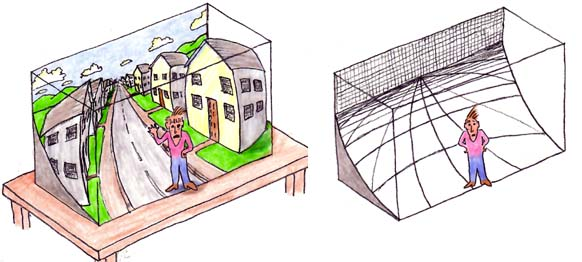
From Cartoon Epistemology by Steven Lehar
All sorts of other distortions occur:
cute boys and girls (especially the girl reading this) literally bend your experienced space towards them, drawing you in;
a cliff edge bends it the other way, infusing nearby space with avoidance and pushing you back;
pain — especially intense pain — may contract the space around it;
social conventions and ownership create boundaries that carve space further: my desk versus yours, my room versus yours, etc;
nearby space feels intimate and actionable, while distant space feels abstract and theoretical.
Ordinary space is rarely (if ever) just space. It’s curved by attraction and aversion, carved into paths and barriers, centered on your body and then lumped into objects.
But the closer you move towards jhana 5, the more these phenomena fall away and the more uniform, Euclidean, and empty space becomes. The sensory modality of this empty space is peculiar. It’s there in your visual field as a foggy silver expanse. But also, the visual and somatic sensations are coupled. You do not merely “see” the space; you “sense” it.
During these days, I experience several dips into full boundless space, with my body completely absent for a couple seconds. As I mentioned, this state would not be stable. After those couple seconds, the most salient bodily sensation — the pressure of the reclining chair against my back — would return, first as a swirl in space and then as ordinary pressure.
Day 6 & 7 were the deepest part of my meditation run. And they also had some other fun experiences.
A replication of a vortex in my chest
Space would usually be quite uniform and it’d overflow into the body in fairly straightforward ways. During one group sit, however, it experienced an interesting topological configuration: my body appeared perhaps 60% opaque, but my chest was completely absent, replaced by a spinning vortex. You can see it in the replication above.
Seeing my hands with my eyes closed
During another group sit, I moved my hands in front of my closed eyes and saw reddish outlines around them — kind of like that scene of Neo seeing the Matrix when he went blind.
In general, the closer you get to jhana 5, the more coupling you experience between the visual and somatic field. Because the mind knows where the hand is, it may sometimes project a representation of it into the visual field.
A brief fall into nothingness
After an extended break from meditation, it’d usually take me 1-2 hours to progress from a vaguely spatial void to full boundless space. Once, shortly after beginning a sit, I found myself inside a lump of void having a diameter of 3–5m or so. It feels a bit strange to assign meters for something in your experience that doesn’t correspond to anything in the real world — it’s not like you can place a ruler on it. But I have to give you some reference, right?
Anyhow, here I’m meditating and focusing on the sense of expansion, when I notice that the space already has this certain infinite quality. Why am I trying to expand it to infinity? Why am I trying so hard? The moment I asked myself this, space collapsed into pure nothingness stretched into infinity. It was not the empty space I’ve been cultivating, but something even thinner… nothing.
I try to spread that nothingness through my body, and my chest completely disappears — where it was there is no longer even empty space. Imagine some “voxels” of the body remaining, without the space to contain it. It was profoundly strange. I wanted to explore it further, but it had just begun to rain. After abiding in nothingness for five minutes, I went inside and I was unable to get it again.
Initially I assumed that this was a half-baked jhana 6, “Infinite Consciousness,” because awareness of the nothingness remained. But Wystan, during one of our regular retreat check-ins, later told me that this was a contact with the meditation object of jhana 7 “The Realm of Nothingness”.
Interestingly, Rob Burbea says that it’s not that uncommon for even beginner meditators to spontaneously experience a fall into that nothingness following simple instructions — while not even trying to practice jhanas.
Days 8-9: wrapping up
Days 8 and 9 are relatively uneventful. After repeatedly dipping into full formlessness, my question becomes: how can I stabilise these dips into a fully formed jhana? Breaking out of full formlessness would happen when a memory would come back tied to some part of my body — and this would re-instantiate the partial body qualia.
Wystan mentioned to me that Jhanas have an inherent frequency you can tune in, and until your mind coheres around that frequency, you won’t be able to experience the full jhana 5 attractor and effortlessly maintain it for prolonged periods of time. Thus, I focused on trying to cohere my mind about the baseline jhana 5 frequency, but, alas, didn’t reach the required full coherence.
On the vibratory quality of the state
The state I experienced throughout the retreat indeed had a vibratory quality which I could tune into. It acted like a tuning fork, reorganising memories around itself and dissipating internal microstresses — dislodging and moving them kind of like sand on Chladni plates.
My best — but tentative — model is this: there are two coupled, phase-locked oscillators. One oscillates at a slower frequency, perhaps 4–10 Hz. The other oscillates much faster, at a frequency I cannot pinpoint and will not try to guess. The two frequencies are harmonious, resonant, and, as I said, phase-locked.
The Symmetry Theory of Valence says that pleasure is equivalent with harmony and symmetry in the brain. It would therefore predict that this phase-locked configuration feels highly pleasurable. And indeed, the more completely the oscillators synchronise, the deeper the semi-jhanic state becomes and the more pleasure arises.
And given that there is significant visual-somatic coupling (the modality of the experienced space is mixed, see the above anecdote about seeing hands with eyes closed), perhaps these two frequencies are the frequencies of your visual field (the slower one) and your somatic field (the faster one). I can’t help but notice that my estimated range for the slower frequency overlaps with the 7-14 Hz range for the alpha range, associated with oscillations in the visual cortex at the back of the brain.
This is highly tentative. Maybe a few weeks or months from now I’d be like, “What was I even thinking?” But as I write this, I feel like I have pinpointed something important about the state.
Re-entering normal life
Immediately post-retreat, observing my normal emotional patterns was interesting. Buddhists talk about tanha — basic patterns of clinging or pushing away that the mind enacts. It became self-evidently obvious how much tanha I was doing: waiting for this or that person to text, worrying whether this or that event would happen, internally resisting doing daily tasks, and so on. Seeing this internal machinery in action was very interesting — as if suddenly a car engine became fully transparent and you could see its inner workings.
There were sensory effects, too. My perception became crisper, carrying more detail in each moment of experience. This was especially noticeable when I put on my headphones for the first time in nine days: songs sounded juicier, and I could experience every beat and every vibration in greater detail. This was not merely an effect of abstaining from music — I had done that before, and this time there was clearly something more. I suspect that when the mind becomes more resonant and internally aligned, it naturally gains greater experiential capacity.
Over the following days, our team moved on to a battery of psychophysics tests, followed by a week exploring 5-MeO-DMT, a powerful psychedelic legal in Mexico. Both lie outside the scope of this post.
Three months later
The meditation retreat took place in early June. The full research retreat ended in late June, and that’s when I returned to London.
I kept practicing this meditation method on and off, typically in blocks of 30-120 minutes, but sometimes over longer 4-6 hour sessions. The practice has brought me greater self-alignment and ease, a higher baseline level of happiness with lower neuroticism and anxiety. This feels especially nice given my lifelong struggle with depression and anxiety.
But, so far I still have not attained full jhana 5 — the deeper moments happened on the retreat. Does this mean my plan was doomed from the start? I do not think so — or at least, not yet. There are specific emotional and mental knots I want to untangle before making another serious attempt at full boundlessness. Perhaps I’ll do a self-organised weekend mini-retreat: stock up on food, turn off my electronic devices, and spend most of my waking hours meditating.
For now, I consider the result part success and part failure. But the experiment continues, and I will publish an update whether the final outcome is positive or negative.
In conclusion: subtractive and additive happiness
Every time I close my eyes, some amount of void is always there waiting for me. Usually there is only a little, but sometimes a lump of it immediately almost completely dissolves the walls of the room. And if I spend a few minutes or seconds tuning into it, it intensifies into this abstract pleasure that’s very nice, albeit not as strong as on the retreat. The void spreads into deep, long-forgotten parts of my mind, unfolding and consuming them. The experience is that of release and unclenching, and it’s usually pleasure with whatever negative emotion was stored.
There is this pop culture image of a rat pulling on a lever to give itself electric shock to stimulate its pleasure centers. After experiencing the resulting pleasure a few times, the rat presses the lever again and again, on and on, to the detriment of everything else it could be doing. This image is usually invoked as a warning about the danger of pursuing freely available pleasure.
And yet, when I look at how my life changed from being able to access varying amounts of pleasure “on tap”, it’s the opposite of this image. I go to the gym and lift hard 3-5 times/week (5-8 hours total). I am getting into a serious habit of running 2-3 times/week (for 1-1.5 hours total). My social life feels more flowy. So does my work life — and I am more productive. I am more content and my mood is more positive and more stable. I sleep better and I even managed to achieve the previously unthinkable — shifting my sleep schedule by 2-3 hours — I now go to sleep before 1 AM most days instead of 4 AM. I do take melatonin and I don’t think I’d be able to change my sleep schedule without it — but I’ve been taking it daily before for years.
My life is far from perfect. Bad days happen, and I sometimes feel tired for no apparent reason, though less often than before. I still have a mild caffeine addiction, consuming 400–600 mg a day in the form of several energy drinks. I spend a bit too much time on twitter or watching youtube shorts.
What gives?
The default implicit happiness models that prevail in our society are wrong on several important dimensions. It appears to us that happiness comes from outside. First, from experiencing external triggers that previously made us happy: money, status, love, sex, drugs, watching your favourite TV show, music, successfully completing an important work project and getting a promotion, dancing under the moon naked at 3 am with your favourite friends. And, second, from avoiding external triggers that made us unhappy — stress, boredom, heartbreak, having to file your taxes, riding on the underground during a heatwave for an hour.
And there is nothing wrong with seeking good experiences and avoiding bad ones, per se. But notice how when you open a bag of Doritos, you only fully experience the joy of eating them with the first couple of chips — then it kind of fades away. I think that if you chase the additive kinds of pleasure — the kinds of pleasure that come from adding something external to your experience — you are doing the equivalent of the Dorito pattern but on a larger scale. You experience some pleasure, yes — but you often end up mostly experiencing chasing it.
And then there are subtractive kinds of pleasure, like the ones generated by jhanic states. You learn and do a skillful set of mental motions to generate a simple pleasurable experience that makes your regular cravings, clingings, and resistances drop off and dissolve, some temporarily and some forever. Once you experience this kind of pleasure you start noticing that the normal waking state mind is like a dog chasing its own tail.
The subtractive pleasure teaches you about how the mind really works on the inside — jailbreaking the mind, and then re-rewiring it. But also somehow this clears up the internal space for additive pleasure being experienced more vividly and fully — while also making daily discomfort and outright pain more tolerable. The subtractive and additive pleasures in the human mind are seemingly at odds with each other but end up being complementary.

Still, why not spend all day mashing the pleasure lever of the semi-jhanic state? Well, it gets kind of boring after a while — I find that the state is the most interesting when you mix it with existing emotional patterns. But to better see these, you need to interact with the world.
And so perhaps the ultimate question here: “Why do anything at all?” And maybe the answer is: “What else is there to do?”. We are all products of cosmic forces beyond our control that conspired to produce this experience — so look inside your mind, fine-tune its mechanism, and just watch it go.
May all beings speedrun functional superhappiness. Towards infinite bliss!
Resources
Wystan Bryant-Scott’s jhana retreat in November 2026 (online & in-person)
Jhourney, a company focused on teaching jhanas, remotely and in-person.
Right Concentration: A Practical Guide to the Jhanas — an excellent beginner-friendly book on jhanas
Daniel Ingram in “Mastering the Core Teachings of the Buddha” writes: “what actually happens is that the perceptual boundaries drop away and a very unitive openness prevails <...> When this state is really cultivated, all or most images and sense of a body are gone, and almost all that is left is vastness”. In other words, his description allows some residual body perception in a less fully cultivated state.
Rob Burbea says jhana 5 exists on a spectrum: “The body and the mind become kind of one with boundless space. <...> ‘Absorb’ is a direction. Dissolving body and mind, absorbing into it --”Being space,” I used to say to myself, “Being space. I’ve become space.” But it’s a direction. However absorbed we are, we can always be more absorbed.”↩︎
Citation
For attribution, please cite this work as:
APA
Putilin (2026, September 11). Jhana 5: Romance with the Void. https://heart.qri.org/retreats/2026-tepoz/sasha-putilin/jhana-5-romance-with-the-void.html
BibTeX
@misc{putilin2026romance,
  author = {Putilin, Sasha},
  title = {Jhana 5: Romance with the Void},
  url = {https://heart.qri.org/retreats/2026-tepoz/sasha-putilin/jhana-5-romance-with-the-void.html},
  year = {2026}
}