Written by Alfredo Parra-Hinojosa on 11 September 2026.
This post is a contribution to the third Qualia Research Institute psychophysics retreat, which took place from May to June 2026 in Tepoztlán, Mexico.
Table of contents
When I told a friend that I was going to attend a week-long research retreat where participants would take 5-MeO-DMT every day (at progressively increasing doses, under proper supervision) to make sense of consciousness, he asked me to spell out exactly what the theory of change was. How exactly does one advance the science of consciousness by doing psychedelics?
I shared this analogy with him. Imagine a video camera connected to a liquid-crystal display (LCD). The LCD shows, in near real time, whatever the camera is pointing at—for example, a garden:

Now someone asks you to figure out how exactly the LCD screen works. How does it convert the electrical signals from the camera into this detailed, colorful picture? Also, imagine you have the following constraints:
You cannot just unscrew or disassemble the screen. It’s a very delicate device. You’d need very specialized and expensive equipment.
You don’t know in advance that it uses liquid crystals (and it doesn’t matter anyway, because the screen manufacturers are extremely secretive and have never published any descriptions of how exactly they built the device).
However, you happen to be an expert physicist, and you know that, no matter how complex the device turns out to be, the Standard Model of physics will very likely explain how it works. Maybe all you need is classical electromagnetic theory; maybe some quantum theory. You have a big enough library of physics books at hand. Basically, you have to reverse engineer how the screen works.
Your first tests are simple: you move the camera around, you put objects very close to the camera, you change the lighting in the garden. And you see if the screen shows any interesting effects that may give you any hints. For example, if you put your finger in front of the camera, very close to the lens, the display shows two fingers, and they’re blurry. You take notes.
You make some progress, but it’s slow, and you have many hypotheses that could explain the effects you’re seeing. You need more drastic measures.
For the sake of it, you decide to put a heater in front of the screen, and you cautiously increase the temperature. The colors on the screen start to change in interesting ways. They become brighter. You turn off the heater and the picture looks normal again. The screen still works perfectly.
You try again, now at a higher temperature. The colors shift again, but at higher temperatures, some of the shapes become more symmetrical. For example, round shapes become more circular, and rectangular shapes become more square. Also, certain objects lose their details.

What’s up with that?!
You also decide to poke the screen with your finger, and you notice some interesting fringes around it:
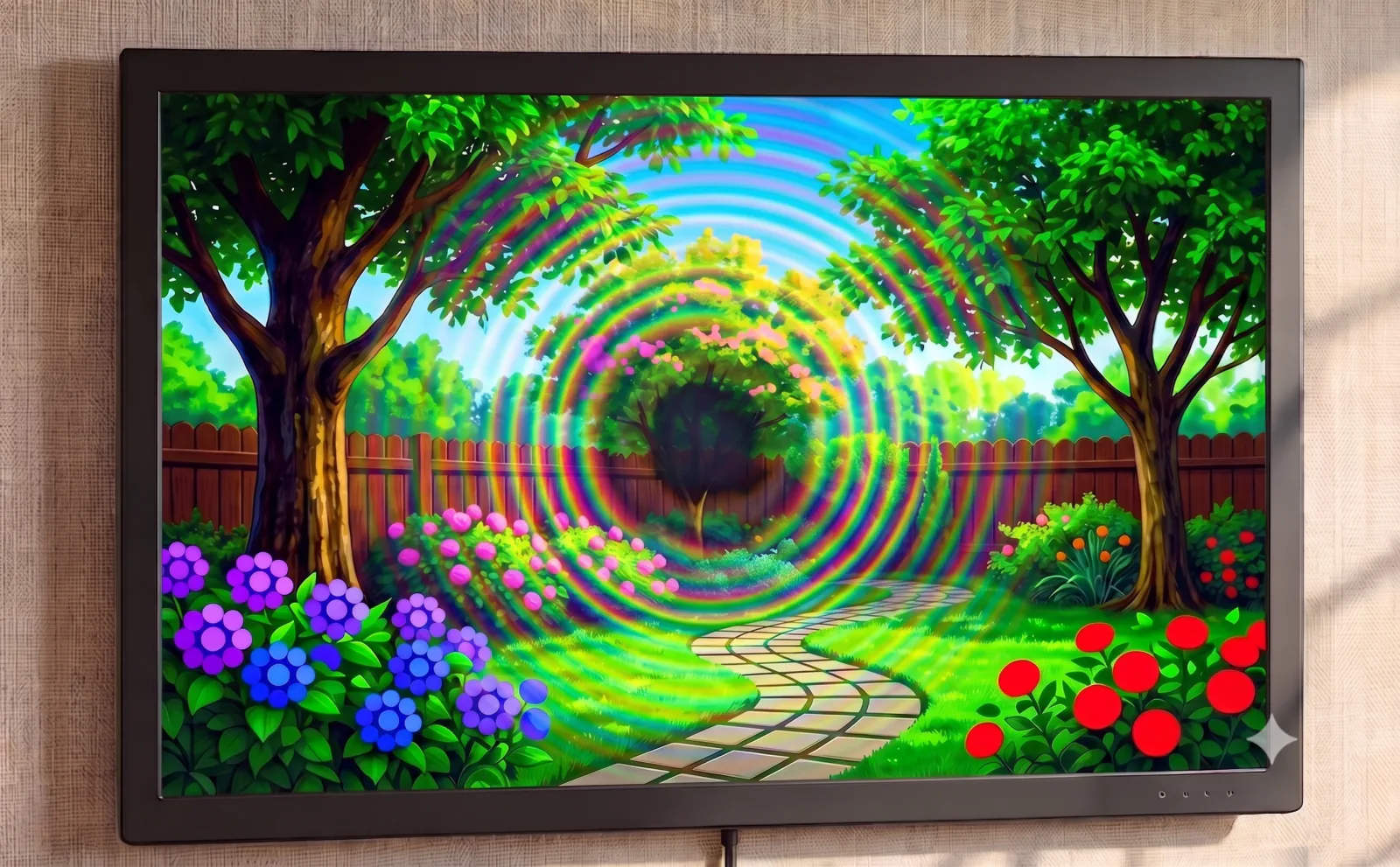
All of these observations narrow down the sort of architecture and substrate that the screen could be implementing. You ask yourself: What specific optical components would give rise to these specific effects? What could possibly explain shapes becoming more symmetrical at higher temperatures? Why do the fringes exhibit exactly that frequency and ordering of colors? The effects are not random. What laws of physics are they obeying?
I think the analogy we’ve been using so far is actually much closer to reality than it may seem. More specifically, I think QRI is correct to suggest that the brain may be a nonlinear optical device, some parts of which may resemble a liquid-crystal display. Our visual field may be created, in very rough terms, as follows:
The eyes (camera) convert electromagnetic waves into electrical signals, which are sent to the brain (LCD);
The brain takes those signals and attempts to recreate the scene that reached the eyes;
Crucially, the brain creates an actual image, made of (most likely) electromagnetic waves (resulting from neuronal firing), using something like (carbon-based) liquid crystals;
The image is updated almost instantaneously as new signals come in.
I’ve said this in the past, but it’s so important that it needs repeating: I think our visual field is an actual image—a hologram of sorts— made of a physical substrate (mostly the electromagnetic field), and the image exists, physically, somewhere inside the brain. I mean a literal image.

Woman on a low dose of DMT (or something).
Although we’ve only talked about the visual field, this hologram sitting in the brain is actually multi-modal and includes an auditory field, a somatic field, etc. This world simulation is what we experience moment to moment.
A corollary: if the world simulation is a thing made of the fields of physics (such as the electromagnetic field), then the fields of physics themselves are fields of qualia. There, that’s panpsychism (or, at least, my flavor of it).
So, back to the motivation.
One of QRI’s bets is that, if we want to reverse engineer consciousness, then observing what happens at the extremes (e.g., psychedelics, meditation) can give us crucial clues as to how consciousness works. (After all, this is also how physics advances.) Psychedelics in particular give rise to many field effects, which we argue can be parsimoniously explained by the picture we just presented. Ringing artifacts on psilocybin or cel animation effects on DMT are two such effects.
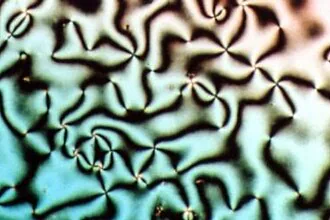
DMT and 5-MeO-DMT are particularly well suited for this task, since the effects are short-lived (10–20 minutes, so one can run many experiments) but extreme (depending on the dose). And, in fact, some of the visual effects caused by 5-MeO are very reminiscent of liquid crystal dynamics:

Through its initiative HEART, QRI is betting on bringing people with different backgrounds (physicists, mathematicians, meditators, visual artists, neuroscientists, etc.) together to accelerate this process of reverse engineering consciousness. I was lucky to have been invited to this year’s HEART retreat in Tepoztlán, just outside of Mexico City, though I only joined for week 6 (out of 8). Week 6 was designed to explore 5-MeO in a safe and controlled setting.
I had been meaning to experiment with 5-MeO anyway, so the timing was good. In the months leading up to the retreat, I took a few steps to ensure I’d get the most out of it while minimizing risks.
Preparing for the most powerful psychedelic
Someone commented at the retreat that the only way to prepare for a high dose of 5-MeO is… to have lived a good life for the couple of years leading up to the experience. There’s certainly some truth to that, but there’s much more one can (and should) do to prepare for a session of 5-MeO (depending on the dose). Not surprisingly, Andrés actually has a 1.5h video on the topic: The Ultimate 5-MeO-DMT Guide: How to Have a Beautiful, Life-Changing Trip.
One of the main pieces of advice (which seems very obvious once you hear it, but which is not often followed) is to start with small doses and work your way up to higher doses over time. Medium and high doses of 5-MeO are, simply put, ontologically shocking. Even low doses can have very profound effects. I imagine that very experienced psychonauts might get away with starting with a high dose.
I’m not a super experienced psychonaut, so I decided to start small. In the 3–4 months leading up to the retreat, I did 5-MeO maybe 20–25 times (across various sessions, with 3–4 doses per session on average). I used a standard vape pen (this battery with these 510 ceramic cartridges) and prepared three cartridges with different 5-MeO-to-vape juice ratios (namely, 1:12, 1:8, and 1:4, with 50/50 VG/PG nicotine-free vape juice). This table (from Erowid) gives you an idea of how many mg of 5-MeO you’re taking given a pen’s concentration and how long you pull for:
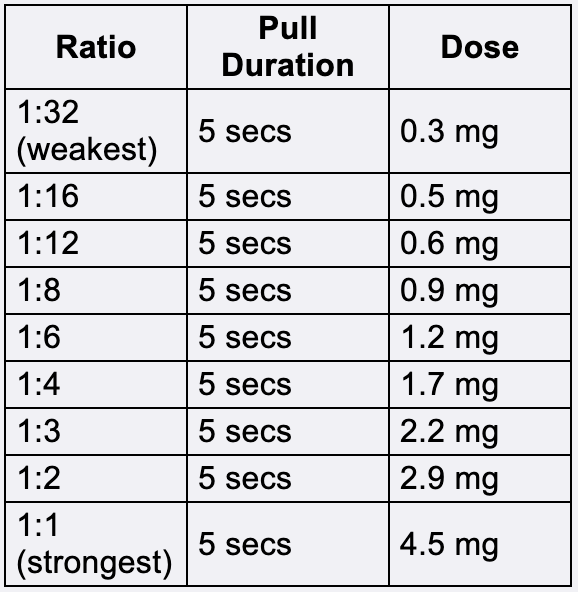
Take the amounts with a grain of salt, though. How much 5-MeO you end up consuming can also depend on how strongly you pull, how hot the cartridge / liquid is (the first few puffs usually feel less strong because the cartridge is cooler), or whether the powder is perfectly and uniformly dissolved in the liquid. Ideally, you familiarize yourself with your equipment, preparation method, and pulling technique to develop an intuition for how much you might be taking. This guide may help you understand how much you’re taking based on the types of effects you experience.
An alternative delivery method is to use an e-mesh vape instead, which works by putting the 5-MeO powder directly onto a metal mesh that heats up and vaporizes it. You then inhale the vapor directly. It’s a very efficient method. Check out this guide if you’re curious.1 The main downside is that it’s very difficult to measure out very small amounts of 5-MeO powder, even with very precise scales.2 The higher the intended dose, the better it is to use an e-mesh.
A few months before my first experiments with 5-MeO, I started experimenting with N,N-DMT (“DMT”), following the same philosophy: start with small doses, increase gradually. My DMT experiments helped me develop what I believe is the most important skill to have when doing either DMT or 5-MeO (and psychedelics more generally, for that matter3): actually, really, deeply letting go. I’m very grateful to Andrés for emphasizing this during a conversation in 2024, because boy, was I not expecting even low doses of DMT to be so profoundly shocking. One of my earliest DMT trips involved the following chain of events:
Inhale DMT
Somatic field starts vibrating violently; fear comes up
Visual field dissolves; I’m fully immersed in a magic eye level trip
After a few minutes, I start resisting the experience (specifically, wanting the trip to end)
Fear increases, which causes me to want more strongly for the trip to end
I remember that I should instead let go and welcome the experience
I resist that thought, thinking “surely welcoming the fear will make it grow!”
Finally, I convince myself to actually let go and welcome the experience, including the fear
Fear subsides; bliss ensues
🤯
Buddhists won’t find any of the above surprising. After all, this ability to say “yes” to any experience is one of the most important skills to develop on the path: equanimity (upekkhā). But DMT and 5-MeO show you the effect of equanimity in the most obvious and direct way; the feedback loop is immediate and the magnitude of the effect is massive.
I’m so happy that I got to train this letting-go muscle on DMT before doing 5-MeO. In fact, I find it harder to fully let go on DMT than on 5-MeO, so I suspect that I could just as well have trained my equanimity on 5-MeO first before doing DMT. Obviously, you can train your equanimity in many other ways that don’t involve psychedelics (for example, cold showers, strong determination meditation, asana yoga, or visiting your in-laws).
All this practice came in very handy when, during a 5-MeO session with friends a few weeks before the retreat, I ventured into the medium-dose territory for the first time. I think I took an eight-second pull of a 1:4 pen, which should correspond to about 2.7mg of 5-MeO. I suspect it was a bit more than that, though, because it felt like I crossed a new phase transition threshold (analogous to experiencing water vapor after only ever having experienced liquid water). Despite feeling some fear during the come-up, I was quickly able to surrender, and the ensuing 10 minutes were, without a doubt, the most intense of my life.
I still struggle to put into words what happened, but I can say that I felt deeply humbled by the experience. Consciousness, and the universe, are vastly, vastly wilder than most of us can ever imagine. Consciousness science is just barely scratching the surface of what’s out there, and I felt like I had a tiny yet profound glimpse of that vastness. So if you intend to do 5-MeO, you must be ready to be shocked to your core. At the risk of sounding paternalistic, I genuinely would advise most people against taking 5-MeO at high doses (and possibly even medium doses).
Speaking of the vastness of the state-space of consciousness.
A topic that comes up during most of my DMT and 5-MeO trips is cluster headache, arguably the most painful condition known to medicine. This is no surprise, since my full-time job involves thinking about cluster headaches. Every day, I’m reminded that about 3 million adults suffer this excruciating pain every year, and that they cumulatively experience about 3 million person-days of extreme pain per year. Needless to say, it’s not particularly pleasant to think about torture while on these substances. And the fact that DMT happens to be so effective at stopping cluster headache attacks adds a layer of humility, awe, and perhaps absurdity to the whole experience. (As far as we know, 5-MeO seems far less helpful for cluster headaches and migraines, for reasons we don’t fully understand yet.)
Fortunately, my DMT and 5-MeO explorations have had an overwhelmingly positive effect on my motivation to fight against cluster headaches. Having experienced states of consciousness so different from normal, room-temperature consciousness has helped me understand more deeply how different consciousness can be on the suffering end of the spectrum. Just as I struggle to describe my 5-MeO experiences, cluster headache sufferers also often struggle to describe to others what the pain feels like, saying that the only way to really understand the pain is to experience it firsthand.
Perhaps coincidentally, almost two years before this year’s retreat, I started thinking about and working more actively on cluster headaches, thanks in part to encouragement from Andrés. Despite the challenges that come from thinking about intense suffering on a daily basis, one thing I’ve noticed is that knowing that I’m doing something to relieve this suffering has actually helped me relax deeply into my psychedelic experiences. I currently feel deep contentment in life, knowing that my work and my values align, and this knowledge has made it easier for me to fully surrender when the psychedelic experiences get challenging. I think this is an underappreciated positive side effect of working to reduce suffering. (Adequate self-care is non-negotiable, though; coming into the retreat, my mental and physical health felt pretty optimal.)
The retreat protocol
The sessions took place at Tandava Retreat, which specializes in 5-MeO-DMT. Retreat participants stayed in Airbnbs nearby.
On the first four days, we did one ceremony each morning, lasting about two hours, in groups of three. We took turns, 40 minutes each, with the other two staying nearby to offer support if needed (a trained facilitator was also present). During each 40-minute session, we were allowed to take up to three doses of a predefined amount for the day, and we roughly doubled the dose each day. The predefined amounts for each of the four days were:
Monday: 3-second pull of a 1:8 pen (~0.5mg)
Tuesday: 6-second pull of a 1:8 pen (~1.0mg)
Wednesday: 6-second pull of a 1:4 pen (~2.0mg)
Thursday: 10-second4 pull of a 1:4 pen (~3.4mg)
On the last day, eligible (and enthusiastically consenting) participants had the opportunity to do a “breakthrough” (high-dose) session during a private one-hour slot (with two trained facilitators), taking anywhere between 8mg and 12mg (up to two times), depending on one’s sensitivity and preferences. Medical supervision was present on-site during the whole week (luckily, it was not needed). About 15 participants (all QRI) joined the sessions.
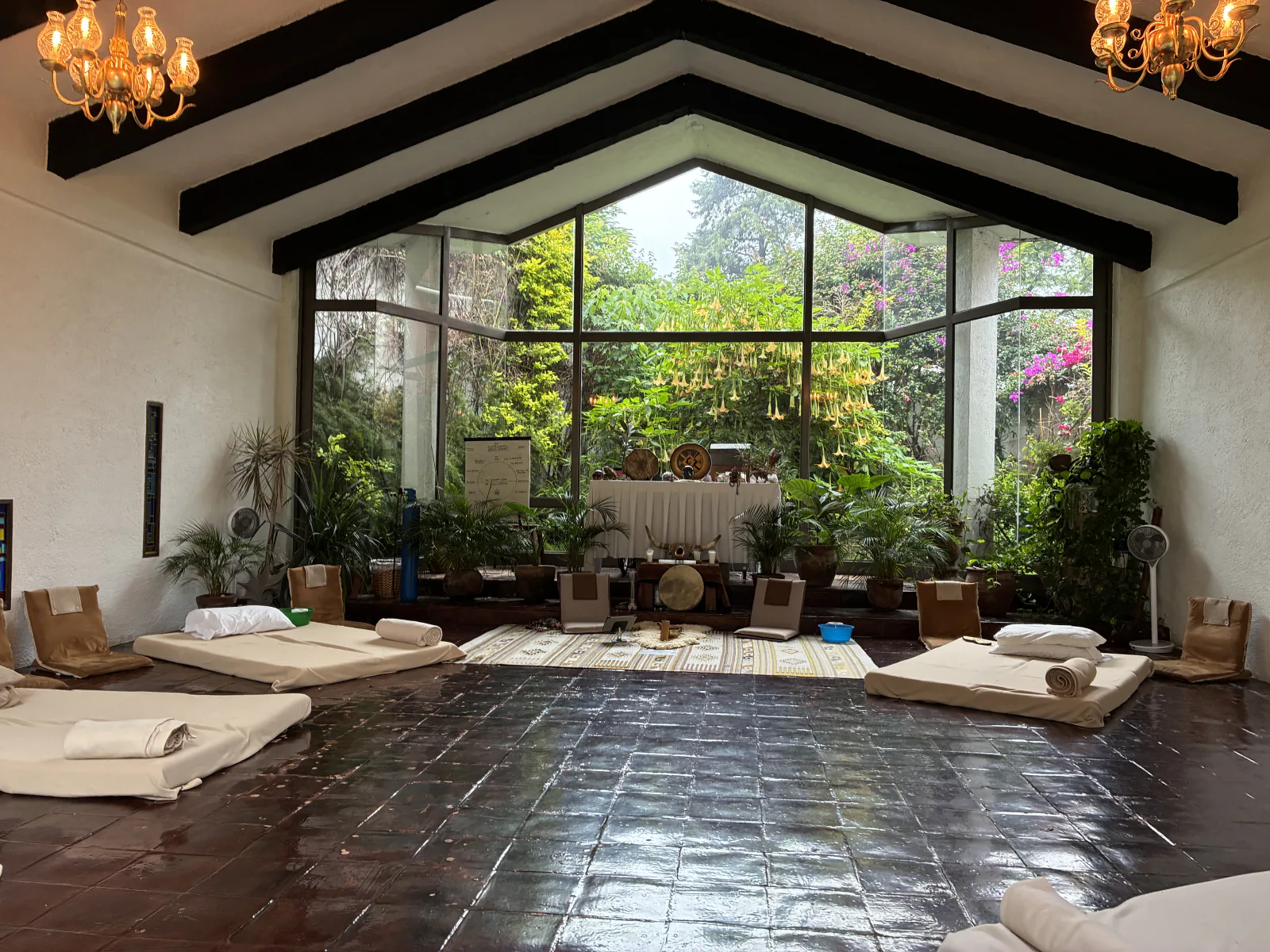
Temple where the ceremonies took place.
During some sessions, there were laptops circulating with some psychophysics tests and exercises ready to be taken by anyone who felt like it. Some people were too immersed in the experience and didn’t take them. I had very mild effects on all four days (including after doing my three doses in quick succession on Thursday, which was very odd), so I spent a good amount of time doing the tests on the laptops. One test, for example, involved trying to judge whether two small circles appearing briefly on the screen flashed simultaneously or slightly out of phase. In another, we looked at a series of optical illusions and noted whether they looked different under the influence relative to sober (we were encouraged to take notes or record voice notes immediately after the session).
I won’t describe all the activities we did outside of the ceremonies (such as answering surveys, recording interviews, making artistic renditions of our experiences, having meetings with other participants, sharing useful skills with others, hosting Q&As, getting and analyzing EEG data, and so much more). But one of the most important aspects of the retreat was to (vibe) code simulations of our experiences, usually in the afternoon (and sometimes well into the night). The simulations could be about any aspect of our 5-MeO experiences, but most of them were replications of the visual effects. (You can find many such replications from the 2023 retreat in Canada here, here, and here.)
How I approached replicating 5-MeO visuals
Before the retreat, I spent some time re-reading some of the outputs from the 5-MeO retreat that QRI organized in Canada in 2023. I had read many of these when they were first published, but that was before I had done any 5-MeO. Now, having done 5-MeO a few times, I wanted to see if any of the replications resonated with my experiences.
One simulation that strongly reminded me of 5-MeO visuals was the following visualization of the Belousov-Zhabotinsky (BZ) reaction, which I initially found in this post by CubeFlipper:
I think CubeFlipper didn’t intend to use this simulation as an actual example of a visual effect of 5-MeO (rather than simply as an example of a medium with both isotropic and anisotropic properties), but the dynamics definitely resonated quite strongly with me. So, as a first exercise, I asked Claude Opus 4.8 (using Claude Code) to create a simulation of the BZ reaction, giving it a screenshot from the video above. Importantly, I asked it to add levers to the UI to modulate the various parameters of the BZ reaction equations, to be able to explore different regimes. (Andrés encouraged us to always parameterize such simulations.)
After some back and forth, this is what came out:
Now, the BZ model describes an oscillatory reaction between exotic chemicals not found in the brain, so I assumed it doesn’t really capture what’s actually happening in the brain. So I asked Claude if it knew of any phenomena in nonlinear optics (and maybe more specifically liquid crystals) that are described by differential equations resembling the BZ reaction.
Claude said yes: the BZ model can be described by the complex Ginzburg-Landau equation (CGLE) (at least in a certain regime, namely, where the reaction is close to its Hopf bifurcation threshold, which I won’t explain here for brevity), which happens to describe a variety of physical systems (in chemistry, fluid dynamics, optics, etc.). In very broad terms, the CGLE describes a field made up of oscillators that can influence each other (through diffusion). It is written as:
∂A/∂t = A + D(1 + i·c₁)∇²A − (1 + i·c₂)|A|²A, A = u + i·v,
where:
A is a complex number whose amplitude is the strength of the oscillator at a given point, and its angle is the oscillator’s phase. The A term on the right-hand side of the equation is a growth term.
−|A|²A is a saturation term which counterbalances the growth.
D∇²A is a spatial, diffusion term, which allows neighboring oscillators to influence each other.
Without the spatial term, the CGLE reduces to the Stuart-Landau equation for a single oscillator.
So anyway, I asked Claude to create a simulation of the CGLE, which didn’t take very long:
Amplitude of a field described by the CGLE, while I modulate different parameters.
To me, some of these patterns felt quite 5-MeO-like, but I wasn’t sure. I just didn’t have many data points. (I vibe-coded these simulations on the first afternoon of the retreat.) I showed them to a few other participants, and most said that the dynamics felt a bit too chaotic, disorganized, or asymmetric; only 1–2 people said that the simulations reminded them somewhat of 5-MeO visuals. So I wasn’t satisfied. Still, I played around with the simulation for a couple of hours to familiarize myself with the model, just in case I happened to encounter any of those dynamics in the course of the week.
Reading through Claude’s description of the model, I noticed it mentioned that our implementation could not generate stripes / Turing patterns. If we wanted those, we’d have to extend the model to include a “Swift–Hohenberg” term to the right-hand side: −s(k₀² + ∇²)²A. This is how Claude explained it:
The pure CGLE goes unstable at zero wavenumber, so it makes spirals and turbulence but not stationary stripes. The −s(k₀² + ∇²)²A term adds a finite-wavelength (Turing) instability centred on k₀, so with s > 0 the field freezes into stripes / labyrinths of spacing λ ≈ 2π/k₀ — the stationary face of a liquid-crystal light valve (the Swift–Hohenberg side of the “CGLE / Swift–Hohenberg” pair). This band only wins over the CGLE’s own diffusion when D is small (~0.3); at the default D = 6 the diffusion smooths stripes away, so lower D when you raise s.
I thought “that sounds interesting,” and asked Claude to implement it.
Here are two recordings where I play around with the simulation parameters:
Two simulations of the CGLE with the extra Swift–Hohenberg term.
One thing I like about this model is that it can give rise to more stable Voronoi-like patterns, which several people (including me) have reported seeing on 5-MeO.
Following this Voronoi rabbit hole, I took one final shot in the dark. I spent some time looking for papers using Voronoi geometry to model biological processes. This 2025 paper by Li et al. caught my eye, mostly because it included some fun-looking simulations and shared some similarities with the CGLE (a phase order parameter, topological defects, and Kuramoto coupling). Good enough for me, though it’s a model of the dynamics of cells in epithelial tissue (where each cell is a Voronoi polygon), and not of the electromagnetic field. But since simulations are ~free, I asked Claude to implement a parameterized model (again, simply with the intention of exposing myself to different dynamics in preparation for my experiences).
Simulation based on Li et al.’s paper (2D Voronoi cell tissues with pulsating activity)
Unfortunately, and for reasons I don’t yet quite understand, the 5-MeO sessions on days one to four were very mild for me (including after doing three pulls in quick succession on day four, which in theory should have caused pretty strong effects). Maybe I was unlucky with the vape pens (and they… all malfunctioned?), or maybe the lack of caffeine severely blunted the effects (we were asked to fast and avoid stimulants before each ceremony); I’m not sure. So I couldn’t really verify whether any of the simulations I’d been playing around with held up.
The breakthrough dose session also didn’t go as I’d wished. I was scheduled to do it on Friday morning, and each participant was given the choice of taking anywhere between 8mg and 12mg, depending primarily on how sensitive they were to the substance. Since I had had very mild effects during the week, I asked for a 12mg dose. For this session, though, instead of using vape pens, we used a (mesh-based) device that vaporized the powder directly.
The onset was immediate and violent, and one of my first thoughts was “yep, this is the craziest thing I’ve ever experienced.” Interestingly, though, the structural and dynamical properties of the experience felt familiar. They reminded me of the experience I described above, from a few weeks earlier in London, just much faster and more intense.
To my dismay, I seem to have experienced amnesia (which I’ve heard can happen at high doses), so I have no memory of most of the experience. I can only remember the first few seconds. I opened my eyes again about 10–15 minutes later (though having lost track of time completely), feeling quite blissful and calm. I don’t seem to have moved at all (I was lying down in corpse pose, basically). For some reason, I assumed that my 1-hour slot was nearly over, so I sat up, thanked the facilitators, and went out to the garden. In hindsight, I would have liked to do another dose (probably 8mg), since I still had plenty of time. Oh well.
One visual effect I noticed while I was in the garden was something akin to cel animation: an old animation technique where different objects in the scene are painted on separate transparent layers, so that they can move independently from each other.
More specifically, the various elements in the scene (the trees, bushes, plants, mountains) seemed to belong to unusually well-defined, independent planes. I couldn’t replicate this effect after prompting Gemini for a while (though I imagine someone with basic Photoshop skills could do it in a few minutes), but I’ll leave this very failed attempt just for the fun of it (which, at least in spirit, gets at the thing):
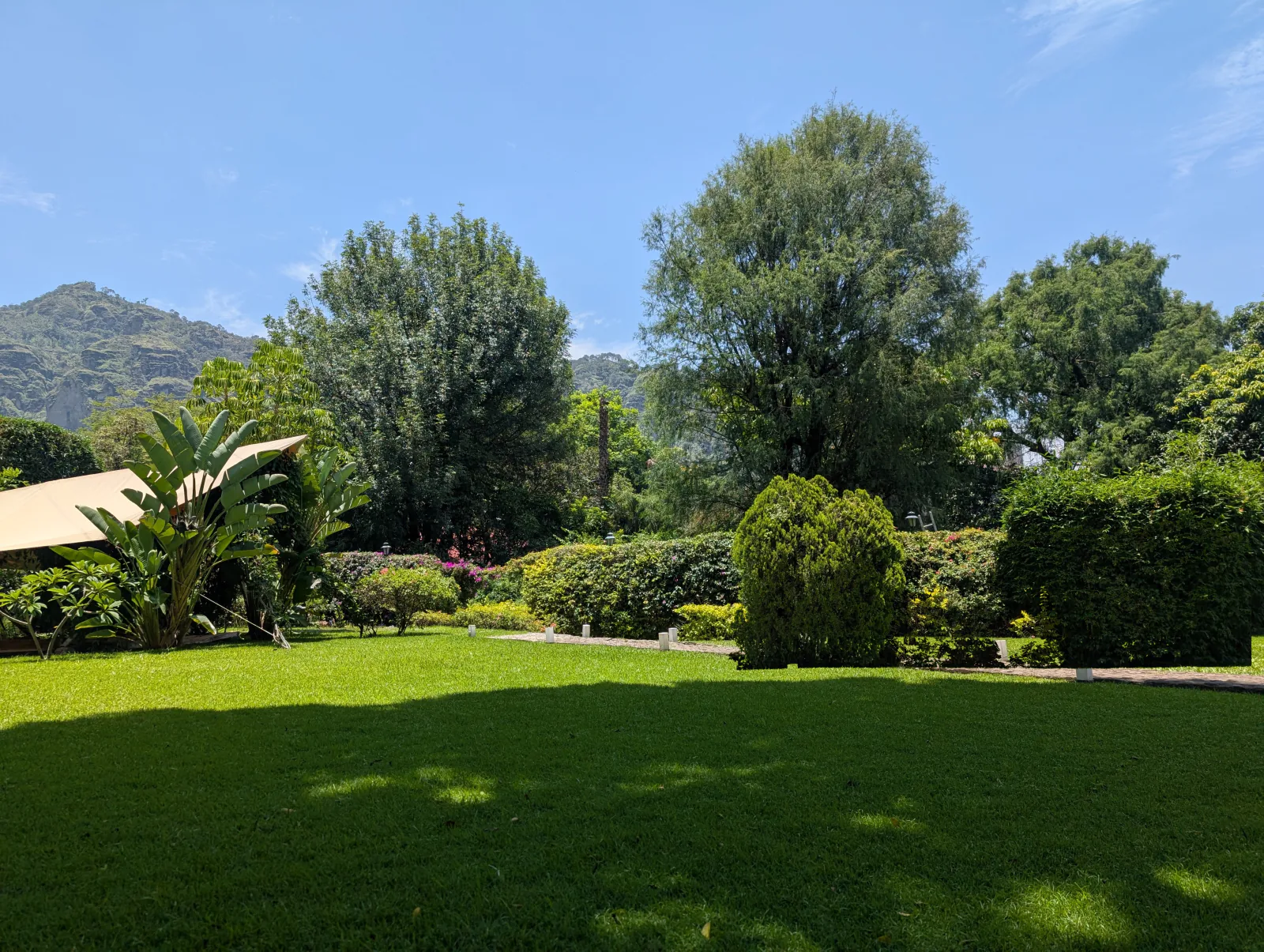
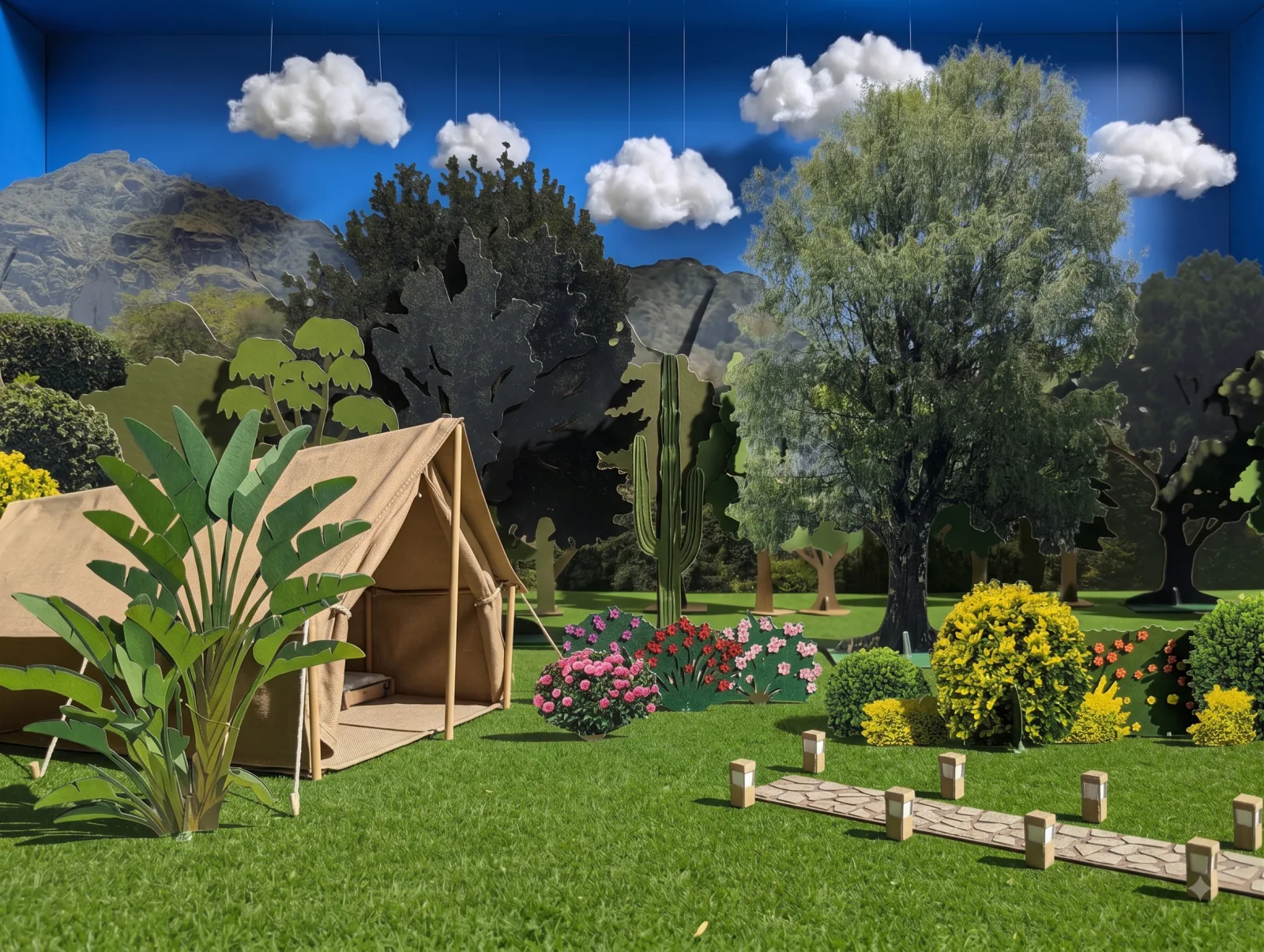
The scene that I saw (left), and a failed replication attempt by Gemini (right).
So in the end, at least in terms of my own phenomenality explorations, the retreat was much less fruitful than I had hoped. But I still learned a lot, and having gone through the ritual of taking a breakthrough dose, and noticing how deeply I trusted my mind and body to deal with the experience, felt like an important rite of passage (despite the amnesia). I came away feeling an even deeper trust in my ability to fully surrender to such extreme experiences. Perhaps more experiments will follow post-retreat.
What’s the point?
Sometimes I think we — the ones who suffer from cluster headaches — should be invited to help pastors when they preach about hell.
Why? Because we’ve experienced something most people can’t even imagine. Every time an attack strikes, it’s like catching a glimpse of hell — not in some distant, spiritual sense, but in the form of unbearable, all-consuming pain.
The agony is so intense, so relentless, it strips away everything: thoughts, dignity, time. It feels like being locked inside your own head while something tries to tear it apart from the inside, and all you can do is hold on.
- S. K., cluster headache patient
All this talk of mathematical models of psychedelic effects risks obscuring why we’re even doing this in the first place. Sure, trying to understand consciousness is an extremely exciting endeavor. (What could be more exciting, really?) But QRI has made it clear that, in the end, any insights we may gain from studying consciousness should serve the ultimate goal of improving the wellbeing of sentient beings, with the reduction of extreme suffering as the top priority.
In fact, I’ve learned that there is one thought that helps me surrender more deeply before these experiences: “May I learn something from this experience that could benefit sentient beings.” I hold this intention lightly, since most often I don’t come away with any interesting insights.5 Try it! Obviously, this trick only works if you actually try to do things that reduce the suffering of fellow sentient beings. Definitely try that!
Note that the DMT vaporizes at higher voltages, so using the same e-mesh settings for 5-MeO will burn the powder. For 5-MeO, try anywhere between 7V and 11V, with lower voltages for lower doses.↩︎
For example, if you want to take 0.5mg or even 1mg, your scale might simply not be sensitive enough. As a workaround, you can try to measure out, say, 3mg, and then manually divide that amount into six similar-looking lumps.↩︎
And maybe actually any difficult experience, for that matter.↩︎
Or until the vape pen light indicator started to blink, which some people reported being less than 10s.↩︎
During a trip, I often feel like there’s a trade-off between fully letting go on the one hand, and generating enough mental contraction to pay attention and try to remember the details of the experience, on the other. I suspect this is a matter of practice: the more familiar you become with such experiences, the less shocking they’ll be (dealing with the shock requires letting go), and the more you’ll be able to focus on the details.↩︎
Citation
For attribution, please cite this work as:
APA
Parra-Hinojosa (2026, September 11). Reverse engineering consciousness with 5-MeO-DMT. https://heart.qri.org/retreats/2026-tepoz/alfredo-parra/reverse-engineering-consciousness.html
BibTeX
@misc{parra2026consciousness,
  author = {Parra-Hinojosa, Alfredo},
  title = {Reverse engineering consciousness with 5-MeO-DMT},
  url = {https://heart.qri.org/retreats/2026-tepoz/alfredo-parra/reverse-engineering-consciousness.html},
  year = {2026}
}