Written by Emil Hall on 23 August 2026.
This post is a contribution to the third Qualia Research Institute psychophysics retreat, which took place from May to June 2026 in Tepoztlán, Mexico.
Table of contents
After careful screening and under medical supervision, the local retreat center Tandava offered me 5-MeO-DMT, a psychedelic that’s unscheduled in Mexico. We recorded audio during my strongest trip of the retreat. I saw wavefronts travelling into and out of “knots” or topological defects. First comes a lightly edited transcript of the things I said in the moment, plus clarifying comments and illustrations added afterwards. Then, a section with detailed analysis and hypotheses on what kind of system could replicate such waves and knots. Finally a glossary - refer to it if any mathematical terms in the text are unfamiliar to you.
Part 1: Transcript
00:00 Intramuscular injection of 22mg fumarate (equivalent to inhaling about 15mg vaporized freebase)
03:23 "Form constants growing. Still feels quite 2-dimensional."
I said "still" because I knew from a previous session that visuals could get much more 3-dimensional. So I expected them to gain more depth in a few minutes. For now, there was a single form constant at the center of my visual field, and it varied slowly over time.
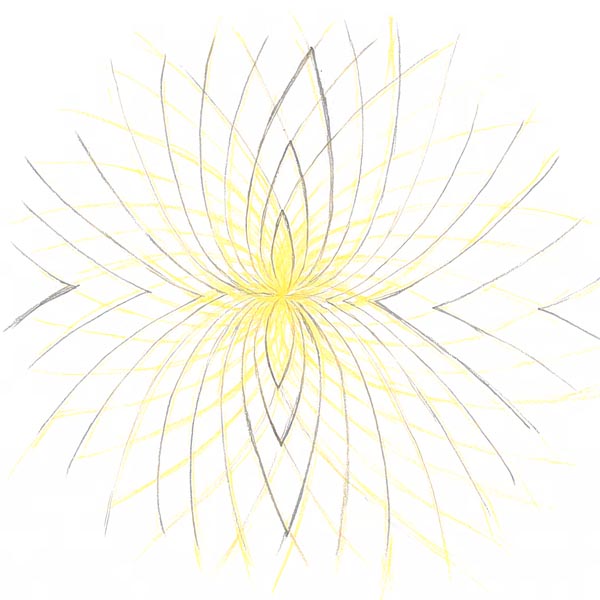
04:45 "Mix of euclidean tessellations and log-polar form constants, somehow coexisting."
The large-scale pattern across the visual field was flat tiling, like a wallpaper, but each single tile of that wallpaper contained some kind of form constant geometry with a central vanishing point. This always stayed true, while the exact shapes shifted slowly and gently over time. Everything fit together with mathematical perfection.
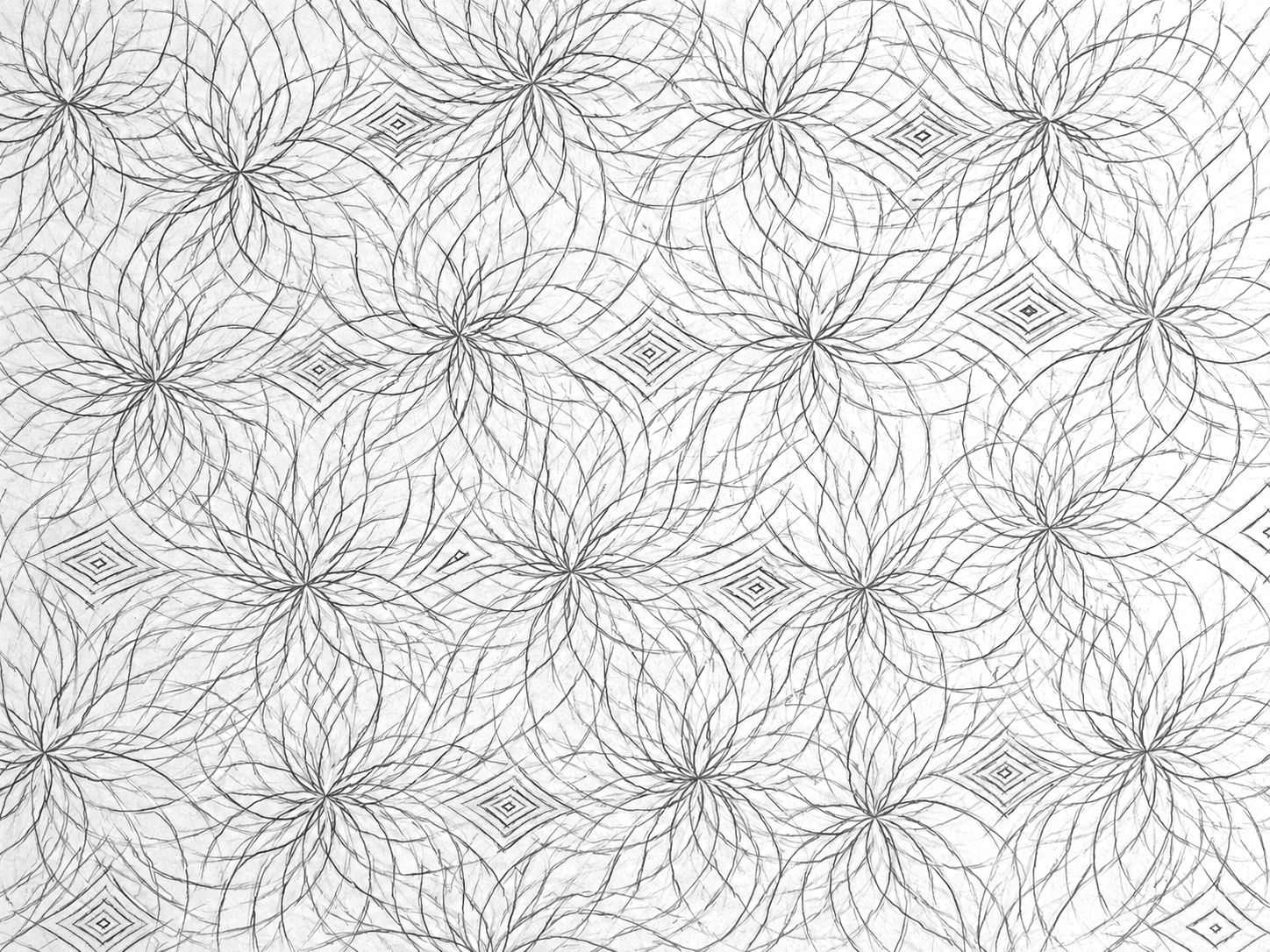
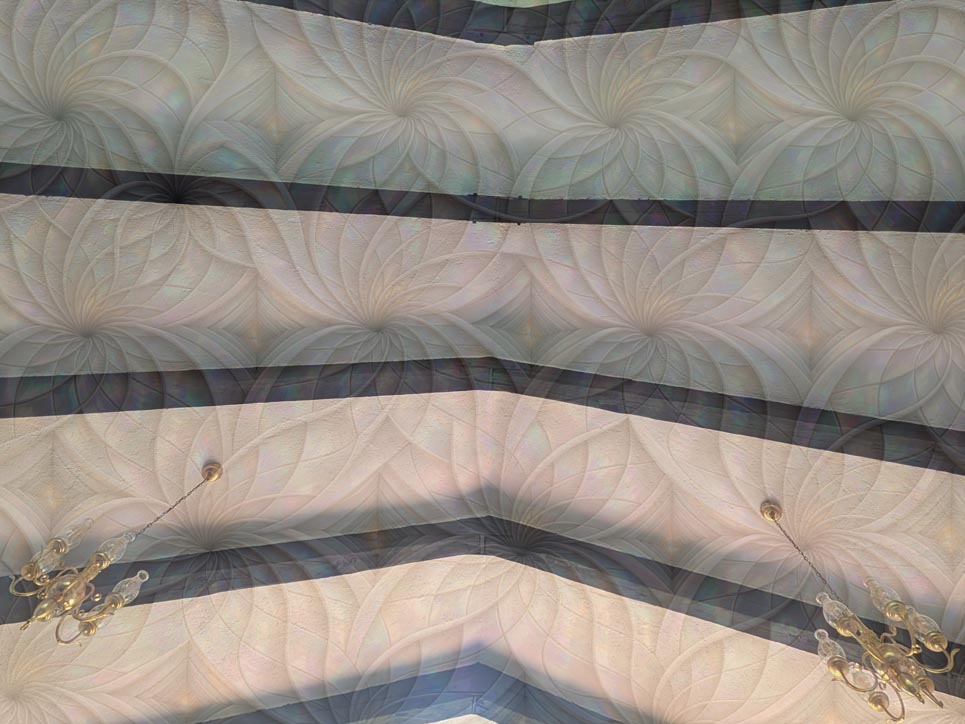
Next, I took a look at a replication attempt on a laptop. I had coded that replication based on what I saw in my previous session 2 days earlier when I had inhaled 12 mg vaporized.
05:13 "This is definitely on the right track. I mean, I'm seeing isosurfaces, rotating in space, on the screen and in my visuals. It's shifting between sometimes more straight lines and tunnels, and more curved and knotted and twisted and vortex-like shapes. Shifting very smoothly or seamlessly between these. This is so on the right track. But I think I need to lay down. Sitting up was hard."
07:02 "It's voronoi-like, definitely, that kind of tesselation."
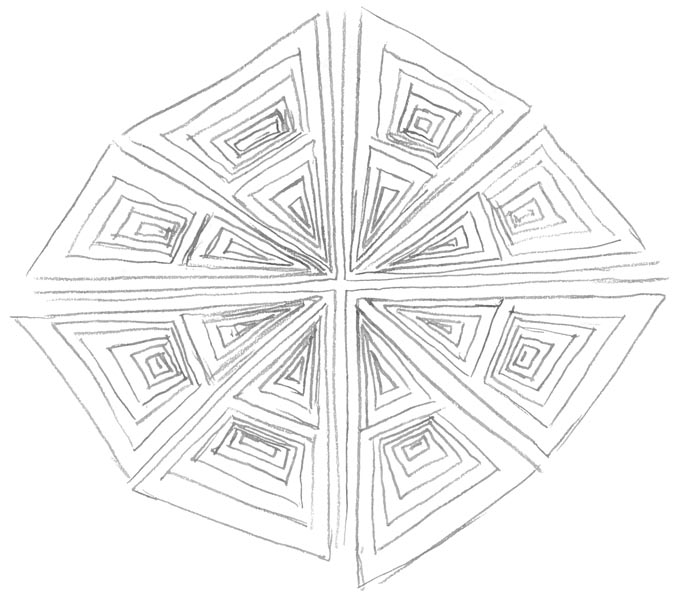
But also, the inside of each voronoi cell contained nested cell outlines. Worth mentioning that 4 other retreat participants have also seen voronoi patterns. Here’s a replication by one of them, Symmetric Vision
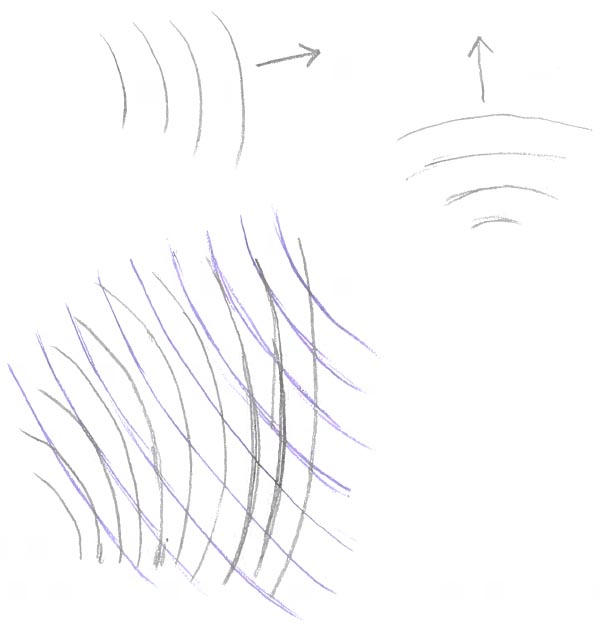
07:08 "The curves, or like, the wavefronts, just propagate in one direction, and they seem to pass through each other, creating interference patterns or moiré patterns."
Clarification: When I said "just propagate in one direction" I meant that now they didn't stand still, nor did they move back and forth. I didn't mean that wavefronts for example only travelled leftwards and not rightwards. There was certainly travel happening in all directions. The wave speed seemed equal everywhere. Also, in retrospect I should just have said interference, because I'm not sure any larger-scale moiré patterns were prominent. From this point onward, forget what I said earlier about patterns shifting slowly and gently - it got fast and intense.
07:40 "I don't think I can hold it anymore. Thank you."
“It” referring to the laptop I had been holding to look at my replication video above. But at this point I hadn’t focused on the video for a while, just patterns in the air / ceiling growing ever more intense and 3D. I handed the laptop back to a helper.
07:56 "So if we vary the wave propagation speed, like soft index of refraction."
Earlier, the wave speed was equal everywhere, but now that was no longer true.
08:20 "It's so beautiful."
08:36 "It's all soft curves."
08:47 "And they do meet in these vortex points or knot points."
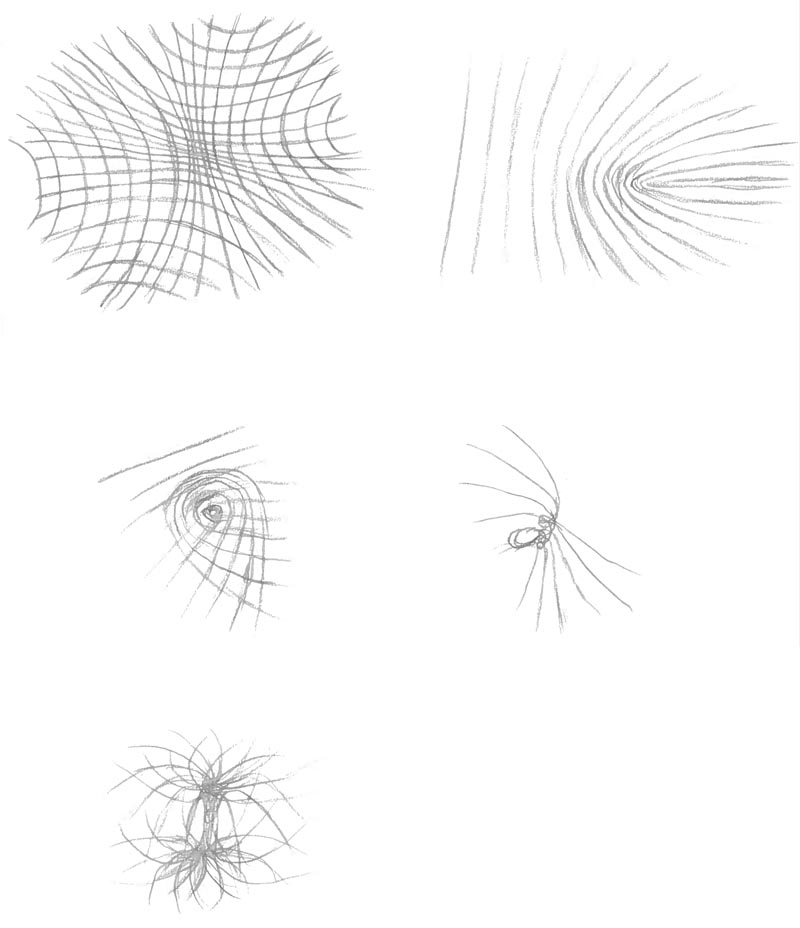
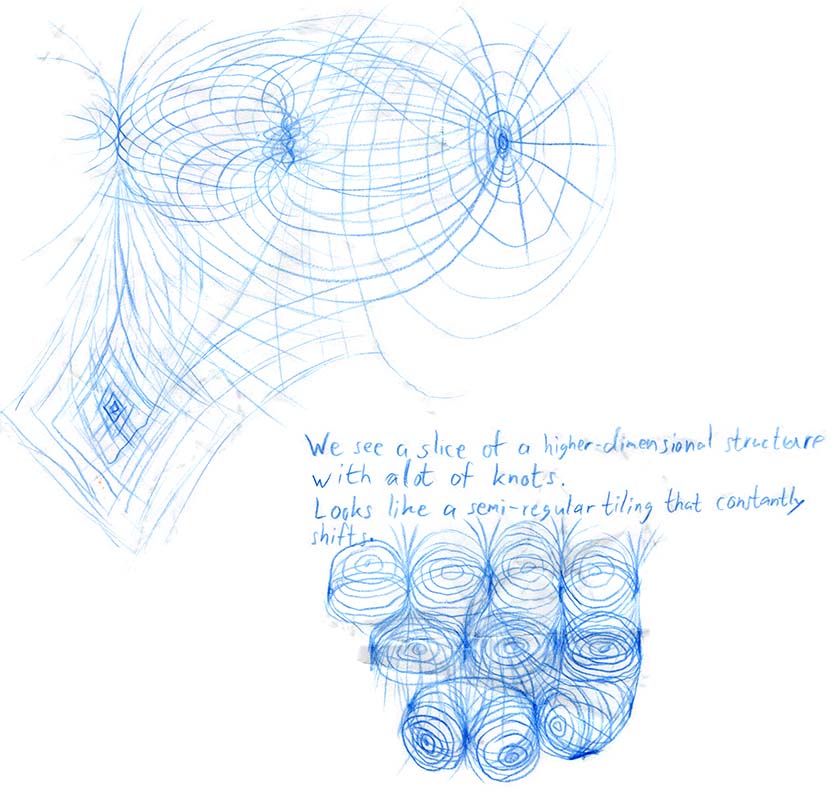
These are the sketches I’m least certain about, because the visual patterns were so detailed and changed so quickly. I drew the sketches from memory soon after the trip, but memory is fallible - it was easier to remember the patterns from earlier in the trip because they were slower, steadier.
09:02 "Woooow."
09:42 "Wavefronts propagating, different speed in different places so that they curl."
10:27 "Can I have a hug?"
11:24 "Feeling vibration. Frequencies."
12:07 "So if we could have these topological defects as... It's all about wave propagation speed."
12:50 "There's some kind of optical lens focusing effect there, yeah. The topological defects are like when the waves meet in the center and then go out again. So there's a lot of those reflection points or center points or..."
13:39 "Forming moiré patterns."
13:58 "Yeah, definitely, the optical or lens angle here is probably fruitful. Focusing effects. Focusing and then spreading out again. Cube Flipper is on to something with the Fourier transforms."
Referring to this QRI post by Cube Flipper about the fractional Fourier transform.
14:30 "It's so beautiful."
14:58 "Ok, enough science for a while. Hehehe."
15:30 "It's so beautiful."
15:47 "Did you say earlier that I had a chance for the refill with... Is that now, or? I could wait, but do we have a time limit?"
The facilitator replied: "5 minutes to last call."
16:04 "Ok, I'll wait, then, to the last call. Thank you."
Referring to a previously discussed offer to inhale some more 5-MeO-DMT.
16:18 "It's so beautiful."
16:38 "And, I'll want the lower redose. So you can prepare for that."
17:38 "You know what? I changed my mind. I'm good. I hope you didn't fill it already. This is enough already. For science and emotions, yeah. I got it."
18:22 "Optical lens focusing wavefronts propagating with different index of refraction, slower here, faster there. Which forms these patterns."
19:14 "I feel a little bit anxious."
From this point onwards, anxiety/fear grew and I got the best imaginable calming support from the facilitators.
21:02 "Hug?"
21:50 "Much stronger than Friday's."
I meant that this trip was stronger than my previous one, where I inhaled 12 mg vaporized.
22:29 "Could I have some water?"
22:58 "Wow, so intense. A blanket?"
23:12 "So slowly starting to fade."
23:26 "This was a safe anchor in this super... space. Breathe with me."
24:38 "So beautiful."
25:10 "Slowly fading. Thank you for your support."
25:24 "I hope that I got some science done also. A bit of both."
25:30 "Amazing how everything can resonate with everything else."
26:25 "Slowly starting to settle. All this diffraction and these interlaced waveforms."
27:43 "Not sure if I'm actually cold or just..."
Asked for and got another blanket on top
28:10 "Thank you, thank you."
28:21 "Yeah. Wave propagation and focus points. Foci where the waves meet and then go out again. Definitely. That's the thing."
29:08 "Oh. Tesseract."
I got the laptop back again to look at a hypercube animation, hoping to be able to notice its 4D nature better than in a sober state, but I didn’t see any distinct effects at all - probably because it was too late. All effects were weakening at this stage.
30:59 "Wavefronts and focus points. That's it. Hehe. These topological knots where waves meet and propagate again."
31:16 "Thank you for your support. That was intense."
31:30 "I feel like I've been through a car wash. Cleansed. I'm happy I got the full thing."
31:55 "I want to chill a little bit longer and then draw patterns."
33:20 "Sooo beautiful. And intense."
34:07 "So, the replication that I had done, it gives, I mean, it looks right, for a small piece of it, but the actual clue, the real thing, is we need propagating wavefronts that meet at focus points and then spread out again. That's the key. Science, hehe. Such a weird mixture. I feel like I'm swearing in church a bit. But I'm glad I did both."
35:32 "I'm gonna tell you something about propagating wavefronts later, and my brief foray into quantum mechanics."
36:14 "Ok, I'm gonna try sitting up."
Part 2: Analysis
Clearly, I was very certain that "knots" or "topological defects" are points where the waves get focused, meet, and then propagate outwards again. But what were the specific properties of these waves and knots, and why is that important?
What were these waves and knots really?
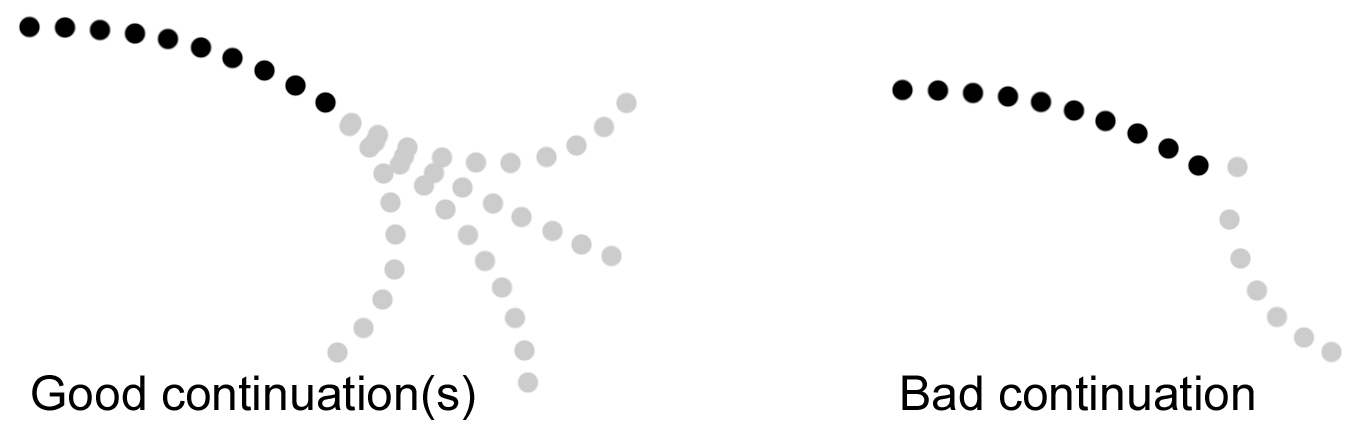
Let’s go from least to most speculative. I think I was seeing the work of the visual cortex’s normal mechanisms going into overdrive. Specifically, the wavefront lines are probably the oriented edge detector neurons in V1 firing (Bressloff, Cowan 2001), together with a mechanism for curve completion or “good continuation” in gestalt theory. Then, later stages of the brain’s visual processing pipeline also join in, stages that are responsible for interpreting lines as 3D objects with depth. At most points that’s easy, the waves can just be thought of as located on a 2D sheet. But at some points, where a lot of curves pass through each other and bend sharply, the most natural interpretation might be a 2D projection of a 3D structure - that would be a topological defect that feels higher-dimensional.
“Unfortunately”, there might not exist any globally coherent way to represent the geometry in 3D. It might be like the impossible figures of the artist Oscar Reutersvärd:
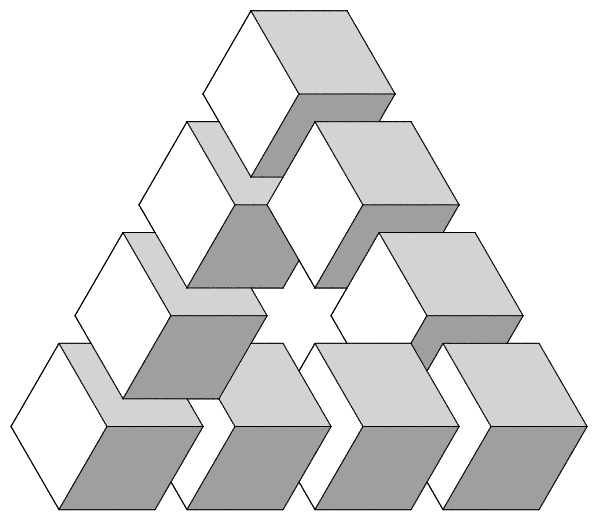
This is locally coherent, but globally impossible in 3D. Since the 3D processing level stage tries its best to form a consistent and continuous interpretation of the world, it will choose one of the locally coherent interpretations, and then send feedback signals upstream towards V1 trying to boost edges that match its chosen shape or error-correct non-matching ones. But since both the 2D and 3D stages are in overdrive, they also generate a lot of different possible “good continuations”, and they may soon choose another favorite. I’m imagining them as locked in a dance of trying to solve the shape together but also often messing up each other’s work.
Yeah, we’re into more speculative territory now. I have a vague hunch that the waves on 5-MeO-DMT are fundamentally the same as the brain uses in a sober state, just made visible. And that the waves are doing computation, and they achieve their computational properties using resonance and lensing, and neurons are just the substrate that these waves happen to be implemented upon. If so, it seems a worthy goal to study the waves in their own right, as mathematical objects abstracted away from their substrate.
I think there might exist a simpler model of these waves and knots. While there was certainly a lot going on, I think a full model of the visual cortex shouldn’t be required in order to model them. Just like one can model chemical reactions without going all the way to quantum mechanics, or just like one can model weather without simulating the chemistry of water molecules.
So we should try both approaches in parallel. I’m implementing a simulation of the V1 stage of the visual cortex, see my other text Simulating V1 following Bressloff, Cowan et al. This text continues with the approach of wanting to model the waves directly.
Knots
For two brief periods, after voronoi tilings and during my anxious period, I just saw wavefronts with equal speed everywhere and no knots. But most of the time I saw wavefronts with locally varying speed, and knots. So how and why did this vary over time? Not sure. Anyway, I'll focus on the periods where I saw knots, because I believe they will be the most revealing and fruitful to study.
QRI realized a few years ago [1] [2] that topological defects can appear as an emergent phenomena in a liquid crystal, and similarly in the Kuramoto model of coupled oscillators. If we simulate a 2D lattice / grid with a unit vector or director in each grid cell, initialized to random directions, and then rotate each vector to try to align it to its close neighbors, we get large areas of alignment with smooth changes, and these singularity points where there's no way to smooth out the field. So the simple 2D Kuramoto model has similarities to 5-meo-dmt phenomenology.
But the 5-meo knots that I saw were way more complex than the simple singularities of Kuramoto. My knots weren't just points, they had some spatial extent, although small compared to the rest of the field. They somehow felt higher-dimensional than the rest of the wave field, and felt like they turned waves inside out or something like that.
Knots were not visible on their own as some kind of object separate from the waves. Knots were only visible due to how the wavefronts moved through them. The knots didn't all look the same as each other, there was a lot of variation, and each knot also changed its shape slowly over time. Many wavefronts passed through each knot, each wavefront shaped almost like the previous one, but with slight changes, which over time added up to the whole knot changing shape completely.
A number of knots were distributed across my visual field, not in a regular tiling pattern, not completely random, but somewhere in between - roughly evenly distributed. The number of knots varied, and were too many to count at a glance, but was somewhere between 50 and 500:
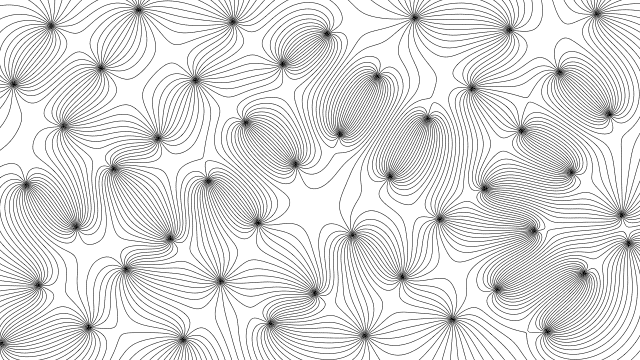
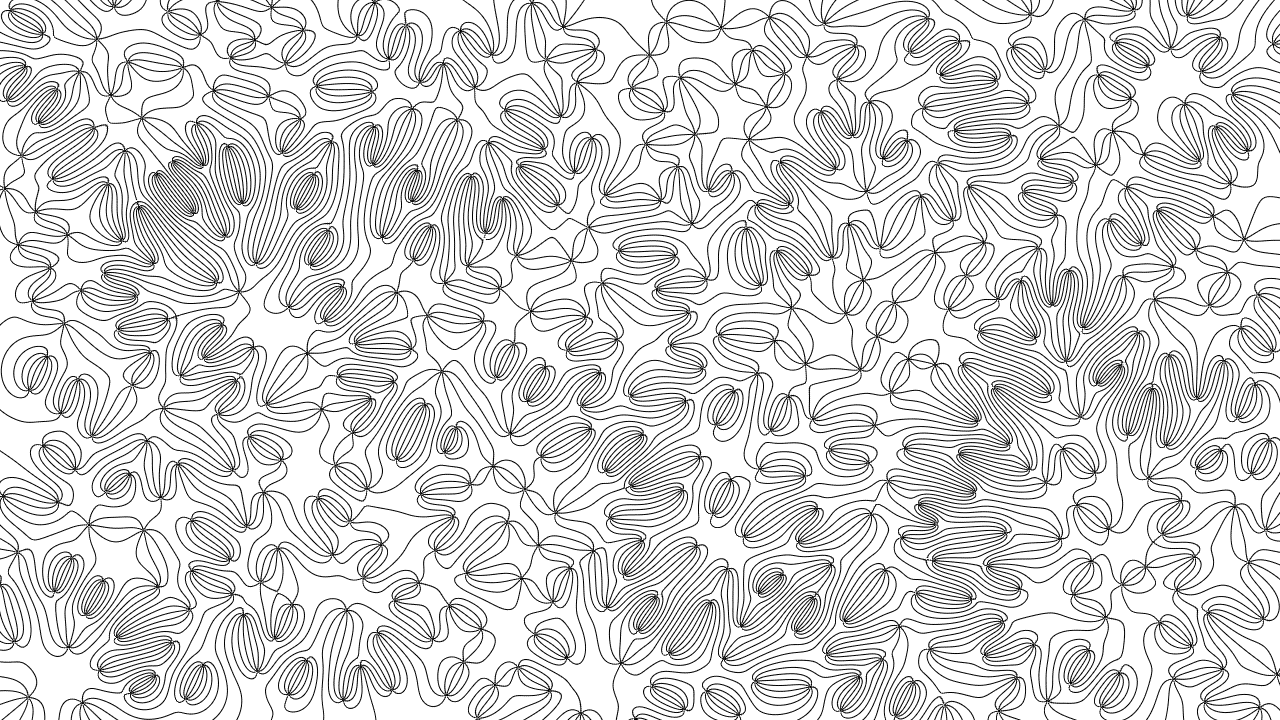
If there was just one big knot at the center of the visual field, I would say it’s already mostly explained by the well-known retinotopic coordinate transform (Ermentrout Cowan 1979). But seeing so many knots at the same time probably has a different mechanism.
So what kind of model might be able to replicate the more complex knots I saw? Not sure. I tried a 3D liquid crystal model but wasn't impressed. My best replications so far aren't field models with knots as emergent behavior, just animations where I put in the knots explicitly, and neither of them feel more than, say, 30% accurate.
Knot replication 1
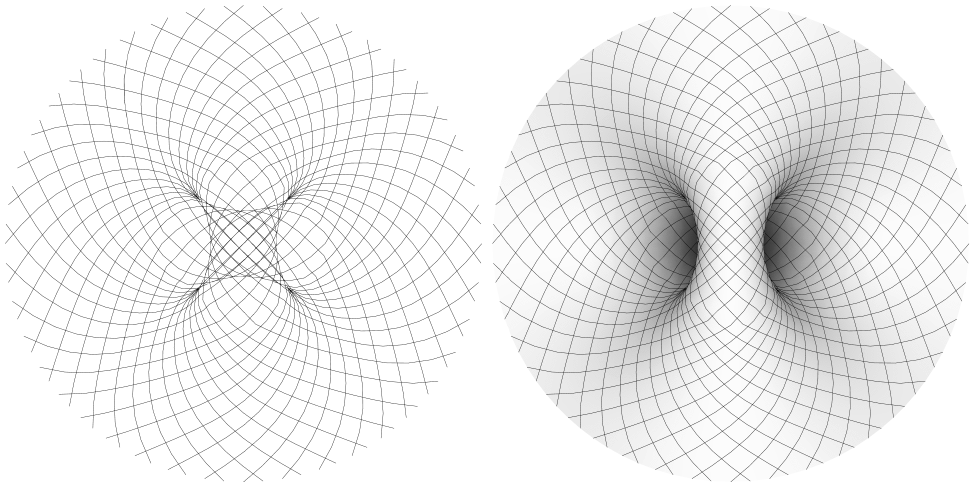
This is the one I made before the trip and looked at during the trip, see transcript above. Essentially, we set up some interesting 3D coordinate system, and draw its isosurfaces. Starting with toroidal coordinates, put two of them side by side and sum their three coordinate components. Then "twist" the isosurfaces by mixing two coordinates into a new one. Then animate orientation and surface phase to make it look more dynamic. Play with my knot replication here.
I showed this replication to other retreat participants who had also recently tripped on 5-MeO, and got a lot of positive “wow, that’s very reminiscent” reactions. But although this replication has the right vibe, several things are wrong:
These knot replications are like pinwheels with wavefronts always radiating out from it radially, like spokes on a wheel. While that sometimes happened, I also (more often?) saw wavefronts more concentrically around knots, like circular ripples on a water surface.
These knot shapes are too static over time. The left knot is just spinning in the 2d plane of the image. The right knot at least is moving in a 3rd dimension, which feels better, but is still too much of a rigid object. The knots really did change shape over time.
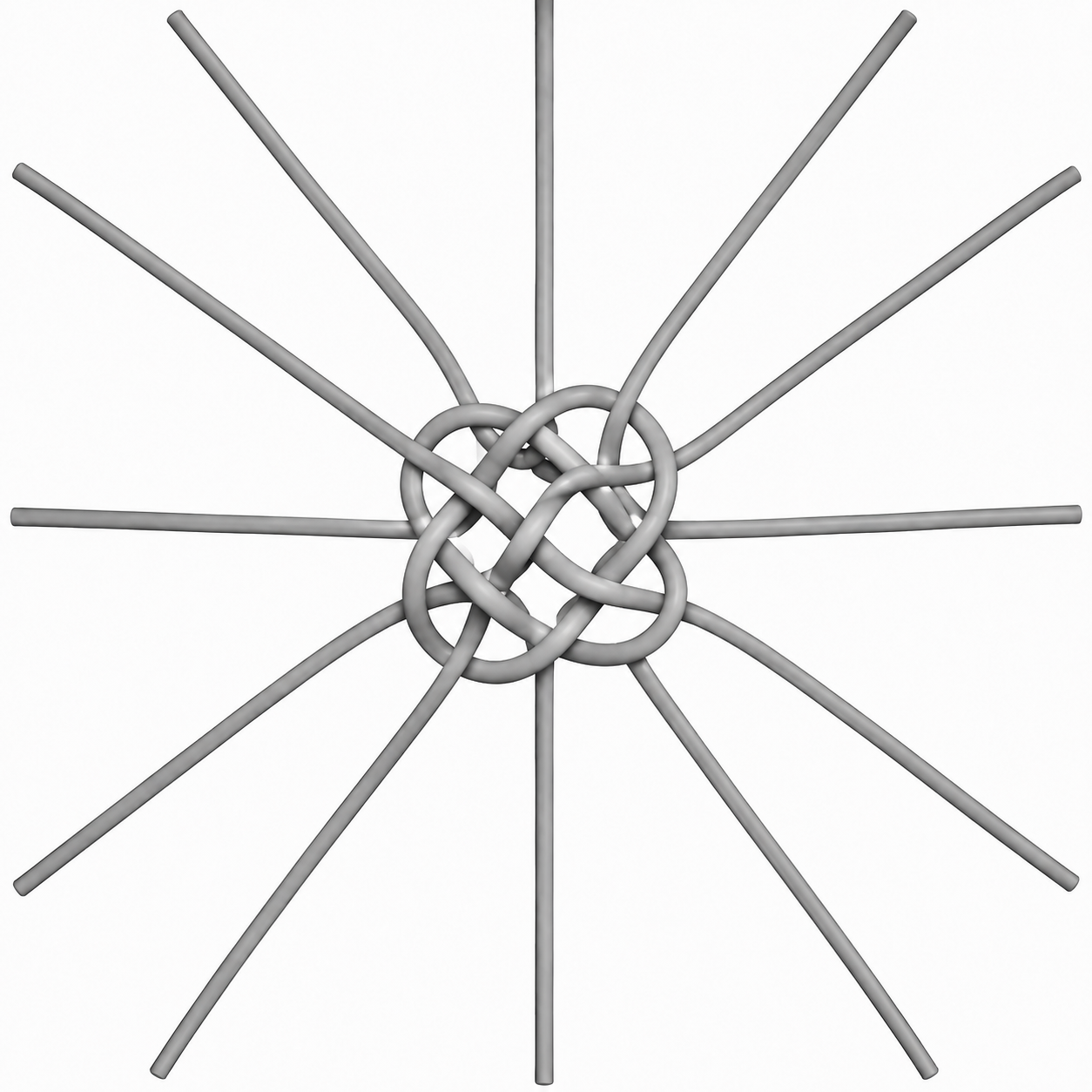
The knot center here is just a white disc where we don’t see any wavefronts at all - because they are packed extremely densely there. That’s not right. While I did see wavefronts packed more densely in the knots, they were still sparse enough to not merge into a blur. Rather, imagine a loosely tied knot like this:
Knot replication 2
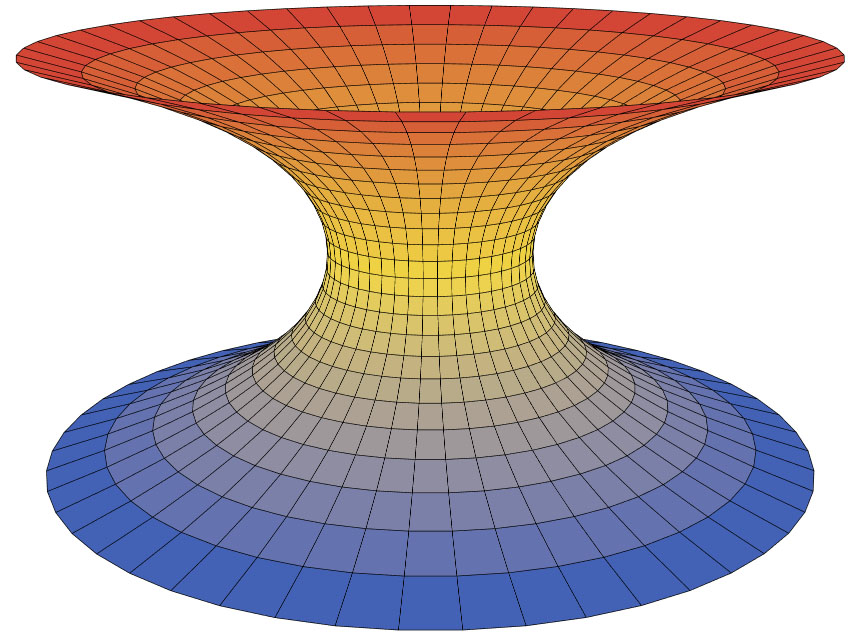
Use a catenoid (wormhole) surface in 3D. Put isolines on the surface. Animate line orientation and phase and 3D camera position.
- This replication has the advantage that waves aren’t infinitely tightly spaced even in the center, and the knot feels truly higher-dimensional. But sometimes this knot center is completely empty, just blank space, which is not right either.
Waves
The wavefronts were very sharp. A wavefront was visible as a 1D curve on the 2D visual field, but they certainly felt 3D during the peak of the effects. What does that mean? As if I saw a thin slice or projection of a higher dimension. Maybe as if the wavefronts I saw were the outlines, the silhouettes, of 3D objects?
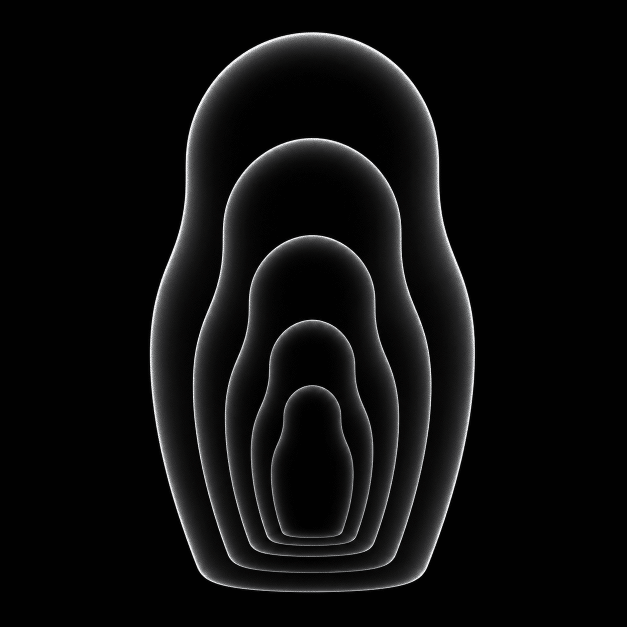
Or maybe as if space was filled with several sets of surfaces, and the curves I saw were where two surfaces intersected? Either way, such a mix of 2D and 3D is something QRI has thought about a lot before, with terms like "visual-somatic coupling" and "cross dimensional coupling". [3]
I saw wave speed vary locally, and it looked like this would focus waves onto the knots, just like a lens would focus light. But I can't honestly say what is cause and effect here. While I did in the moment talk about smoothly varying index of refraction, that's honestly just a hypothesis. It's possible that the presence of a "lens" is what creates the knot, but it's also possible that the knot causes lensing.
Wave model comparison
It's not clear to me how to best model these kinds of waves. Two of the most utilized models in science are the "wave equation" and waves happening in an "excitable medium". The wave equation describes something like ripples on the surface of water, spreading outwards from the place where a pebble dropped into the pond. An excitable medium on the other hand is like a grass fire - a thin front of flames spreading outwards from the source of ignition, and then the grass can't burn again until it has grown back. But in trying to match what I saw to those two categories, none of them match perfectly.
| Wave equation | Excitable medium | 5-MeO-DMT waves | |
|---|---|---|---|
| Do waves pass through each other? |
Yes ✅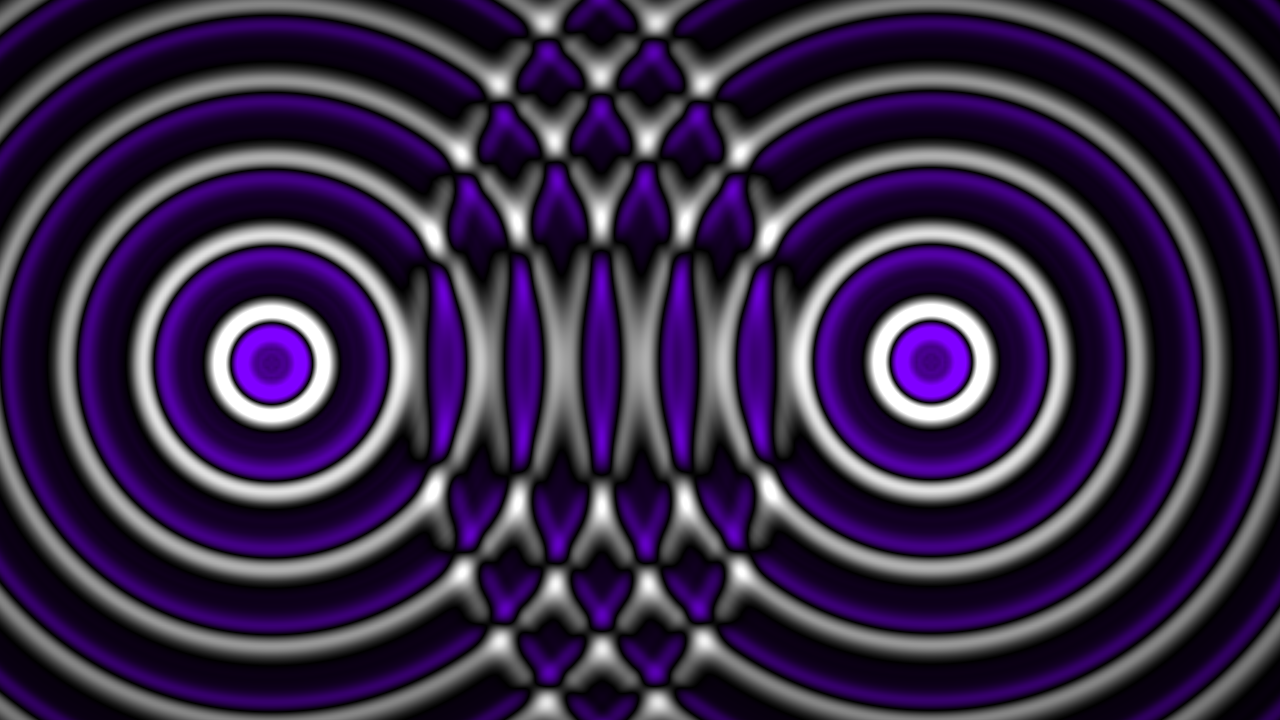
|
No, they annihilate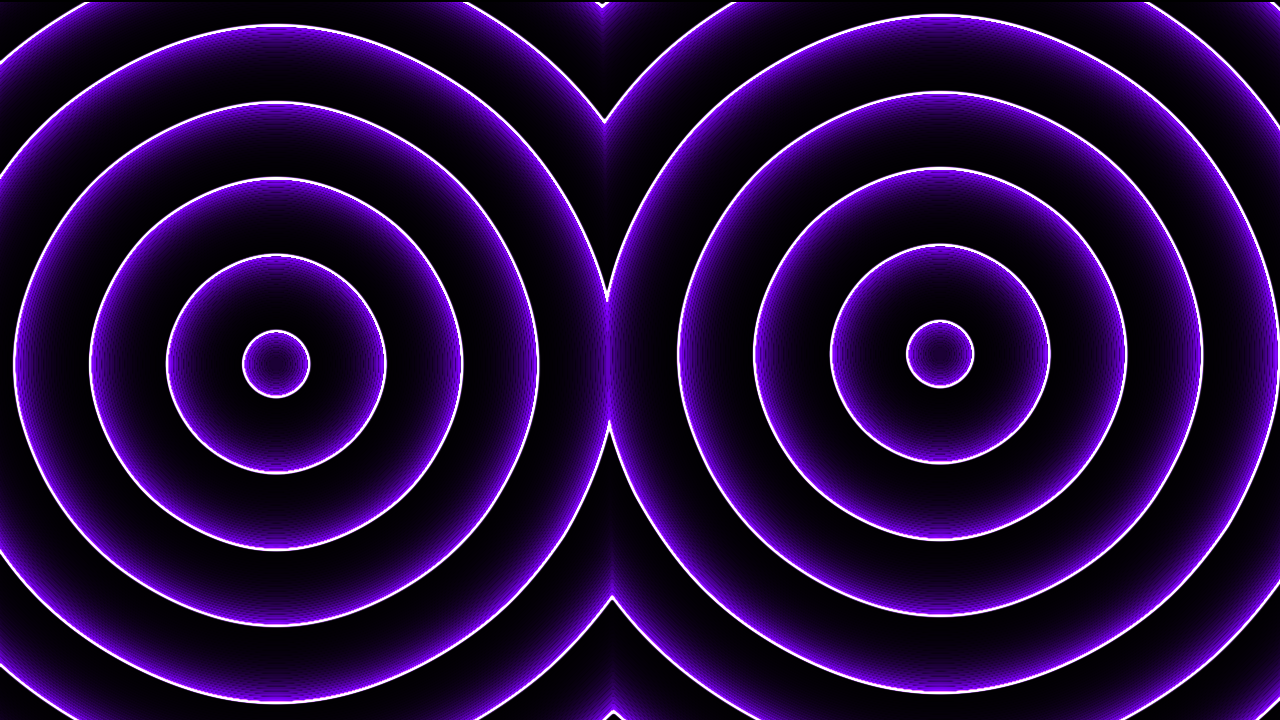
|
Yes |
| What happens to the amplitude as waves spread out? |
Decreases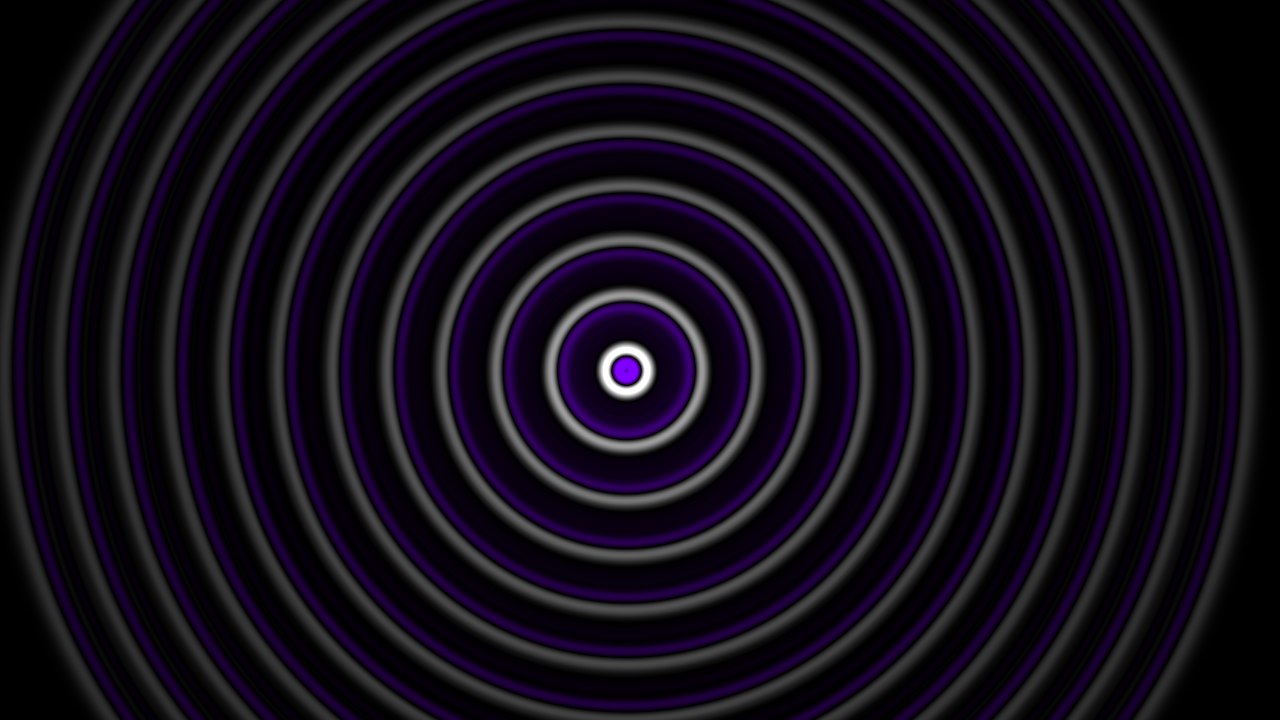
|
Stays constant ✅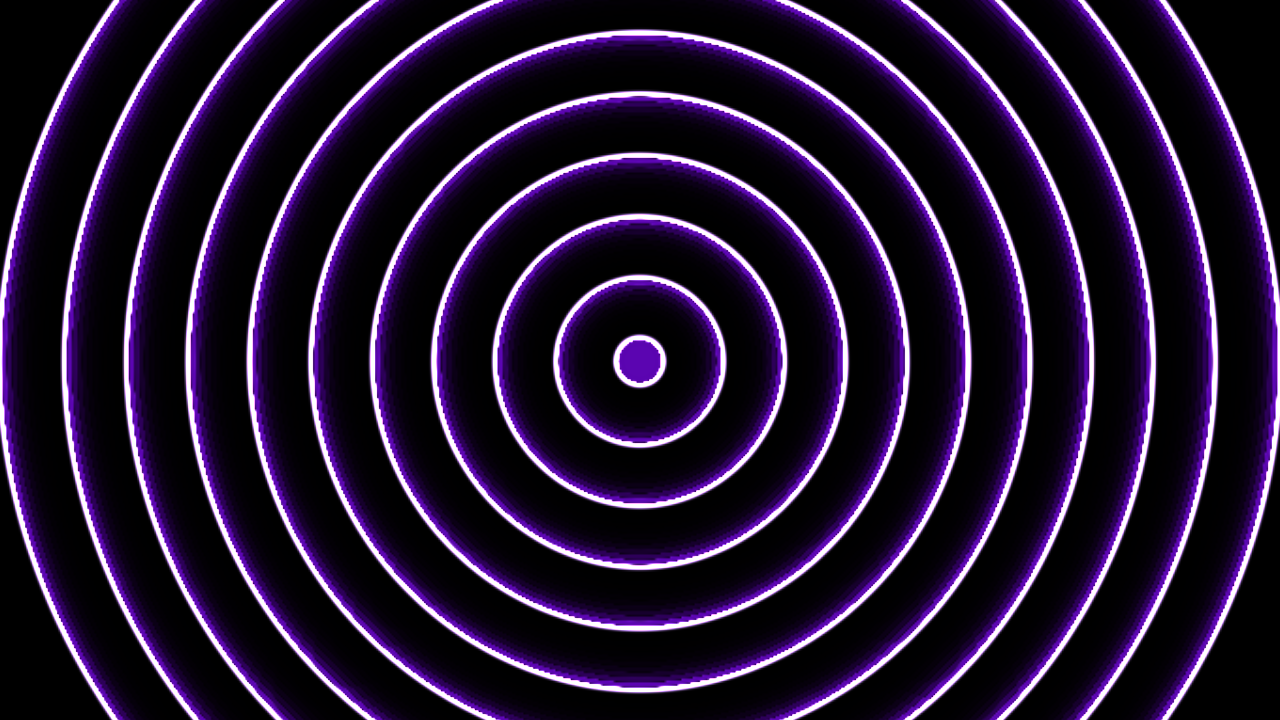
|
Stays constant |
| Reflection when passing into a region with different propagation speed? |
Yes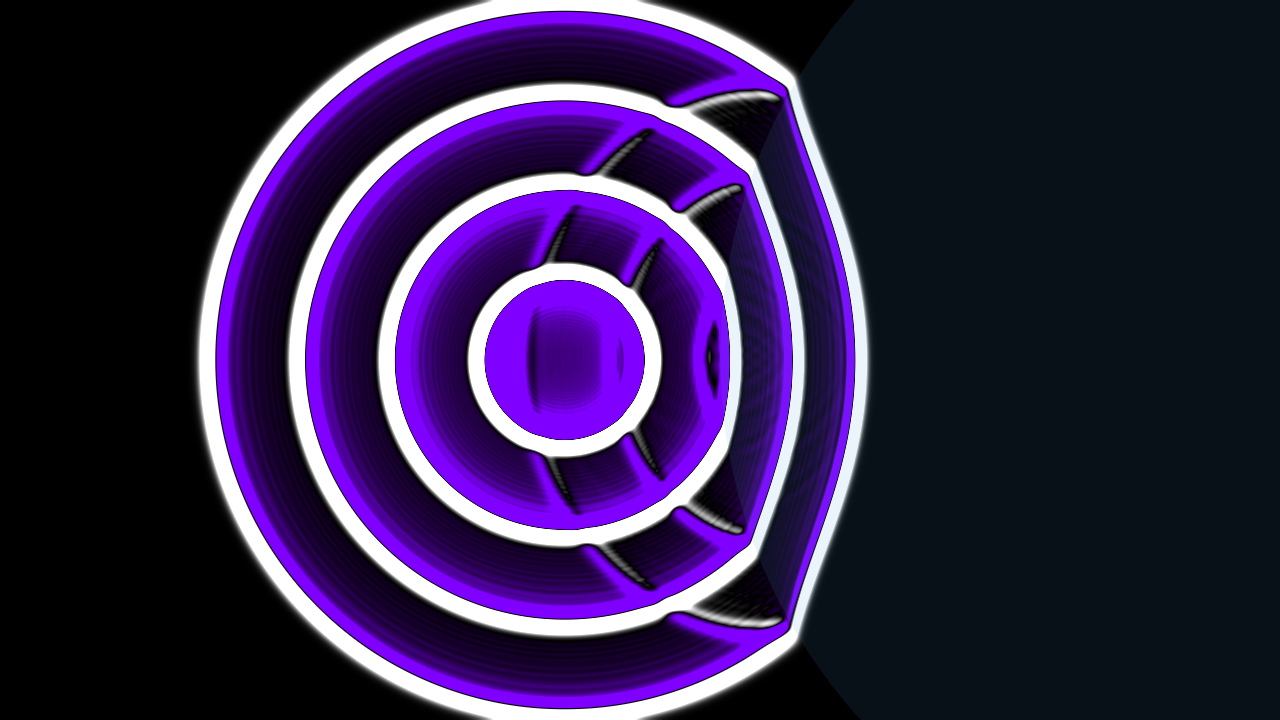
|
No ✅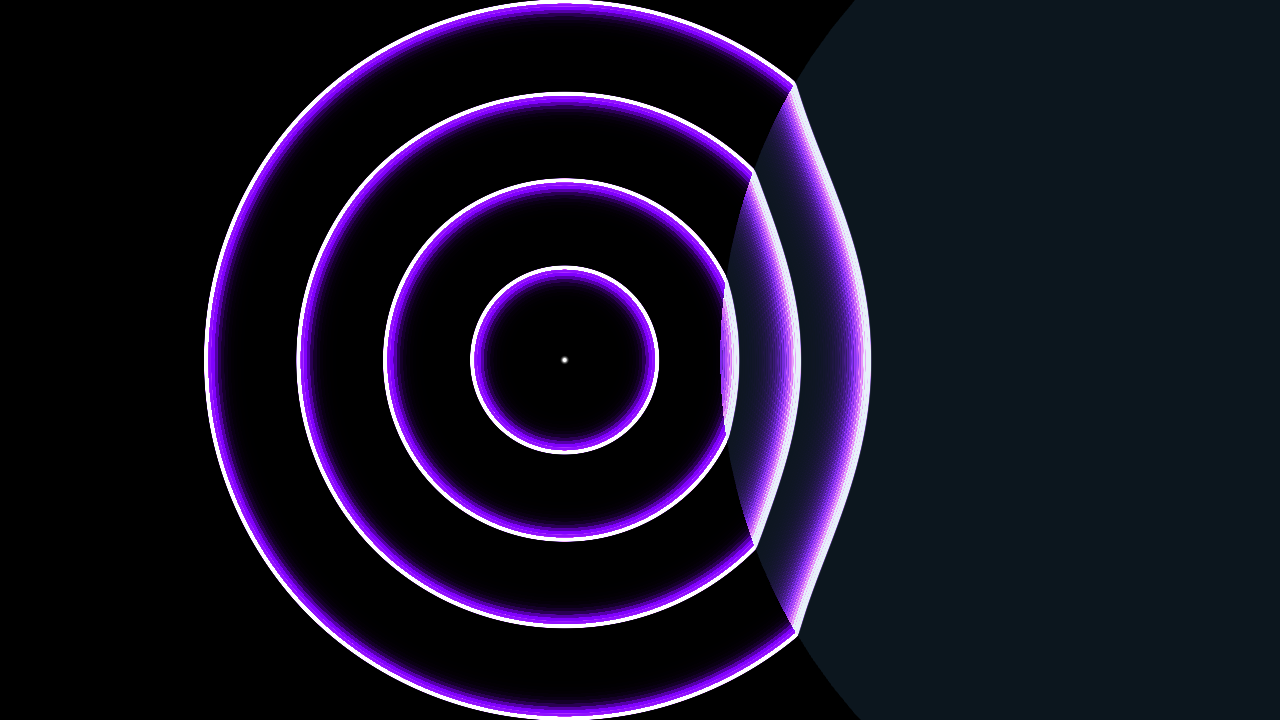
|
No |
The wavefronts I saw could pass through each other, which suggests wave equation, not excitable medium where meeting wavefronts would annihilate. But I saw no varying amplitude, and no reflections as waves passed into regions with slower propagation speed. These two facts suggest excitable medium, not wave equation. Contradictory! It's of course possible that I can't trust what I saw here - maybe amplitude did in fact vary but invisibly because of some "sharpening filter", and maybe reflections did happen but below the threshold of this filter. But before I second-guess myself like that, it seems more promising to explore what happens if I take my observations at face value.
A particle model of waves
Since none of the standard field-based models match, I found it easier to use a particle-based instead of field-based simulation of wavefronts. (The difference is that with particles, we can model the wavefronts explicitly, while in a field-based model, the wavefronts are an emergent phenomena.) We spawn a bunch of particles (x and y positions) connected to each other in a chain, where the first and last are also connected, forming a ring. Each particle also has a "forward" direction, initially pointing outward from the ring center. Each timestep, each particle moves some distance in its forward direction, but can move a shorter distance if it's inside a "lensing region" with higher index of refraction aka slower propagation speed. Then when all particles have moved one step, the wavefront might no longer be a perfect circle, so we recalculate the "forward" direction based on the local shape of the wavefront - basically just looking at the two neighbors of each particle. This simple algorithm automatically supports cusps and caustics. Then there's also some extra code to spawn more particles in parts of the wavefront that start to become too jagged and low-res. Then we can simply spawn many more such wavefronts - as many as the computer can handle without choking.
Below is a video from this model, where waves come from the left and right side, and we gradually introduce a lens in the center, by gradually increasing the index of refraction there. This causes a focus point to form some distance after the lens, slowly approaching the lens, and reaching it once the lens center index of refraction reaches infinity.
Play with my particle wave simulation here, best seen on a computer, not a smartphone.
One problem with this type of simulation is that, as waves bounce back and forth through the lens, more and more fronts are created, and even if they visually overlap, they never merge.
A new field model of waves?
So ideally we want a field-based model. My best idea for how to resolve the aforementioned contradiction is with a special variant of an excitable medium. Rather than storing a single excitation value for each cell in a lattice, I'd store multiple values, say 16, one for each of 16 directions of propagation. So each little packet of wavefront would only travel forward in its prefered direction, and also slightly spread out to neighboring directions. Thus, wavefronts that travel in very different directions will pass through each other, while those traveling in very similar directions will merge. This model isn't taken out of thin air - it’s almost the same as in the aforementioned Simulating V1 following Bressloff, Cowan et al, but with vectors as wave normals instead of directors as wave tangents. This simulation is a very early work in progress, but here’s a video clip from it, and we’ll keep working on it. (Then we’ll have to figure out how to add those higher-dimensional knots…)
Play with the field wave simulation here, best seen on a computer, not a smartphone.
References
G. B. Ermentrout and J. D. Cowan: A Mathematical Theory of Visual Hallucination Patterns (1979)
Paul C. Bressloff, Jack. D. Cowan et al: Geometric visual hallucinations, Euclidean symmetry and the functional architecture of striate cortex (2001)
Appendix: Glossary
Amplitude. The strength / height of a wave. https://en.wikipedia.org/wiki/Amplitude
Catenoid. A mathematical surface, a wormhole that connects two otherwise flat sheets. https://en.wikipedia.org/wiki/Catenoid
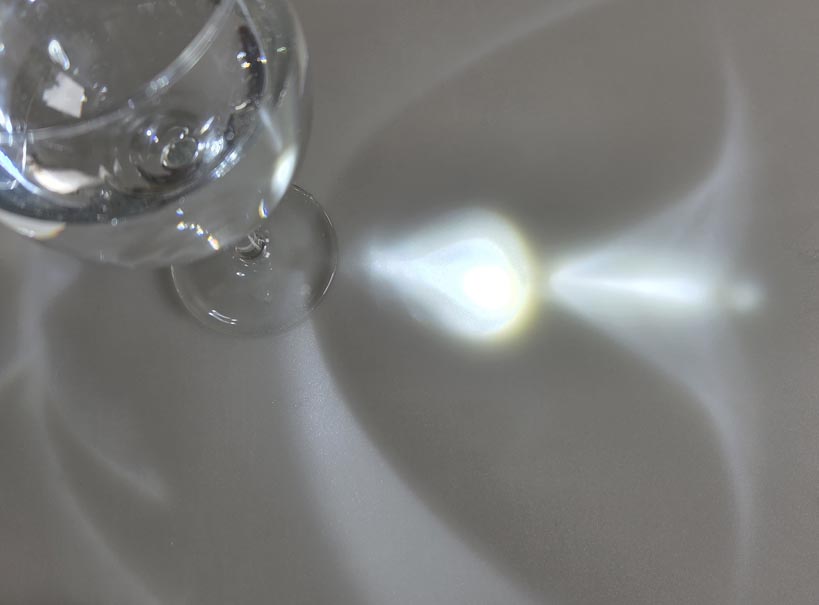
Caustics. Optical effect where rays of light get concentrated in some areas. You may have seen it at the bottom of a swimming pool, or in the ceiling above it, or on the table beside a full glass. https://en.wikipedia.org/wiki/Caustic_(optics)
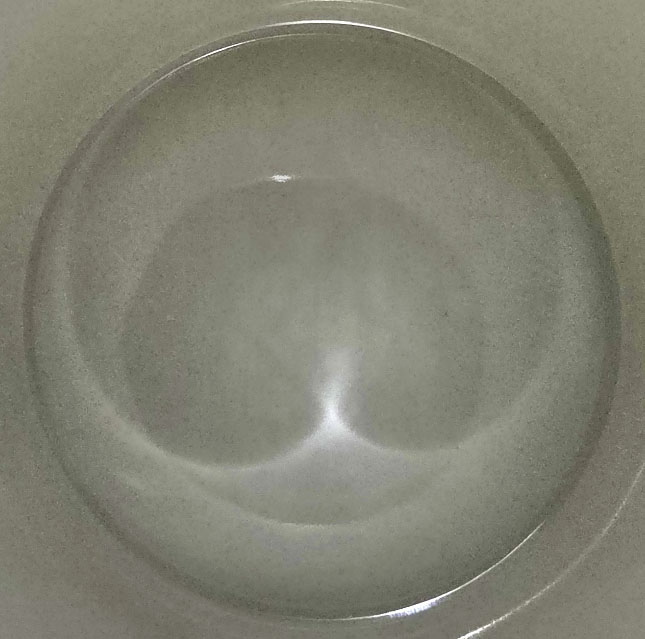
Cusp. A specific pointy shape (caused by caustics) which you may have seen at the bottom of a cup. https://en.wikipedia.org/wiki/Cusp_(singularity)
Diffraction. The process of waves spreading around an obstacle. A typical signature of diffraction is a diffraction pattern produced where several waves add up either constructively (increasing amplitude) or destructively (canceling each other out). https://en.wikipedia.org/wiki/Diffraction
Euclidean geometry. The classic “flat” space. I used the term to contrast it with non-flat space such as spherical or hyperbolic. I also, admittedly a bit sloppy, used the term to mean Cartesian plane, to contrast it with log-polar coordinates. https://en.wikipedia.org/wiki/Euclidean_geometry https://en.wikipedia.org/wiki/Cartesian_coordinate_system
Form constant. Four geometric patterns that are very commonly seen by people on psychedelics or other altered states of consciousness. Three of the patterns roughly follow a log-polar coordinate system. https://en.wikipedia.org/wiki/Form_constant
Good continuation. A concept from Gestalt psychology. When we see a line, curve, or a set of pieces positioned along a curve, we easily imagine what a natural extension of that curve could be. https://en.wikipedia.org/wiki/Gestalt_psychology#Law_of_continuity
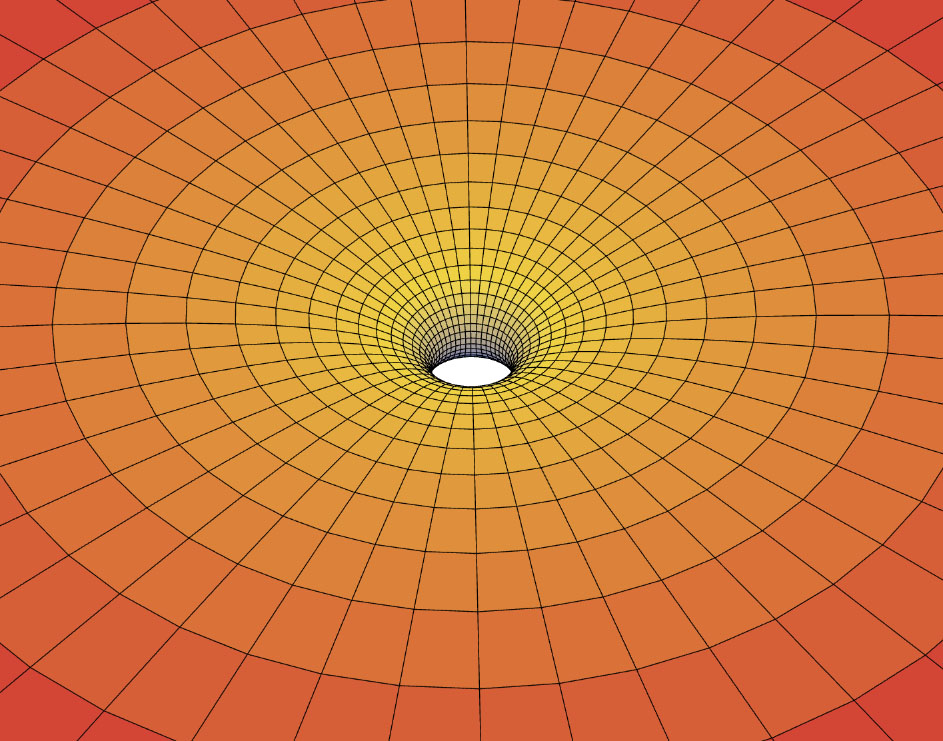
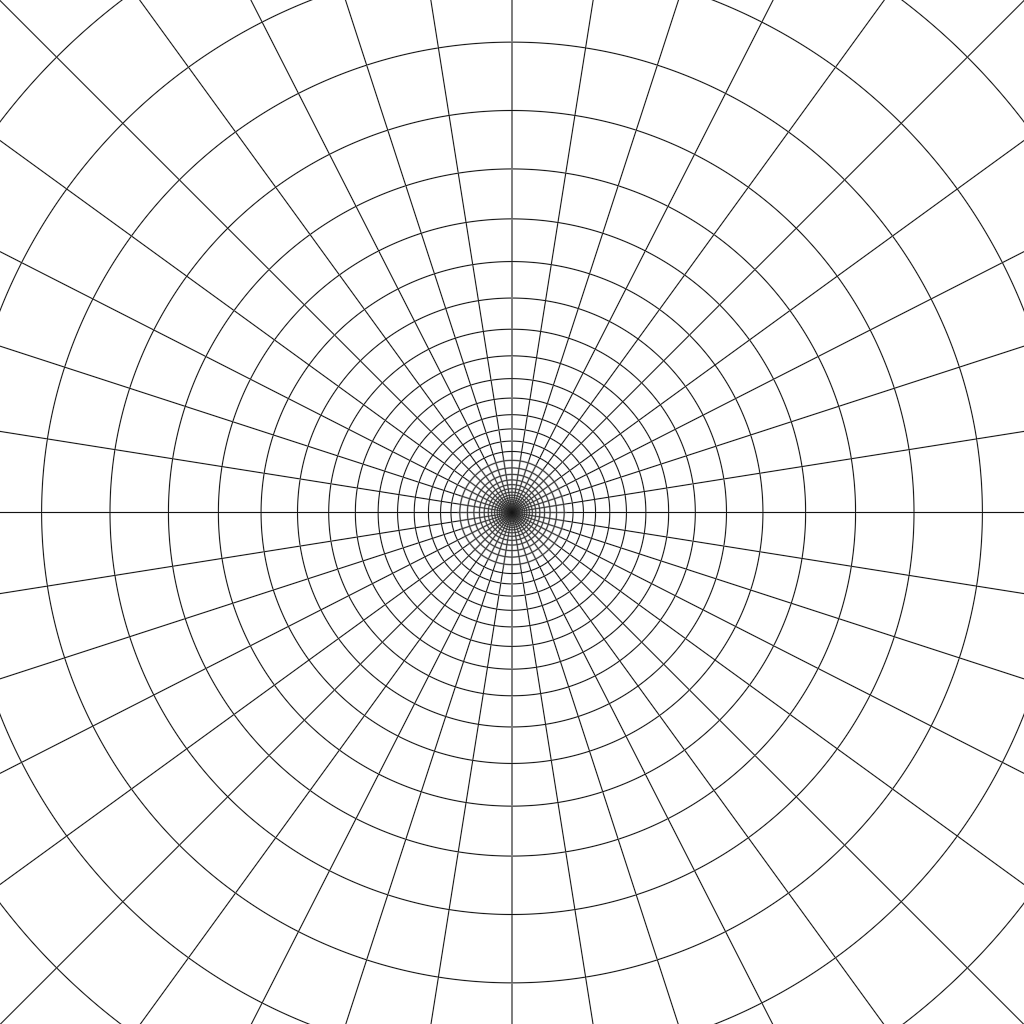
Log-polar coordinates. A 2-dimensional coordinate system. Shaped a bit like a spider web or dart board. One dimension measures the angle around the origin, the other dimension measures the distance to the origin, but in contrast to ordinary polar coordinates, in log-polar coordinates we actually measure the logarithm of the distance to the origin. This makes each tile have the same shape, uniformly scaled. Like looking down an infinite tunnel/cylinder with tiled walls. https://en.wikipedia.org/wiki/Log-polar_coordinates
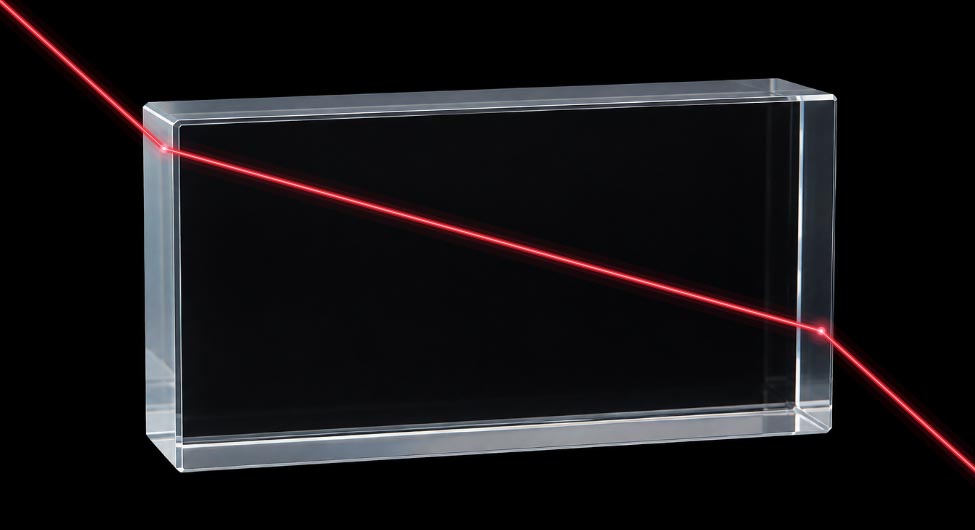
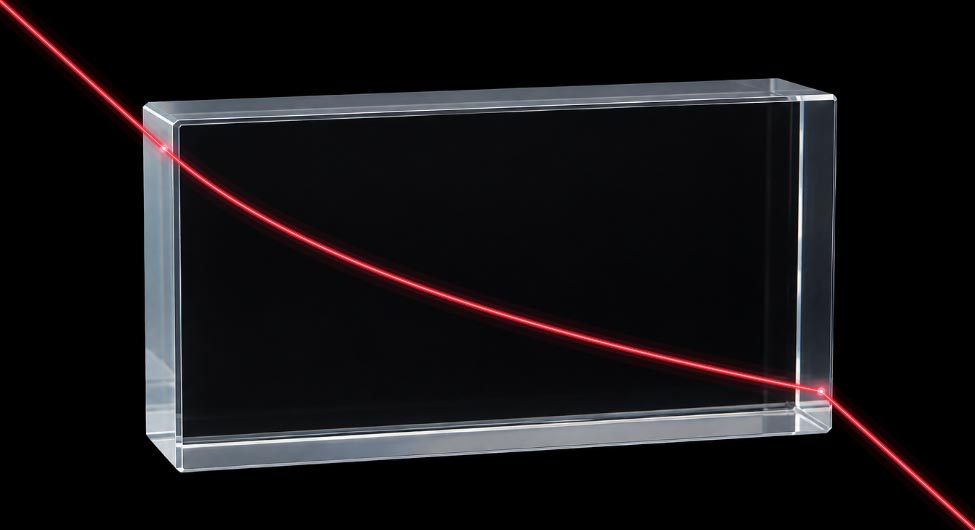
Index of refraction. A number measuring how much slower a wave travels inside a material, relative to some “default” full-speed wave. And when I said soft index of refraction, I meant that this number would change smoothly throughout a material, instead of suddenly at the boundary. https://en.wikipedia.org/wiki/Refractive_index https://en.wikipedia.org/wiki/Gradient-index_optics
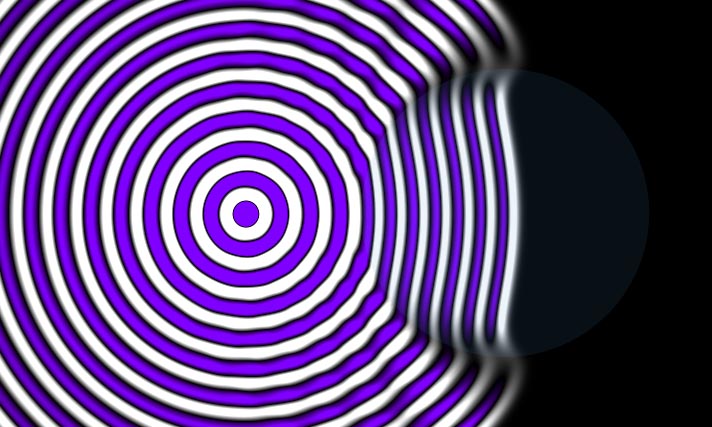
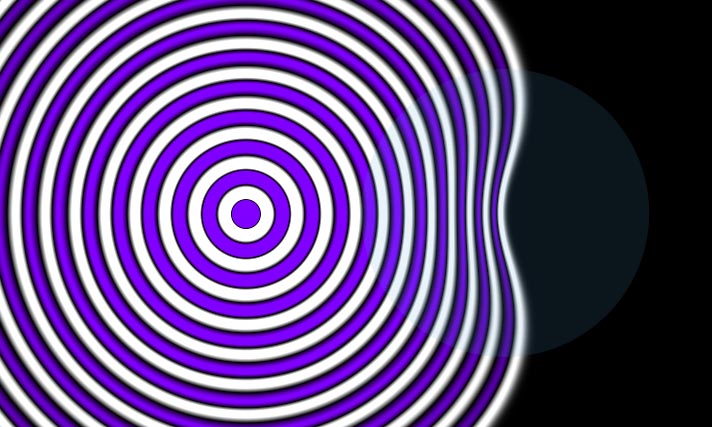
Interference. https://en.wikipedia.org/wiki/Wave_interference
What happens when two or more sets of waves overlap. Closely related to diffraction pattern mentioned above and moiré pattern below.
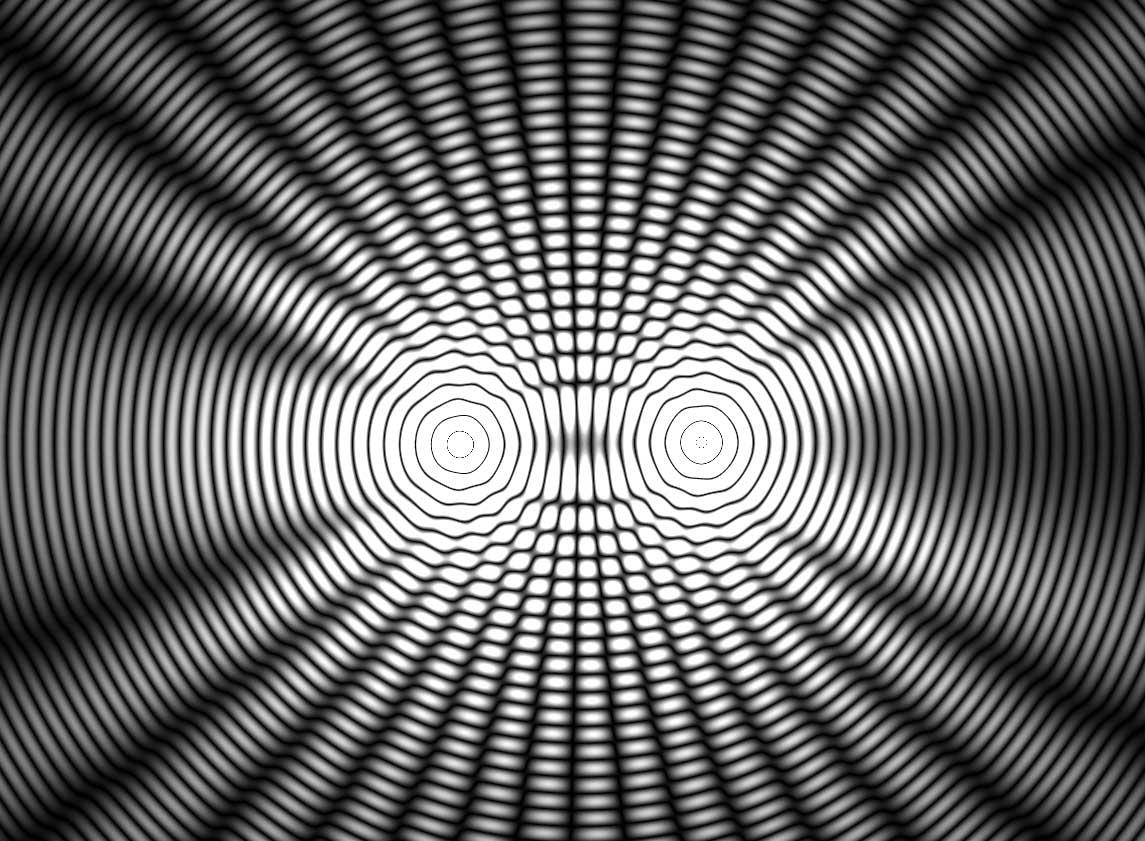
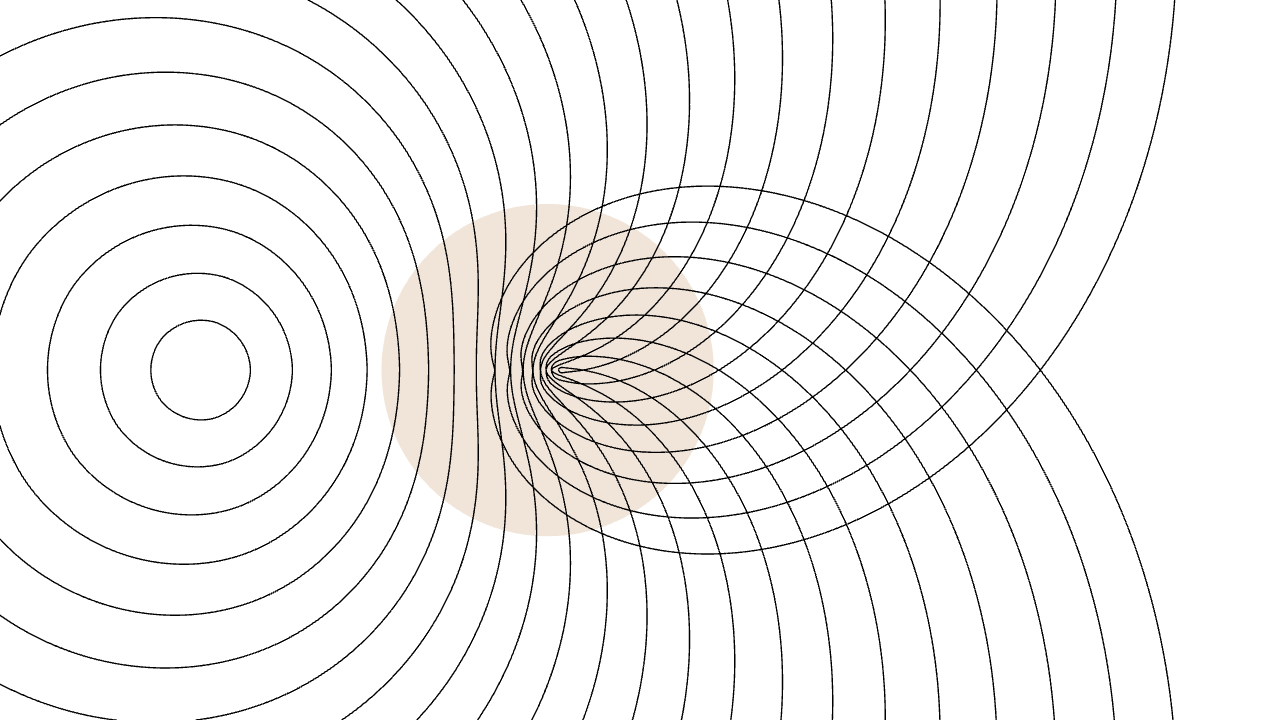
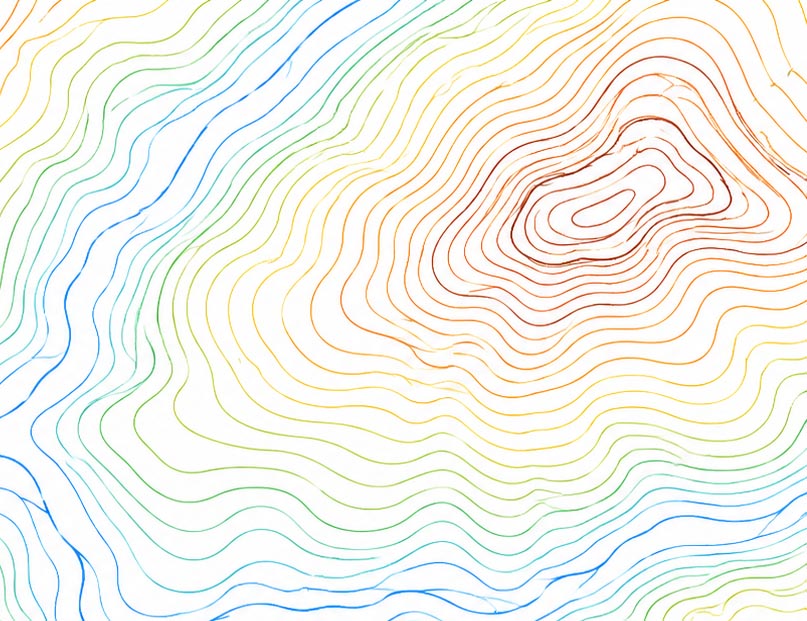
Isoline. Also called contour line. A curve in 2D space that represents points of a constant value, for example elevation on a map. If you have a landscape with hills and valleys, you can draw a contour line that’s 100 meters above sea level, another curve 110 meters above, and so on. https://en.wikipedia.org/wiki/Contour_line
Isosurface. Same concept as an isoline, but one dimension up. A surface in 3D space that represents points of a constant value, for example temperature. If you have a heat source in a cold place, some distance from it is an isosurface where the temperature is 100 degrees, a bit further out is an isosurface where the temperature is 90 degrees, and so on, nested like russian dolls. https://en.wikipedia.org/wiki/Isosurface
Moiré pattern. The larger “secondary” or “higher-order” pattern that can show up when two smaller patterns interfere. https://en.wikipedia.org/wiki/Moir%C3%A9_pattern

Tessellation. Covering a surface with small pieces, for example tiles on a floor. Tessellations can repeat a regular pattern (see Wallpaper) or be irregular (see for example Voronoi diagram) https://en.wikipedia.org/wiki/Tessellation
Toroidal coordinates. A 3-dimensional coordinate system based on a torus (donut). One coordinate measures the distance to the ring - if we draw its isosurfaces they look like nested donuts. Another coordinate measures the angle around the ring, as if we cut the ring into pie slices. The third coordinate is perpendicular to the previous two. https://en.wikipedia.org/wiki/Toroidal_coordinates
Wallpaper tiling. Fundamentally, there are only 17 possible ways to cover a flat plane with a regular repeating pattern.. https://en.wikipedia.org/wiki/Wallpaper_group
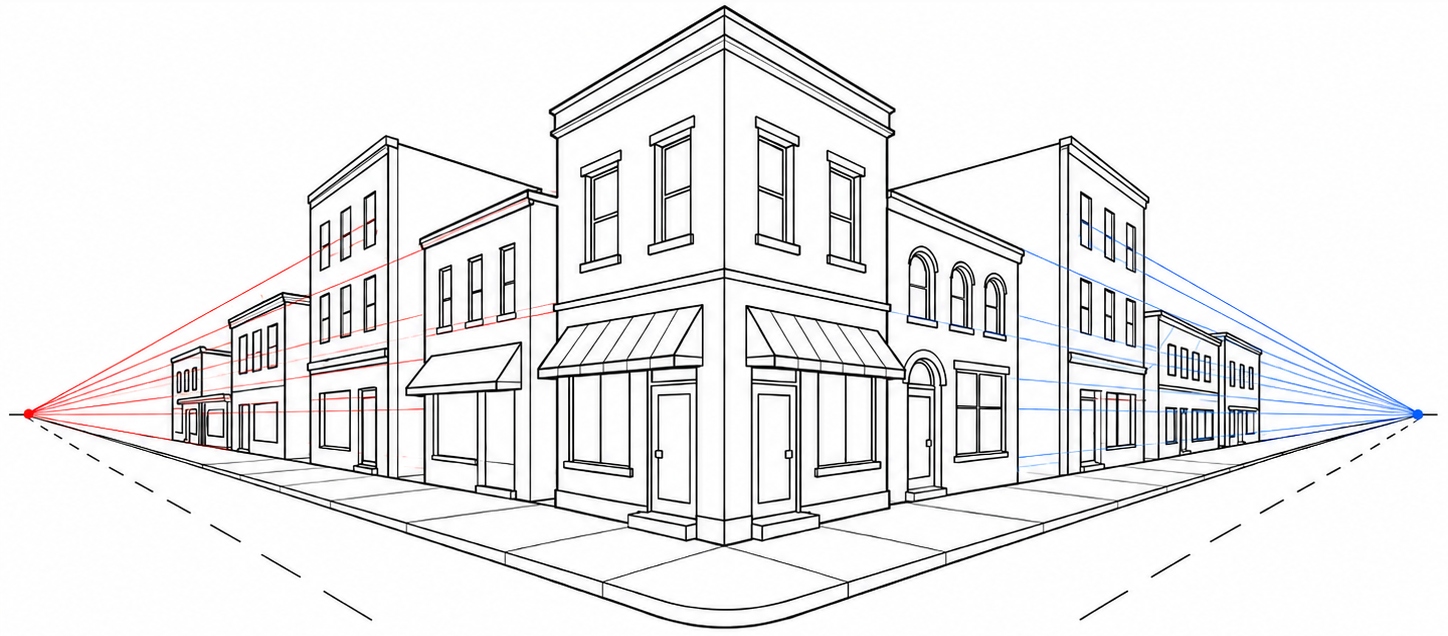
Vanishing point. A point (on a photograph or perspective drawing) where lines converge. For example the point on the horizon where railroad tracks seem to meet. https://en.wikipedia.org/wiki/Vanishing_point
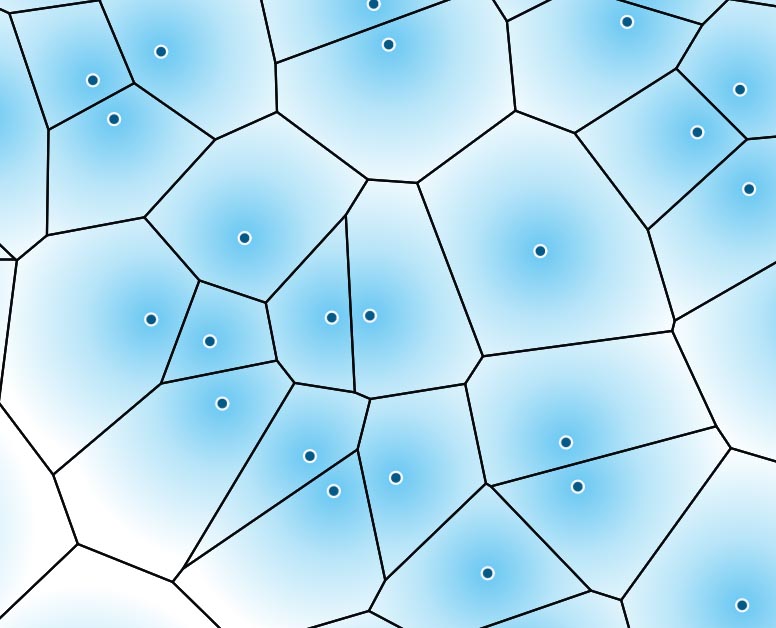
Voronoi diagram. A way to split up a plane into cells. Formed by starting from some seed points. Each cell is the area closer to one seed than to any other seed. https://en.wikipedia.org/wiki/Voronoi_diagram
Vortex. A spinning structure in liquid or gas. Examples include tornados, hurricanes, whirlpools and smoke rings. https://en.wikipedia.org/wiki/Vortex
Citation
For attribution, please cite this work as:
APA
Hall (2026, August 23). Wavefronts focused into knots. https://heart.qri.org/retreats/2026-tepoz/emil-hall/wavefronts-focused-into-knots.html
BibTeX
@misc{hall2026wavefronts,
  author = {Hall, Emil},
  title = {Wavefronts focused into knots},
  url = {https://heart.qri.org/retreats/2026-tepoz/emil-hall/wavefronts-focused-into-knots.html},
  year = {2026}
}